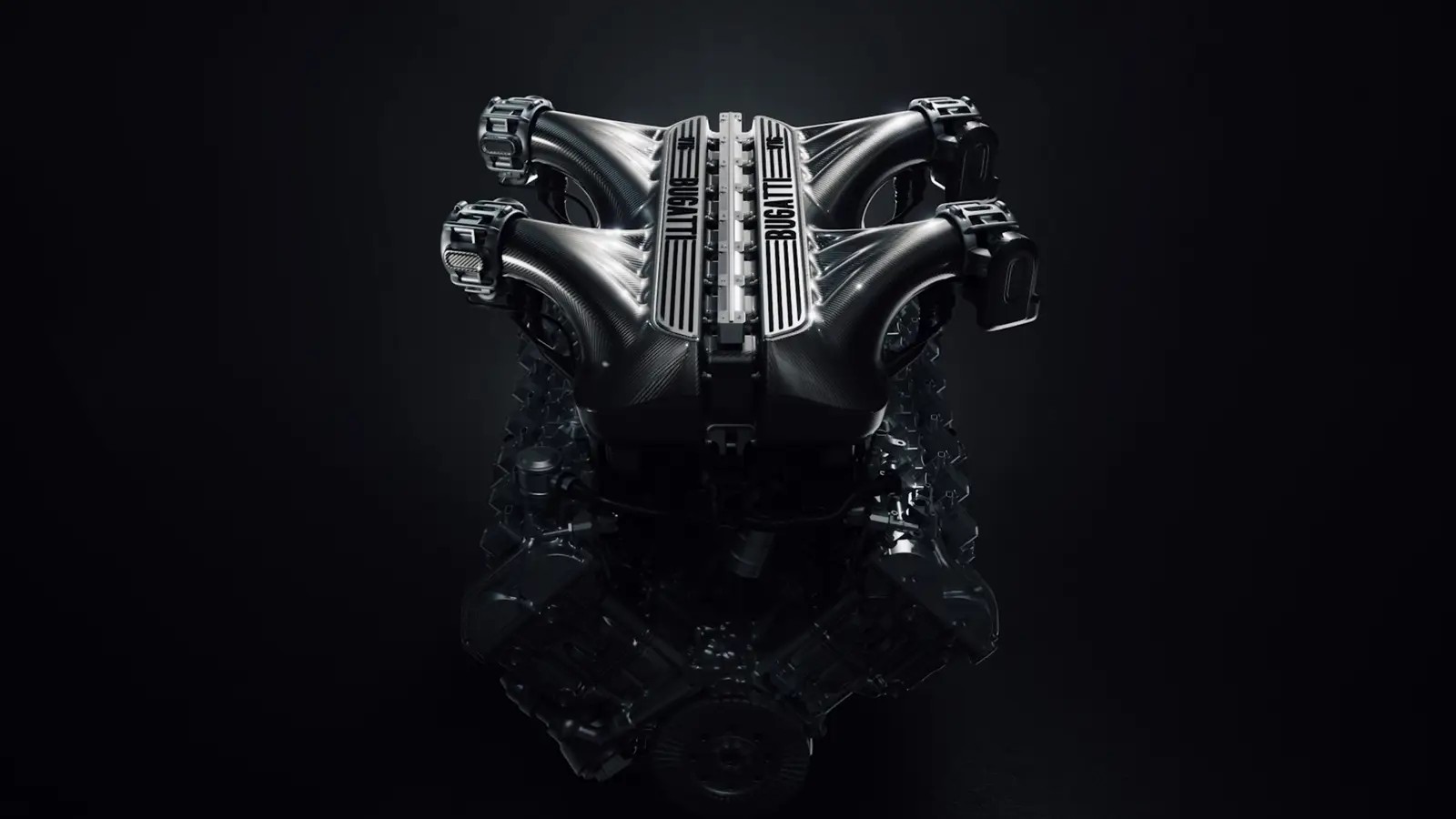
Bugatti has unveiled the most ambitious internal combustion engine ever fitted to a European supercar: an 8.3-liter naturally aspirated V16. This is not simply an engine; it’s a deliberate statement against the industry’s shift toward electrification, doubling down on displacement while integrating modern hybrid technology. The engine represents a defiant celebration of combustion, yet it doesn’t shy away from the future. It merges both worlds into a singular vision of performance, setting a new technical precedent in the 21st century.
The Philosophy Behind the Power
Bugatti’s decision to craft a new, massive powerplant in an era dominated by electric motors speaks volumes about its philosophy under its new Rimac partnership. The V16 is a rejection of downsizing and forced induction, instead embracing a high-revving, naturally aspirated approach paired with electrification. The result is a combined system output exceeding 1,800 horsepower, where the V16 alone contributes over 1,000 horsepower.
This isn’t about nostalgia; it’s about redefining what a European supercar can be. The V16 offers a progressive build-up of power, evoking classic grand prix engines while the electric motors provide instant torque and silent assist, creating an unbroken wall of thrust across the rev range.
The End of the W16 and the Dawn of a New Era
For decades, Bugatti’s legacy was defined by the 8.0-liter quad-turbocharged W16. The shift to the V16 symbolizes more than just an engine change; it represents an evolution of Bugatti’s philosophy. The W16 was a product of early-2000s engineering bravado, while the V16 is a product of modern craftsmanship and environmental consciousness.
The new engine, free from turbocharging, emphasizes purity and mechanical beauty. It’s lighter, more responsive, and paired with a cutting-edge hybrid system that ensures Bugatti can meet future emissions standards without compromising its brand DNA. The end of the Chiron era marked the end of turbocharged excess and the beginning of something more refined, more deliberate, and, paradoxically, more extreme.
Inside the 8.3-Liter V16: A Technical Masterpiece
The Tourbillon’s 8.3-liter V16 engine, co-developed with Cosworth, is a mechanical sculpture stretching nearly a full meter in length. Unlike the W16, which was compact and turbocharged, the V16 is a purebred naturally aspirated design that revs up to 9,000 rpm. With 90 degrees between cylinder banks and titanium internals, the engine weighs less than its predecessor despite offering more displacement and higher output.
Every element is engineered for precision and drama. The intake and exhaust systems create a sound signature Bugatti describes as “mechanical music.” Despite its monumental size, the engine’s balance and refinement are astonishing, a testament to Cosworth’s engineering prowess. Throttle response is immediate and organic.
Combustion Meets Electrification: A Harmonious Blend
Bugatti’s decision to pair the colossal V16 with hybrid technology isn’t contradictory; it enhances the visceral experience. Three electric motors provide instant torque and torque vectoring, giving the Tourbillon all-wheel drive and hypercar agility. The electric components add around 800 horsepower, supplementing the combustion engine for brutal yet efficient performance.
The hybrid system doesn’t mute the experience; it heightens it. Instant torque eliminates lag, while regenerative braking recovers energy during deceleration. This is a modern interpretation of the grand touring ethos: ultimate performance, delivered with refinement and responsibility.
The Future of European Supercars: A Bold Statement
Bugatti’s V16 is more than an engineering achievement; it’s a cultural statement about the future of performance. By proving that a naturally aspirated V16 can coexist with cutting-edge hybrid systems, Bugatti has redefined what “sustainable performance” can mean.
The long-term significance of this engine will likely transcend Bugatti itself, as other brands may follow suit, exploring ways to preserve the sensory engagement of combustion engines in a hybrid framework. As Europe edges closer to zero-emission mandates, the Tourbillon stands as a reminder that innovation doesn’t always mean abandoning tradition. The V16 is a defiant yet forward-looking statement: a last hurrah for combustion, reimagined for the 21st century.