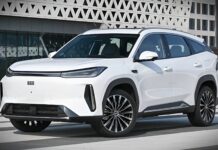
The competition in the electric vehicle (EV) market has shifted from mere range to the speed of replenishment. Just one month after BYD claimed dominance with its second-generation Blade Battery and megawatt flash charging technology, Geely’s Lynk & Co brand has responded with a performance that sets a new benchmark for the industry.
Breaking the Speed Barrier
New data released regarding the Lynk & Co 10 and its 900V Energee Golden Brick Battery reveals charging speeds that outperform BYD’s recent milestones. According to official test results, the Lynk & Co 10 achieved the following:
- 10% to 70% charge: 4 minutes 22 seconds (BYD: 5 minutes)
- 10% to 97% charge: 8 minutes 42 seconds (BYD: 9 minutes)
During these tests, the battery reached a peak charging power of 1,100kW. Notably, the system demonstrated remarkable stability; even after the state of charge (SOC) surpassed 80%, the power output remained above 500kW, minimizing the “charging taper” that typically slows down EVs as they get full.
The Infrastructure Variable
While the battery performance is groundbreaking, a critical detail remains: these speeds were achieved using Zeekr’s V4 megawatt flash charging piles. These specialized chargers feature a peak power of 1,300kW and a peak current of 1,300A, utilizing a liquid-cooling system to manage the intense heat generated by such high-voltage transfers.
This highlights a growing trend in the EV sector: the hardware is only as fast as the network supporting it. A vehicle’s theoretical charging speed is meaningless without the corresponding high-power infrastructure.
A Battle of Networks
The rivalry between Geely and BYD is not just about the cars, but about the massive rollout of charging stations required to make ultra-fast charging a reality for the average consumer.
| Feature | Geely (Zeekr/Lynk & Co) | BYD |
|---|---|---|
| Current Infrastructure | ~2,103 stations / ~10,212 piles | ~5,000 megawatt stations |
| Network Reach | 215 cities | Expanding rapidly |
| Future Goal | High-density 800V ultra-fast network | 20,000 stations by year-end |
Geely’s network, as of February 2024, covers 215 cities with a significant presence in highway service areas. However, BYD is moving with aggressive scale, aiming to deploy 20,000 megawatt flash charging stations by the end of this year to meet the demands of its massive user base.
The Compatibility Question
As these technologies evolve, a significant technical question looms for the industry: interoperability.
While Geely has proven what is possible using Zeekr’s hardware, it remains to be seen whether a BYD vehicle equipped with a Blade Battery 2.0 can achieve similar results on a Zeekr charger, or if the Lynk & Co 10 can unlock its full potential when plugged into a BYD flash-charging pile. For the consumer, the ultimate winner will be the brand that provides the most seamless, high-speed experience across diverse charging networks.
Conclusion: Geely has successfully pushed the technical limits of EV charging speeds, but the true test of this technology lies in whether the industry can standardize infrastructure to ensure these rapid speeds are accessible to all drivers, regardless of their vehicle brand.