For automotive enthusiasts, the 2000s weren’t just another decade; they were a time when Honda proved its engineering prowess with the S2000. This roadster wasn’t just a car; it was a statement. The heart of that statement? An engine capable of screaming to 9,000 RPM, an achievement that set the standard for high-revving four-cylinder performance.
The Rise of VTEC and High-Performance Engineering
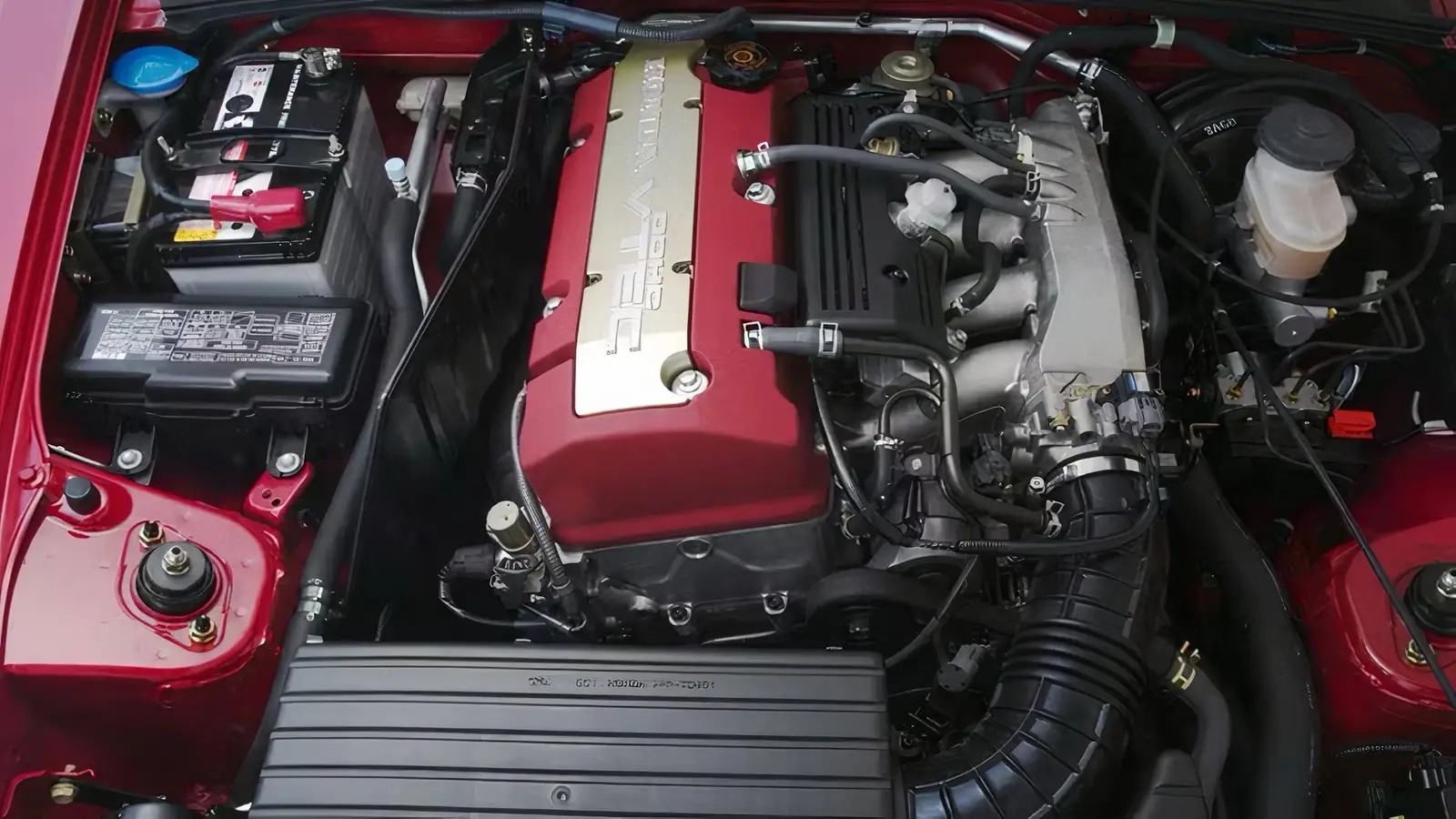
Honda’s shift towards motorsport-inspired engineering in the 1990s wasn’t accidental. Facing new Japanese tax laws based on engine displacement, Honda responded with VTEC (Variable Valve Timing and Lift Electronic Control). This wasn’t just about complying with regulations; it was about extracting maximum power from smaller engines. The result? The F20C, the engine at the core of the S2000, quickly became legendary among enthusiasts.
The F20C: A Blueprint for Durability and Performance
Developing a high-revving engine that could survive years of daily driving was no easy task. Honda’s engineers didn’t just focus on power; they obsessed over friction reduction and airflow. The engine block itself was made of aluminum with fiber-reinforced cylinder liners, balancing weight, strength, and heat dissipation. Forged aluminum pistons and a forged steel crankshaft further reinforced the engine’s durability.
What truly separated the F20C was its ability to last. Unlike Formula 1 engines needing constant rebuilds, the F20C proved remarkably reliable, capable of exceeding 200,000 miles with proper maintenance. The average annual running cost for an S2000 is around $404, which is impressive for a high-mileage sports car.
How VTEC Made the Magic Happen
The F20C’s VTEC system wasn’t just a gimmick; it was a carefully calibrated performance enhancer. At lower RPMs, the engine operated with smaller cam lobes for efficiency. But at 6,000 RPM, the system switched to aggressive, high-lift lobes, flooding the combustion chamber with air and fuel for maximum power. The result? A noticeable “kick” and a signature rasp in the exhaust note.
The engine’s output was remarkable: 247 horsepower from a 2.0-liter displacement (Japanese market) or 240 horsepower (North America/Europe). This gave it the highest specific output of any non-turbo four-cylinder engine, peaking at 123.5 horsepower per liter. It wasn’t until 2010, with the Ferrari 458 Italia, that another naturally-aspirated engine surpassed it.
The S2000 Today: Still Worth the Investment?
The S2000 hasn’t lost its appeal. Today, a well-maintained 2009 model can fetch around $24,597. Some pristine examples even exceed $30,000. This raises the question: is it worth more than a new Mazda MX-5 Miata, which starts at $30,430?
For some, the answer is a resounding yes. The S2000 isn’t just a car; it’s an experience. The raw feel of the high-revving F20C and the boldness of Honda’s engineering make it a unique proposition. While the MX-5 offers modern reliability and a warranty, the S2000 offers a timeless character that no new car can match.
The S2000 stands as proof that Honda wasn’t just building cars in the 2000s; they were building legends. The F20C isn’t just an engine – it’s a symbol of a bygone era where engineering excellence wasn’t just a goal, but a statement.