The basics are settled.
Every electric car starts from 0 to 60 faster than most people care about. The battery lasts long enough for a Tuesday commute. The seats recline. But now we need to ask the annoying question.
What does “Performance” actually mean on a compact SUV?
Is it track grip? Is it loud noises (which there aren’t any)? Is it just marketing glue stuck onto the badging?
We have two cars to decide that. One is the king of the world. The other is… well, let’s look at that one in a second.
The Mismatch
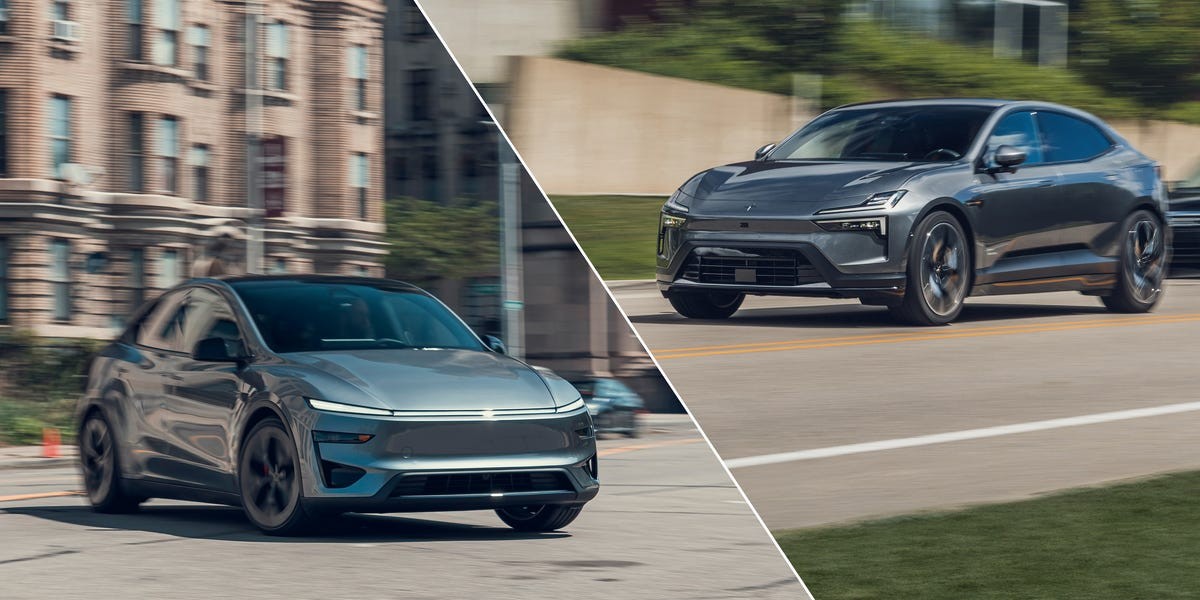
The Tesla Model Y Performance.
You know this car. It is everywhere. It was the best-selling car on the planet for three straight years. It is mainstream to the point of invisibility. Then comes the 2026 refresh. Tesla stripped away the hard-core track toys. They want it to handle twisty back roads better now. Less racing. More… lifestyle?
Enter the Polestar 4.
This thing is a baby. 2026 is its first model year. But it also has a death sentence hanging over it. Polestar is getting banned from selling new cars in the U.S. starting in 2027 due to government export rules. It feels less like a product launch and more like a liquidation sale.
So it goes.
We test them anyway. The rookie wants to topple the vet. Let’s see if the math adds up.
Skin and Bones
The Tesla hasn’t changed its shape much. Ovoid. Bulbous. Boring? Sure. But the 2026 light bars help. They give it eyes. It still looks like every other EV you’ve ever parked next to, though.
The Polestar looks like a spaceship designed by a nervous intern. Sharp angles. Coupe slopes. Too much chrome? No, not quite. Just too much trying. The rear window is gone. It’s just glass and cameras. The digital mirror is crisp, but when you’re reversing? Your spatial awareness takes a nosedive. You forget how wide your car is. It’s unnerving.
Inside.
Polestar wins on vibes.
The interior is smooth. Buttery leather. Electrochromic glass. It smells like a high-end spa. Tesla started the minimalist trend. Polestar finished it. The Tesla is fine, now. Better than before. Materials feel solid. But the Polestar? It feels expensive in a way that doesn’t feel fake.
Trunk space is identical. Seven suitcases standing. Twenty lying down. You have to use the Tesla’s frunk to get twenty. Polestar swallows them without complaint.
The screens are a headache for both.
Why do we still trust car makers with UI? Nearly everything is buried in menus. Volume knob? Only on the Polestar. The rest is touch. It takes days to learn where the parking brake lives. Both get worse with rain on your hands.
Numbers Game
Polestar 4 has 536 horses.
Tesla Model Y has 510.
Big deal. Polestar weighs 5,254 pounds. Tesla is a slender 4,438 pounds. Eight hundred pounds isn’t just a number. It’s physics.
Drag race.
Polestar hits 60 in 3.2 seconds.
Tesla does it in 3.3.
Basically tied. The Polestar wears custom summer Pirelli P Zero tires. Massive traction. Tesla gets all-season Hankooks. You can’t order the summer tires for the Model Y even if you beg. That’s a handicap.
Skidpad? Polestar wins. 0.96g versus Tesla’s 0.88g. The summer rubber cheats the game slightly. We know that. But on a straight line? Weight matters more than peak horsepower eventually.
Brakes are better on the Swede. Four-piston Brembos. Real calipers. Tesla uses modified Premium brakes with bigger rear rotors. Polestar stops from 70 in 169 feet. Tesla needs 179. A ten-foot gap. Noticeable? Only if you panic stop often.
The Drive
Acceleration sickness is old news. Everyone can do that now. We drove them on real roads.
Polestar feels frantic.
The steering is the problem. It’s weird. Numb one second. Accurate the next. There is no middle ground. You can adjust the weight on the screen but there’s no feel from the asphalt. You don’t know what the tires are doing until you’re already mid-correction.
The suspension tries too hard. Three modes: Standard, Nimble, Firm. None of them are good. Nimble is stiff enough to hurt your back over potholes. But soft enough that the car leans like Jell-O when you corner hard. It’s discordant. The parts are there—brakes, motors, dampers—but they don’t talk to each other.
Step into the Tesla.
Silence. Competence.
Tesla has spent eight years fixing this platform. Torsional stiffness? Fixed. Steering geometry? Dialed in. The Y grips. The dampers squish body roll in Sport mode nicely. It rides well on Comfort too. You can turn on dampers and forget it exists.
It’s boring. It’s excellent.
They removed the track menu items. No torque distribution sliders. No stability control tweaks. Who used those anyway? Most drivers want to get from A to B without thinking. Tesla understands that.
Also. Tesla has FSD (Full Self-Driving). It works. Surprisingly well. It’s a $99/month subscription now instead of an $8,000 upfront cost. Polestar’s Pilot Assist is adequate for lane keeping on a boring highway. Tesla drives the car for you. Polestar just holds the lane.
Range Anxiety
Pragmatism points to Tesla.
EPA range for the Model Y? 306 miles.
Polestar 4? 255 miles.
That is a 51-mile gap. In real life driving at 75mph:
Polestar got 250 miles.
Tesla got 270 miles.
Polestar’s battery is bigger (94 kWh) but slower to fill. Caps at 200kW charging speed. Tesla caps at 250kW with a smaller 81 kWh pack. If you road trip. You want Tesla. If you live near chargers? Maybe not a big deal. But it feels like a trap.
The Verdict
Polestar is stratospheric.
The base price starts at $64,300.
Add the Performance pack (+$4,500).
Add the Plus cabin package (+$5,500).
Add leather, glass roof, paint.
Our test car cost $80,800.
It is beautiful. It accelerates like a rocket. But it drives like it hasn’t finished homework. And soon, it will disappear from US lots. Urgency doesn’t justify bad handling.
Tesla Model Y Performance costs $59,630.
It grips. It charges faster. It goes further. The interior feels cheaper compared to Polestar, sure. The design is generic. But it works. It works really, really well.
Who does performance better?
Tesla did. By understanding that performance isn’t just 0-60 time. It’s about not breaking your spine on a pothole. It’s about steering you home when you’re tired. It’s about delivering exactly what the badge promises without the ego of a prototype.
The Polestar is a beautiful mistake. A fleeting moment of luxury design that lacks the engineering cohesion to back it up. The Tesla?
It’s just ready.
Does that mean it’s the best car out there? No. But in a vacuum, asking for “performance”? You want the one that handles. You want the one you don’t have to worry about charging on a Tuesday evening in November.
The winner is boring.
I think we all knew that.