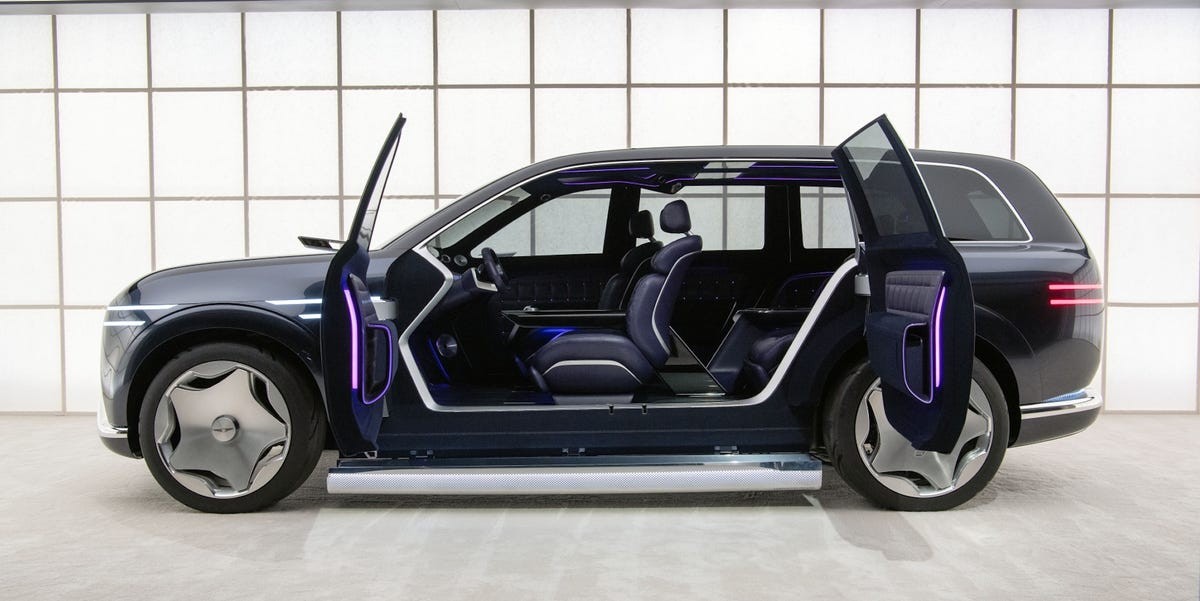
Genesis isn’t hiding this one. The brand has officially confirmed that its upcoming GV90 electric SUV will feature coach doors. Not concept car fantasies. Actual production-ready rear-hinged doors.
The news breaks in an interview with CAR magazine, specifically quoting Peter Kronschnabl, Genesis Europe’s managing director. We’d written off the Neolun concept’s suicide doors as pure styling drama when it debuted in 2024. Who needs rear-hinged access in 2026? Turns out, Genesis thought differently.
The GV90 lands in August. This moves up the timeline from late 2025 delays, likely pushed back due to autonomous software headaches. But the hardware is settled. The doors are real.
Why Coach Doors Matter for the GV90
Suicide doors are niche. Historically tied to luxury wagons and limos of the 1930s. Today? They are exceedingly rare. Rolls-Royce keeps them alive for the Phantom and Ghost. Ferrari dabbled with rear-hinged access on the Purosangue. Lincoln tried it briefly on the Continental.
But for a mid-size luxury EV? It’s a different story.
The GV90 enters a market crowded by the Lucid Gravity and Mercedes-Benz GLS-Class. Standard doors are the norm. They are functional. Safe. Boring. Coach doors break the silhouette. They change how you interact with the vehicle’s interior.
Kronschnabl put it bluntly: “The only other brand with coach doors [in this space] is Rolls-Royce.”
That’s a bold claim. It positions the GV90 not just as an EV competitor, but as a style statement. In a segment dominated by boxy MPVs and sleek sedans, vertical opening doors demand attention. They also simplify access in tight parking spots. Open the rear door outward, and you don’t need the full swing radius of a front-hinged door.
Production Realities: Safety and Structure
The Neolun prototype hinted at the look. But real cars require real compromises. The 2025 Nürburgring spy shots showed variations. Some prototypes had rear doors that opened conventionally forward. Why the inconsistency?
Because engineering coach doors isn’t just about hinges. It’s about structure.
Historically, true coach doors meant no B-pillar. Front and rear doors met at the middle, with a single long frame. Easy ingress. But modern safety standards mandate a rigid safety cage. You can’t just delete structural integrity for the sake of style.
So Genesis keeps the B-pillar. It’s a modern interpretation of the classic design. The rear doors still hinge back, but the car maintains the crumple zones and rigidity needed for crash tests. It’s a compromise we can live with. The aesthetic remains. The safety remains.
Is it worth the engineering headache? Maybe not. But luxury is often about the extra friction. The extra complexity that signals effort.
The GV90: Specs and Availability
The GV90 isn’t just a door experiment. It’s an electric platform play.
It shares underpinnings with the Hyundai Ioniq 9. And the Kia EV9. That’s the Hyundai Motor Group’s E-GMP architecture. Scalable. Efficient. Fast-charging capable. We expect the GV90 to launch as a pure EV.
But don’t rule out a hybrid version yet. Genesis has been talking about range extenders for years. A plug-in hybrid GV90 could offer the coach doors and solve range anxiety for long-haul trips. It’s a plausible future scenario.
What to Expect Next
The full reveal drops in August. Not late 2025. August. That means we have months of teasers, spy shots, and marketing buildup ahead.
For now, the GV90 is shaping up to be one of the most visually distinct EVs of the decade. Coach doors are risky. They are expensive to manufacture. They require custom hardware. But if done right, they create an emotional connection to the vehicle that standard doors never will.
Genesis is betting on that connection.
Will buyers care about rear-hinged doors? Maybe not as much as the executives in the boardroom think. But in a saturated EV market, unique features are the only way to stand out. The Lucid Gravity is fast. The Mercedes is comfortable. The Genesis? It’s dramatic.
And sometimes, drama sells.