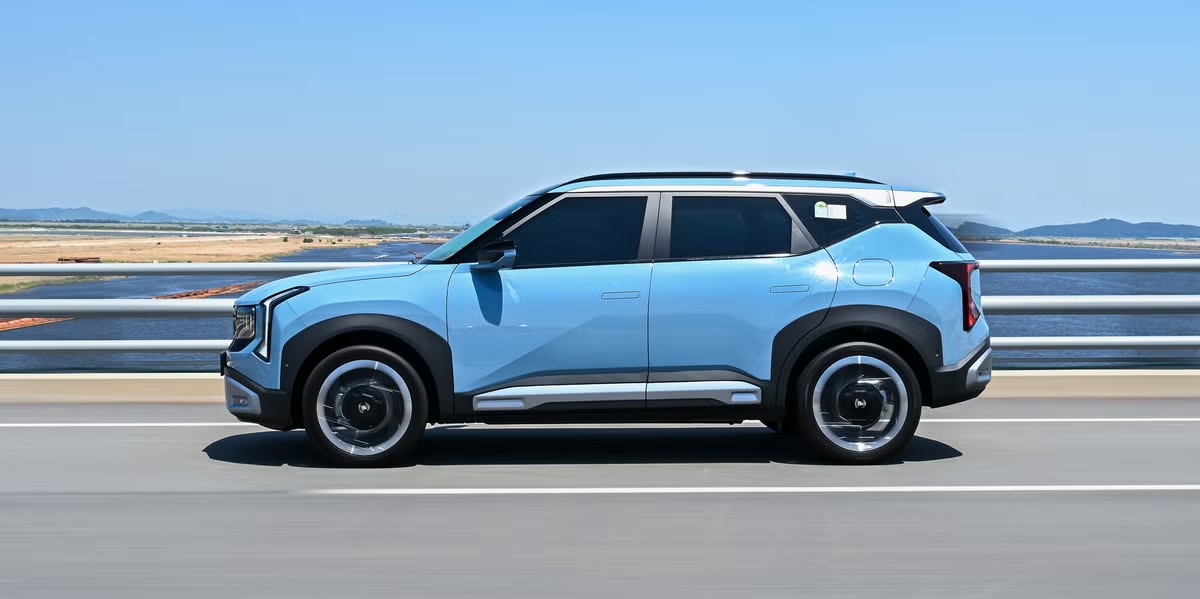
Entry-level subcompacts are usually compromises. Smaller. Cheaper. Fewer choices. That was the game. Now, it looks like the 2027 Kia Sltos is trying to break the rules.
We drove the second generation in Korea. It feels less like a budget buy and more like it jumped segments entirely. Kia took notes from the big brother—the Telluride—and applied them to the small guy.
A dual-12.3-inch screen setup, a head-up display, matte exterior colors, streaming Netflix inside your car? All available.
None of that existed before. Now you can get heated steering, panoramic glass, a 360-camera, even an outlet big enough for a tailgate blender.
Genuinely Nice
Inside, the word “subcompact” doesn’t apply. Not really. Sure, the plastics are cheaper than what’s in a Telluride. But the design language elevates everything. Brown-on-tan two tones. Mesh headrests that borrow directly from the luxury cousin. The rear liftgate even mimics the taillight shape. It looks expensive.
The dimensions shifted, too.
- 1.8 inches longer
- 1.2 inches wider
- Wheelbase up by more than two inches
Passengers notice it. The back seats recline 24 degrees—actually relaxing, not just “slanted forward slightly.” Adults fit. Cargo space grows by a cubic foot, hitting 28 total. That is large for this class. Large for any class.
Engines With History
Here is where things get familiar. The engines carry over.
You have the base 147-horsepower 2.0-liter four with a CVT. Front or all-wheel drive. Then there is the punchy option: a 1.6-liter turbo making 190 horses. That mates to an eight-speed auto, AWD only, locked to the new top-tier X-Line trim.
Then, the twist. The Hybrid.
It uses tech from the Kia Niro but tweaks the formula. A 1.6-liter NA engine paired with electric motors. Six-speed dual-clutch transmission. Output sits at 155 horses domestically, which beats the Niro. But wait, the Sltos hybrid offers AWD. That rear motor pushes total system power to 179.
Does it move quickly? Not particularly.
Acceleration is modest. We expect U.S. models to hit 60 mph in roughly 8.6 seconds. Does that sound fast? Look around the segment. The Honda HR-V takes 9.4. The Buick Envista takes 8.8 at its best. You are already winning by waiting.
Fuel economy should redeem the lack of speed. Likely near 50 mpg combined. The brake pedal feels weird at first. Non-linear during hard stabs. Sticky in stop-and-go traffic. But it is manageable.
We drove Korean specs. Those hybrids made less power, 139 horses. So our local predictions remain educated guesses.
On the Road
South Korea is a specific environment. Low limits. Everywhere speed cameras. It forces a relaxed pace. Which let us evaluate comfort.
Seats are good. Handling is above average. Suspension layouts remain standard: struts up front. FWD 2.0 liters use torsion beams. Everything else—including hybrids—gets independent multilinks out back.
The tires?
19-inch wheels on rough roads created flutter. Structural resonance. A slight buzz that reminds you this chassis has mass limits, despite the stiffer steel. Body motion felt floaty too, sometimes excessively so.
But those were Korean spec cars. Different tuning. We will hold judgment until American wheels hit American asphalt.
Price Tag Guesses
Kia knows how to stack value. You get a lot for a little.
- Base Start: Likely $27,00
- Hybrid Adder: ~$1,50
- Top Trim (1.6T): Around $35,0
Prices haven’t been finalized, but a modest bump makes sense given the upgrades.
The gasoline models arrive first. Hybrids come later, around late 2026. If the previous generations taught us anything, sales numbers will jump again.
Kia packed this small car with big-car tricks. The gap between budget and premium is shrinking.
Who cares what segment it sits in?
It just feels right.