The pump price hit hard. You stare at the meter, then at your dashboard, wondering if it’s time to swap your current ride for something that drinks less fuel. Maybe you’re also sweating the carbon footprint, but the idea of plugging in every night feels like too much hassle for now.
Enter the hybrid car.
It sits right in that uncomfortable middle ground. But before you write off your internal combustion engine or sign a lease for a battery-powered sedan, you need to understand the mechanics. How does a hybrid squeeze 20 or 30 extra miles per gallon out of a tank? Does better mileage actually mean cleaner emissions? And where do plug-in models fit into this equation?
We are breaking down the anatomy of these machines. We will look at how the technology functions and, just as importantly, how you should drive to get the most out of it.
Gasoline vs. Electric: The Fundamental Divide
A gasoline-electric hybrid is a compromise. It is a bridge between the reliability of a gas tank and the instant torque of an electric motor. To understand the bridge, you have to understand the banks it connects.
A standard gas car is straightforward. Fuel tank supplies gasoline to the internal combustion engine. The engine spins the transmission. The transmission spins the wheels. Simple.
An electric car (EV) is different. It relies on a battery pack. The batteries send electricity to an electric motor. The motor spins the transmission. The transmission spins the wheels. No combustion. No exhaust.
The hybrid attempts to take the best of both. It keeps the gas tank for range and convenience. It adds electric power to boost efficiency and cut emissions. The goal is to get you to the destination without constantly stopping for fuel, while keeping your environmental guilt at bay.
Under the Hood: The Hybrid Anatomy
Hybrids are not just a gas engine with a small battery. They are complex systems. Here is what you are dealing with.
Gasoline engine : This is the heart of the traditional side. However, hybrid engines are usually smaller than their non-hybrid counterparts. They use advanced technologies to burn fuel more cleanly and efficiently. Less displacement often means less friction and better thermal efficiency.
Fuel tank : This is the energy storage for the gas engine. Gasoline has a massive energy density compared to batteries. To put it in perspective: it takes roughly 1,000 pounds (454 kg) of batteries to store the same amount of energy as one gallon (3.8 liters) of gasoline. That weight difference is why hybrids don’t just swap the engine for a battery; they need both.
Electric motor : These units are sophisticated. They are not just motors. Advanced electronics allow them to flip roles. When you need to accelerate, they act as a motor, drawing energy from the batteries to push the car forward. When you lift off the gas or brake, they act as a generator. This process, known as regenerative braking, captures kinetic energy that would otherwise be lost as heat and sends it back to the batteries.
Generator : Similar to a motor, but it only produces electricity. You will mostly see this in series hybrids. It converts mechanical energy from the gas engine into electrical energy to charge the batteries or power the electric motor.
Batteries : These store energy for the electric motor. Unlike the fuel tank, which only provides energy to the gas engine, the battery system is bidirectional. The electric motor can draw from it, and the regenerative braking system can put energy back into it.
Transmission : This part varies wildly. Some hybrids, like the Honda Insight, use conventional transmissions that look and feel familiar. Others, like the Toyota Prius, use radically different setups, such as a Continuously Variable Transmission (CVT) or an e-CVT, which has no fixed gears at all.
Parallel Hybrids: The Most Common Setup
Most hybrids you see on the road are parallel hybrids. The name describes the power flow.
You have a fuel tank feeding the gasoline engine. You have batteries feeding the electric motor. Both power sources can turn the transmission at the same time. They work in parallel.
This setup allows for flexibility. At low speeds, the electric motor might do all the work. At highway speeds, the gas engine takes over. During hard acceleration, both might fire up simultaneously to provide maximum torque. The transmission simply relays the combined power to the wheels.
Series Hybrids: The Generator Loop
Series hybrids work differently. They are less common in mainstream passenger cars but prevalent in larger trucks and buses.
In a series hybrid, the gasoline engine never directly turns the wheels. Instead, it spins a generator. That generator creates electricity. The electricity either charges the batteries or powers an electric motor. That electric motor is the only thing driving the transmission.
Think of it as a gas-powered generator inside the car. The engine runs at a steady, efficient RPM to generate electricity, which then powers the traction motor. The gas engine is decoupled from the wheels. This allows the engine to operate in its most efficient zone more often, regardless of how fast the car is going.
Why choose one over the other? Parallel hybrids are generally more efficient at high speeds because they can bypass the electric motor entirely. Series hybrids excel in stop-and-go traffic because they eliminate the inefficiencies of shifting gears and idling.
The technology continues to evolve. Plug-in hybrids (PHEVs) take this foundation and add a larger battery pack that can be charged from an external outlet. This allows for longer electric-only ranges, blurring the line between hybrid and electric. But the core principles remain the same: capture energy, store it, and use it wisely.
You are looking at a system designed to waste less. Every brake light is a chance to recharge. Every idle minute is a chance to save fuel. But how you drive still matters more than the hardware. We will cover that next.
The fundamental trick behind a hybrid is simple but profound: you can drastically downsize the gasoline engine because you don’t need it to do all the heavy lifting. Conventional vehicles require big, thirsty engines to generate the immediate torque needed for quick acceleration. Hybrids sidestep this. They use smaller, lighter components, fewer cylinders, and operate the internal combustion engine closer to its maximum load efficiency point.
The result is a powertrain that sips fuel rather than gulping it.
Why Smaller Engines Burn Less Fuel
It comes down to physics and inertia. A massive V-8 engine is heavy. Every time you accelerate or climb a hill, you are wasting energy just moving that dead weight around. Heavier pistons and crankshafts require more energy to oscillate up and down within the cylinder bore.
Then there is displacement. Larger cylinders need more fuel per stroke. More cylinders mean more combustion events, even when the car is idling or crawling in traffic. This is why two cars of the same model, but with different engine options, yield wildly different MPG figures.
On the highway, both engines must output the same power to maintain speed. But the smaller engine uses less of that power to drive its own internal friction and weight. The extra power goes entirely to moving the vehicle.
Getting Enough Power From a Tiny Engine
So, how does a small hybrid engine keep up with a muscle car? Compare a Chevrolet Camaro with its massive V-8 to a typical hybrid. The Camaro’s engine is overkill for cruising. It’s built for peak power scenarios—those split-second moments when you floor the accelerator. In reality, most drivers use peak engine capacity less than one percent of the time.
Hybrids size their gasoline engines for average power requirements, not peak. The gas engine handles freeway cruising just fine. But when you need to merge onto a highway or climb a steep incline, the small engine asks for help.
That help comes from the electric motor and the high-voltage battery. The system kicks in instantly, providing the torque surplus the small gas engine lacks. It’s a handoff. The gas engine does the steady work; the electric motor does the bursts.
Improving Fuel Economy in 5 Different Ways
Beyond the engine swap, hybrids employ a suite of efficiency hacks. Some are universal automotive improvements, others are specific to the hybrid architecture.
1. Recovering Energy and Storing It in the Battery
Braking is essentially the act of destroying energy. Kinetic energy turns into heat via friction pads. That heat dissipates into the atmosphere, gone forever. Hybrids capture some of that lost energy.
Through regenerative braking, the electric motor reverses its role. Instead of consuming battery power to spin the wheels, it acts as a generator. The motor resists the rotation of the wheels, slowing the car while simultaneously charging the battery. You are reclaiming energy that would otherwise be wasted.
2. Sometimes Shutting Off the Engine
Why burn fuel when you aren’t moving? A hybrid with an internal combustion engine has an alternative: the electric motor. At a stoplight, or in heavy traffic, the system can shut off the gasoline engine entirely. No idling. No fuel waste. The electric motor keeps the accessories running and the vehicle ready to move.
3. Using Advanced Aerodynamics to Reduce Drag
Highway driving is a fight against air resistance. Aerodynamic drag consumes most of a car’s power at speed. You can reduce this drag by minimizing the frontal area. An SUV pushes a much larger wall of air than a sports car.
Hybrids often feature smoother underbody panels, covered wheel housings, and tighter body gaps. These details manage airflow, reducing turbulence and drag. It’s not just about looks; it’s about slipping through the air with minimal resistance.
4. Using Low-Rolling Resistance Tires
Standard tires are a compromise. They prioritize ride comfort, noise reduction, and wet-weather traction over efficiency. But tire flex creates rolling resistance—a form of drag that eats fuel.
Hybrids use specialized low-rolling-resistance tires. They are stiffer and run at higher pressures. This reduces the energy lost to tire deformation. The trade-off is a firmer ride, but the fuel savings are real.
5. Using Lightweight Materials
Weight is the enemy of efficiency. A lighter car requires less energy to accelerate and less force to climb hills. Hybrids often incorporate lightweight materials to shed pounds. Aluminum, magnesium, and sometimes carbon fiber composites replace heavier steel and plastic components. Less mass means better mileage.
It’s a holistic approach. Every gram saved, every drag coefficient reduced, every joule of kinetic energy recovered adds up. The gasoline engine is just the tip of the iceberg. The rest is an intricate dance of physics and electronics, all designed to keep you moving while wasting as little energy as possible.
The question isn’t whether hybrids work. It’s whether we’re ready to accept that the way we’ve driven for a century is fundamentally inefficient.
The Planetary Gearset at the Core
Forget the traditional automatic or manual gearbox. Inside the Prius, there is no clutch pack to slip, no torque converter to hunt for lockup, and no shifting points to feel. Instead, Toyota buried the entire transmission architecture inside a single, dense mechanical unit: the power split device. It is, quite literally, the heart of the hybrid system.
This isn’t just a clever add-on. It is a planetary gear set that physically hooks the gasoline engine, the generator (motor G), and the drive motor (motor A) into one inseparable knot.
The power split device allows the car to operate like a parallel hybrid, a series hybrid, and a CVT all at once.
The engineering here is brutal in its simplicity but brilliant in its execution. By locking these three components to specific points on the planetary gear set, Toyota eliminated the need for a separate starter motor. The generator starts the engine. It also eliminates the need for a shift lever, a torque converter, or a conventional transmission housing. The result is a drivetrain that feels weightless.
How the Planetary Gears Manage Power Flow
To understand how this works, you have to look at the geometry of the gears. A standard planetary gear set has three main moving parts: the sun gear, the planet gears (which rotate on a carrier), and the ring gear. In the Prius configuration, these are assigned specific roles.
The gasoline engine connects directly to the sun gear. This is the input. When the engine spins, it drives the sun gear, which in turn pushes the planet gears.
The ring gear is connected to the electric drive motor. But it is also directly linked to the final drive differential. This means the speed of the ring gear dictates the speed of the wheels. Whatever speed the electric motor and ring gear spin at determines how fast the car moves.
The planet carrier is where the generator attaches.
This layout creates a unique mathematical relationship between the three components. The speed of the sun gear (engine), the ring gear (wheels/motor), and the planet carrier (generator) are locked together by the gear ratios. You cannot change one without affecting the others.
Series vs. Parallel: The Split Decision
This mechanical linkage allows the car to seamlessly switch between hybrid operating modes without any interruption in power delivery.
In series mode, the gasoline engine runs at a fixed speed to generate electricity. The engine spins the sun gear. The planet carrier (generator) spins to produce power, which charges the battery or feeds the drive motor. The drive motor then spins the ring gear to turn the wheels. The engine has no direct mechanical connection to the wheels. It is purely a generator.
In parallel mode, the gasoline engine provides direct mechanical power to the wheels through the planetary gears. The engine spins the sun gear, which drives the planet carrier and the ring gear simultaneously. The electric motor can assist this power or resist it to regenerate energy.
The power split device allows the car to operate like a parallel hybrid: The electric motor can power the car by itself, the gas engine can power the car by itself or they can power the car together.
But it also allows the car to operate like a series hybrid. The gasoline engine can operate independently of the vehicle speed, charging the batteries or providing power to the wheels as needed.
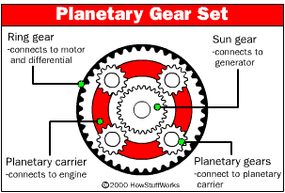
The mechanical heart of the system relies on a specific gear arrangement. The generator attaches to the sun gear, while the engine connects to the planet carrier. The ring gear’s speed dictates the output, meaning all three components must coordinate constantly. They cannot work in isolation.
Acceleration starts with electricity. The electric motor and batteries provide the initial thrust. Because the ring gear connects to the motor, it begins spinning immediately. The planet carrier stays put. The engine is off, so the carrier is stationary. But the ring gear is moving. This forces the planetary gears to rotate, which spins the sun gear and the generator. The generator spins at whatever speed is necessary to keep the engine dormant.
The engine only wakes up around 40 mph (64 km/h). The generator’s speed shifts suddenly. This change spins the planet carrier, starting the gasoline engine. Once running, the engine holds a constant speed. The generator varies its own speed to match the output requirements of the electric motor.
Hard acceleration draws extra power from the batteries. At freeway speeds, the car runs on a mix of gas and electricity. All electricity comes from the generator, not the battery pack, at that stage.
The Horsepower Paradox
Most driving demands only a fraction of a car’s total output. Cruising at 60 mph (96.6 km/h) requires power for just three things:
- Overcoming aerodynamic drag
- Counteracting friction in tires, transmission, axles, and brakes
- Running accessories like AC, power steering, and lights
For most vehicles, this totals less than 20 horsepower. So why buy a 200-horsepower engine? You need that reserve for “floor it” moments. The rest of the time, you are using considerably less power than available.
Maximizing Hybrid Mileage
Desire for quick acceleration kills efficiency. A less powerful engine often gets better gas mileage than an identical model with more power. Look at the window stickers at any dealership. The difference is stark.
Driving for Efficiency
You get the best mileage from a hybrid using habits that help gasoline cars too.
- Drive slower. Aerodynamic drag increases dramatically with speed. Drag at 70 mph (113 km/h) is about double that at 50 mph (81 km/h). Lower speeds mean better mileage.
- Maintain constant speed. Each acceleration uses energy. Some of that energy is wasted when you slow down. Constant speed makes efficient use of fuel.
- Avoid abrupt stops. The hybrid’s electric motor acts as a generator during braking. It recovers energy as the car slows. If you stop quickly, the mechanical brakes do most of the work. That energy is wasted. This applies to gasoline cars too. Abrupt stops waste energy.
Sources
- “Diesel-based hybrid cars.” The Daily Times. http://www.dailytimes.com.pk/default.asp?page=2006%5C01%5C09%5Cstory_9-1-2006_pg6_13
- FuelEconomy.gov http://www.fueleconomy.gov/
- Honda Insight http://automobiles.honda.com/models/specifications_full_specs.asp? ModelName=Insight&Category=ALL
- HybridCars.com http://www.hybridcars.com/
- Toyota Prius http://www.toyota.com/prius/specs.html