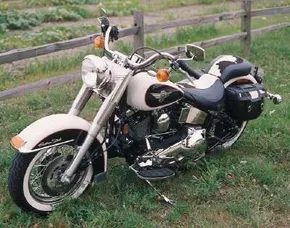
Willie G. Davidson had a knack for turning heads. As the grandson of a Harley-Davidson founder and the brand’s chief designer since 1963, he pushed the envelope hard. He didn’t just want to build motorcycles; he wanted to build statements. Most of his designs were bold, sure. But when he rolled out the 1993 FLSTN Heritage Softail, he crossed a line into the bizarre. It was strange. It was stunning. It was the “Cow Glide.”
Harley built exactly 2,700 of them. They all sold before the ink was dry on the order forms.
Why the 1993 FLSTN is Called the Cow Glide
The nickname came from the accents. A lot of them.
To celebrate the company’s 90th anniversary in 1993, Harley released special commemorative models. You had the standard two-tone silver “Silver Anniversary” bikes. Then you had the FLSTN. It was painted a stark, high-contrast black and white. But the real kicker was the hardware.
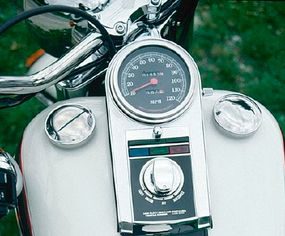
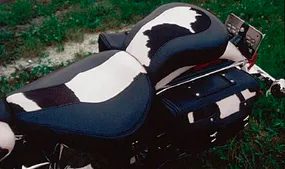
The bike featured trim pieces molded to look like cow hides and bovine motifs. Combine that with the retro styling cues, and the result was unmistakable. It looked like something you’d see on a ranch, if ranches had wire wheels and whitewall tires.
The aesthetic was a love letter to the past. We’re talking:
- Wire wheels: Classic spoke design, not the cast aluminum common on modern cruisers.
- Whitewall tires: A vintage touch that screams 1950s diner.
- Running boards: Practical for a passenger who likes to feel the road, or purely decorative for the photos.
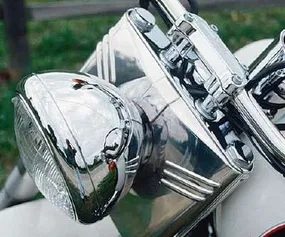
- Chromed headlight nacelle: The metal housing around the headlight was polished to a mirror shine, framing the bulb like a jewel.
It was a factory custom that looked like it had been built in a barn, not a assembly line.
Under the Skin: Modern Mechanics in a Vintage Wrapper
Don’t let the retro look fool you. The FLSTN wasn’t a relic. It was a modern machine dressed in costume.
Harley knows how to keep the soul of the bike while updating the skeleton. The Softail frame is the star here. It looks rigid. There’s no rear suspension visible. But that’s an illusion. Harley hid the shock absorbers inside the frame rails. The result is a clean, hard-tail aesthetic without the bone-jarring harshness of a truly rigid bike.
Mechanically, the FLSTN was ahead of its time:
- Belt drive: No noisy chains to lubricate or adjust. A rubber belt runs quieter and lasts longer.
- Disc brakes: Front discs for stopping power that actually works.
- Hydraulic forks: Improved handling and comfort over the older springer setups.
It was a blend of old-school style and new-school reliability. Harley figured out that riders wanted the look of the 1930s with the engineering of the 1990s. The FLSTN delivered that in spades.
The Ox-Pull Legacy
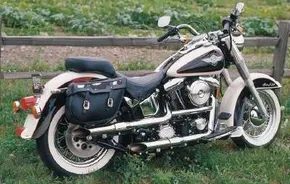
Most Softails from the early nineties looked like they were trying to hide their rear suspension under a flared fender. The 1993 Harley-Davidson FLSTN Heritage Softail did something different. It leaned into the “Ox-Pull” aesthetic, a design language that was as polarizing as it was distinctive.
“It combined classic Harley cues with an unusual bovine-trim design, resulting in a striking machine.”
This wasn’t just about paint. The Heritage Softail nameplate carried weight, evoking the pre-war big twins. But the 1993 iteration added a layer of visual grit. The front fender was shorter, chopped off to reveal the wheel more aggressively. The handlebars were ape hangers, raised high to force an upright riding posture that screamed vintage cruiser.
Why the Ox-Pull Look Mattered
The term “Ox-Pull” refers to the forward-leaning stance of older motorcycles, where the rider appeared to be pulling the bike along rather than sitting on it. Harley-Davidson revived this look for the ’93 model year.
- Front End: Shortened front fender with a small, vintage-style headlight nacelle.
- Seat: A solo saddle with a slight hump, encouraging the rider to lean forward.
- Exhaust: Sissy bar paired with a low-slung, blacked-out exhaust system.
This configuration wasn’t just for show. It changed the weight distribution and handling characteristics. The bike felt more agile in corners than the standard Heritage, which had a more relaxed, slouched profile. Riders who wanted that authentic, early-20th-century vibe found this model compelling.
Engine and Performance Specs
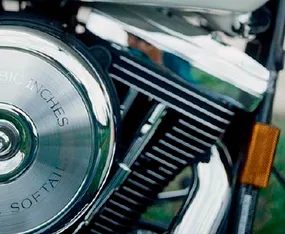
Underneath the bold styling lay the proven Evolution engine. Displacement sat at 1340cc (82 cubic inches). This air-cooled, four-stroke V-twin produced 65 horsepower at 5,200 rpm and 70 lb-ft of torque at 3,000 rpm.
| Specification | Detail |
|---|---|
| Model Year | 1993 |
| Chassis | FLSTN Heritage Softail |
| Engine | Evolution V-Twin, 1340cc |
| Power Output | 65 hp @ 5,200 rpm |
| Torque | 70 lb-ft @ 3,000 rpm |
| Transmission | 5-speed manual |
The transmission was a five-speed, a standard for the era. Clutch effort was light, and shifting through the gears felt smooth. The bike didn’t break records, but it delivered reliable power with a deep, throaty exhaust note that defined the Harley experience.
Suspension and Handling
The Softail name was a misnomer in the strictest sense. There was no rear suspension. Or rather, there was, but it was hidden. Harley engineers mounted the rear shocks under the frame to mimic the look of a rigid tail.
For the 1993 Ox-Pull model, the front fork was a conventional telescopic unit. The wheelbase was relatively short, enhancing maneuverability
Where to Find More Two-Wheeled Content
If the previous sections left you wanting more, there are dedicated hubs that dig deeper into the mechanics and history of the industry. Classic Motorcycles offers a curated look at vintage machines, preserving the heritage of bikes that defined eras before modern engineering took over. For those who prefer to understand the inner workings of a combustion engine or an electric drivetrain, How Motorcycles Work breaks down complex systems into digestible explanations. And for the loyalists of American steel, the Harley-Davidson Motorcycles section provides a focused archive on the brand that shaped cruiser culture. These resources are worth bookmarking if you’re tracking developments beyond the current news cycle.