If you live in the US, your odds of dying in a car crash hover around 1-in-84. It sounds abstract until you realize that’s one of the more likely ways to kick the bucket. Heart disease kills more people, sure. But on the road, death moves fast.
The math changes if you buckle up. Wear a seatbelt and you cut your risk in half. That’s the headline. The subtext is how modern restraints work.
Modern systems don’t just hold you there. They prepare you. Before your brain can even process the impact, a seatbelt pretensioner activates. It yanks you back. It removes slack. It positions your body for maximum airbag protection.
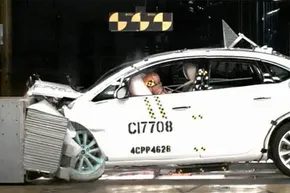
Consider yourself lucky if you never trigger one. If it goes off, you just had a serious front-end collision. You probably took out a tree or another vehicle. Front airbags likely deployed too. The pretensioner sacrificed its mechanism to save your spine.
Here’s the mechanics. Sensors detect abrupt deceleration. An explosive charge fires. A concealed piston drives forward. It spins the spool wrapped in the seatbelt fabric. The retraction is incredibly fast. Slack vanishes instantly.
This adds “pre-tension” before the main impact force hits. You’re pulled firmly into the seat. Your body is aligned. This prevents “submarining.” Car crashologists use that term for when momentum jerks your body under the lap belt. Your torso slides forward below the dash. The pretensioner stops that. It keeps you in the sweet spot.
The tech didn’t just appear on assembly lines. Its ancestors were military. In the 1950s, aircraft pilots needed similar restraint systems. Royce Strickland Jr. filed a patent in 1958. He called it a “harness inertia reel.” It used explosive gas to cinch pilots into ejection seats. They were about to be blown out of a fighter jet mid-flight.
Few of us will ever bail out of a stricken jet. But that same tech keeps us anchored if we hit a head-on collision. It’s the difference between sliding out of control and staying in the harness.
“The pretensioner mechanism uses an explosive charge to drive a concealed piston when sensors detect the signature abrupt deceleration of an accident.”
The system works in milliseconds. You won’t feel the explosion. You’ll just feel the sudden tightness. Then the airbag catches you. The pretensioner does its job and breaks. It’s a one-time use component. You replace it after a crash. It’s cheap insurance for a very expensive consequence.
We take for granted how much engineering goes into stopping movement. We think of cars as metal boxes. They’re actually complex restraint systems designed to manage kinetic energy. The pretensioner is the first line of defense. It sets the stage for the rest of the safety suite.
It’s easy to ignore a buckle until it matters. But the tech is there. Waiting. Ready to fire. You don’t need to be a pilot to benefit from Strickland’s invention. Just drive. And buckle up.
The road is unpredictable. The car isn’t. It’s doing everything it can to keep you inside the safe zone.