You look away for a second. Maybe to tweak the volume on the radio, punch in a new address, or fish a pen out of the floor mat. It’s a micro-second of distraction. You look back up. The car ahead, which was moving at your speed a heartbeat ago, is now stopped. You slam the brakes. The nose dips. Tires scream. You stop inches from their bumper. A close call. You survive.
Now imagine you are pulling a trailer.
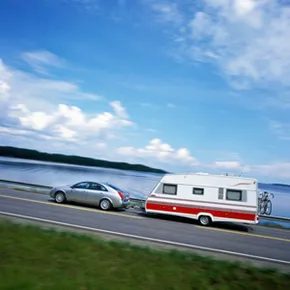
Add 3,000 to 4,000 pounds to that equation. The math changes instantly. The physics are brutal. You aren’t just stopping a car anymore. You are managing a massive, swinging pendulum of inertia. Inertia is the stubborn refusal of an object to change its state of motion. More mass means more resistance. More resistance means you need significantly more distance to stop. If you try to brake like you do in solo traffic, you won’t just fail to stop. You might jackknife. Or worse, you’ll plow into the vehicle in front of you with the weight of a small house behind you.
This applies whether you’re hauling a boat in a towed RV, dragging a pickup trailer full of firewood, or pulling a pop-up camper in a minivan. The principles remain identical. Misunderstanding these dynamics doesn’t just risk a fender-bender. It risks your weekend. It risks lives. It risks turning a fun trip into a police report and an insurance nightmare.
The Golden Rule of Trailer Braking
Most drivers think braking is about pressure. They are wrong. When towing, braking is about timing and technique. The single most critical rule? You must brake earlier than you think necessary, and you must do it progressively.
Here is why panic braking fails when you have a trailer attached:
- Increased Stopping Distance: Your vehicle-trailer combination requires 20 to 40% more stopping distance than a solo vehicle, depending on weight and load distribution.
- Sway Risk: Sudden braking can cause the trailer to swing out, inducing a jackknife scenario where the trailer pushes the tow vehicle sideways.
- Brake Fade: Heavy loads generate immense heat in your brake system. If you brake too hard, too often, your brakes lose effectiveness.
How to Brake Safely When Towing: A Step-by-Step Guide
- Scan Far Ahead: Look at least 12 to 15 seconds down the road. Anticipate stops before they happen. If traffic is slowing, lift off the accelerator early. Let engine braking do the initial work.
- Brake Early and Gently: Press the brake pedal firmly but smoothly. Do not slam it. Let the brakes engage gradually. This gives the trailer time to slow down without pushing into the tow vehicle.
- Avoid Abrupt Steering: If you need to correct your path, make small, smooth steering adjustments. Jerky movements will destabilize the trailer.
- Use Lower Gears on Downhills: Don’t ride the brakes on long descents. Shift into a lower gear to use engine braking. This preserves your brake pads and prevents fade.
- Check Your Load Distribution: Ensure 60% of the cargo weight is in the front half of the trailer. This keeps weight on the tongue, improving traction and stability. An improperly loaded trailer is dangerous regardless of your braking technique.
Why Inertia Matters More Than You Think
Inertia isn’t just a physics term. It’s a force multiplier. When you stop suddenly, the trailer’s momentum keeps moving forward. If the trailer doesn’t have its own brakes, it pushes into the tow vehicle. This can cause the tow vehicle’s rear tires to lose traction, leading to a spin. Even if the trailer has electric brakes, they must be synchronized with the tow vehicle’s brakes. If they engage too late, the same push happens.
“Braking
Slowing Down Is the Only Real Fix
You can have a massive rig hooked up, but if you don’t respect physics, you’re just waiting for a bad day. The most effective way to keep your trailer from pushing you into the guardrail isn’t some high-tech trick. It’s right there in the driver’s ed handbook. Slow down.
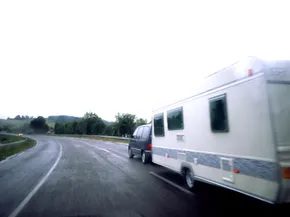
It sounds obvious. It’s easy to ignore until you’re staring at a brake light that’s too close. When you’re hauling hundreds or even thousands of pounds of dead weight behind you, stopping distances skyrocket. You aren’t just stopping your own vehicle anymore. You are stopping a combined mass that has its own momentum.
Give yourself way more room than you think you need. Then give yourself more. Panic stops while towing are the quickest way to lose control. There is no ABS magic that will save you from your own bad judgment.
Eyes Up, Space Out
Concentrate on the road. Not the taillights of the car in front of you. The road. A significant part of towing safety is maintaining a buffer zone. You need space to react. If the vehicle ahead brakes hard, you need room to ease into your own brakes gently.
Abrupt inputs cause trailer sway. Sway causes jackknifing. Jackknifing causes accidents. Keep your distance. Maintain a steady pressure on the pedal. Let the vehicle and trailer stop as one unit. It takes practice. It takes patience. It takes space.
Manual Transmissions: The Downshift Advantage
If you drive a stick shift, you have an extra tool in your belt. Downshifting before you apply the brakes. This isn’t just about stopping faster. It’s about engine braking.
By shifting down, you use the engine’s compression to slow the vehicle. This reduces the load on your brake pads and rotors. Less heat means less risk of brake fade or failure. You’re preserving your braking power for when you really need it.
But this only works if you have time. You need that buffer zone. You need to downshift early. If you wait until the last second, you’ve already lost the advantage. Keep speeds low. Stay in a lower gear if the conditions demand it. Control is everything.
The Reality of Heavy Loads
Towing changes the character of your vehicle. It changes how it handles. How it stops. How it feels. Respecting that change is the difference between a safe trip and a roadside emergency.
For those who want to dig deeper into the mechanics of stopping, there’s always more to learn.
Related Articles
- How Brakes Work
- How Disc Brakes Work
- How Drum Brakes Work
- How Master Cylinders and Combination Valves Work
- How Power Brakes Work
- How Anti-Lock Brakes Work
- What does it mean to call a pickup truck a ‘half-ton truck’?
More Resources
- RVbasics
Sources
- California Department of Motor Vehicles. “Towing Your Trailer Safely.” (Sept. 15, 2008) http://www.dmv.ca.gov/pubs/dl648/dl648pt12.htm
- RV Basics. “RV Fifth Wheel & Travel Trailer Towing Safety Tips.” (Sept. 15, 2008) http://rvbasics.com/techtips/travel-trailer-towing-safety-tips.html