Fred and August Duesenberg didn’t just build cars. They built legends. Most automotive historians still agree: these were the finest American vehicles ever produced. Their obsession with precision started long before they touched an engine block. After moving from Germany to Iowa in the late 1800s, a young Fred was already building racing bicycles that demanded exacting craftsmanship. The brothers eventually headed to Des Moines, where they designed the 1904 Mason. They named it for their financial backer. By 1912, they were hammering out high-performance engines for Mason’s racecars.
Then came the pivot. In 1913, they launched the Duesenberg Motor Company. They made marine engines. They built racing cars with their name on the grille. The strategy was simple: win on the track, sell on the street.
From Elizabeth to Indianapolis
The brothers moved operations to Elizabeth, New Jersey, in 1917. The new plant was larger, designed to churn out aircraft and tractor engines during the war years. But that business model quickly faded. The real money—and fame—was in auto racing.
In 1919, a 16-cylinder Duesenberg engine shoved a land speed record car to 158 mph. This happened on the sands of Daytona Beach, Florida. For that era, that speed was terrifying.
The next year, they designed a straight-eight engine. It was 180 cubic inches. It featured a single overhead camshaft. Each cylinder had three valves. The design was clearly inspired by Bugatti. But this wasn’t a copy. It was an evolution. In 1921, that engine powered the only American car to ever win the French Grand Prix.
Duesenberg-powered racers soon dominated Indianapolis. They went head-to-head with the famous Millers. They won the Indy 500 three times before 1930. That reputation carried weight.
The Model A: Fast, But Not Enough
With racing fame on their side, the Duesenbergs decided to move to Indianapolis. Their goal was a road car. Enter the Model A. It launched in late 1921. The price tag was $6,500. That was a princely sum back then.
The Model A was a track-bred machine. It used a 259.6-cid overhead-valve straight-eight. It could hit 85 mph. That was quick. More importantly, it featured four-wheel hydraulic brakes. Fred had invented this system for racing back in 1914. It was the first time American cars saw this technology.
But the Model A had flaws. The engineering was brilliant. The craftsmanship was fastidious. The style? Terrible. It didn’t set trends. It followed them.
Worse, Fred and August were terrible businessmen. They sold fewer than 500 Model As through 1926. The numbers didn’t add up. So, they sold the company.
Enter E.L. Cord
Errett Lobban Cord bought Duesenberg Motors in 1926. He also took control of Auburn that same year. Cord was brash. He had vision. Fred and August stayed on. They knew what they had to do.
In 1927, they built a dozen or so Model A derivatives. They called them the Model X. It was a stopgap. A bridge to something bigger. E.L. Cord didn’t want a stopgap. He wanted something exotic. Something that screamed wealth and power.
He got it.
The Birth of the Model J
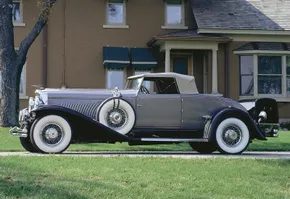
The Duesenberg Model J arrived in December 1928. The reaction was immediate applause. It was a statement.
Cord called it “the world’s finest motor car.” He said it with characteristic immodesty. But was he wrong? By almost any measurement, he wasn’t. The Model J was a collision of two forces: Cord’s money and Fred’s genius.
The car that followed changed the landscape of American luxury. It took lessons from the track and wrapped them in bespoke coachwork. It wasn’t just a car. It was a rolling declaration of independence from European dominance. The race was over. The road was theirs.
But the real story isn’t just the specs. It’s the tension between the engineer who wanted perfection and the businessman who wanted profit. The Model J was
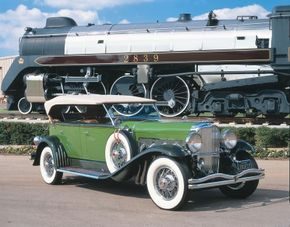
Forget the myths. When people talk about the Duesenberg Model J, their eyes usually glaze over and they start babbling about horsepower. And sure, that engine was monstrous. Built by Lycoming to Fred Duesenberg’s exacting specs, it was a 420-cid straight-eight. The factory claimed 265 horsepower. For 1928, that number was obscene. It was more than double the output of Chrysler’s best effort at the time.
Skeptics always argued the real number was closer to 200. But the evidence suggests the factory wasn’t lying. The stock compression ratio was a modest 5.2:1, which is low by today’s standards but normal then. However, a modified unit with an 8:1 compression ratio allegedly pushed out 390 horsepower. There’s also a legendary Lycoming chart that lists a rejected Model J engine hitting 208 horsepower at 3,500 rpm. John R. Bond, the founder of Road & Track, calculated that production models likely hit 245-250 hp at their redline of 4,250 rpm. So, it’s safe to say you were getting at least 250 horses, probably more.
Engineering Beyond the Broomstick
But focusing solely on horsepower misses the point. The Duesenberg Model J engineering was far more complex than just big numbers. While other manufacturers were still sticking to side-valve engines or single overhead camshafts, the J had dual overhead cams. Not just for show either. These cams drove four valves per cylinder through hefty chains. That’s 32 valves in total. The engine bay itself was a visual treat, enameled in bright green with fittings finished in nickel, chrome, or stainless steel.
The chassis was equally brutal. Standard wheelbase sat at a massive 142.5 inches. The frame rails? A solid 8.5 inches deep and a quarter-inch thick. Brakes were oversized and hydraulic, with vacuum assistance added after 1930.
Duesenberg was obsessed with weight savings, specifically through the use of aluminum alloy. You’d find it everywhere: engine blocks, dashboards, steering columns, differential housings, flywheels, crankcases, timing covers, water pumps, intake manifolds, brake shoes, and even the gas tank. This extensive use of light metals kept the curb weight under 5,200 pounds despite the car’s sheer size. The result? A top speed of 89 mph in second gear and 112-116 mph in high gear.
The Cockpit of a Superyacht
Step inside and you’ll find opulence that feels functional rather than decorative. The instrument cluster was the most extensive ever seen in an automobile at the time. You had the standard speedometer (calibrated to 150 mph), ammeter, water temp, and oil pressure gauges. But there was more. A tachometer. A brake pressure gauge. A split-second stopwatch. An altimeter/barometer combo.
Warning lights blinked to remind you to add chassis oil (which self-lubricated every 75 miles), change engine oil, or top up the battery water. This wasn’t clutter. It was Fred Duesenberg’s obsession with excellence. He demanded superiority in every metric.
The Cost of Exclusivity
Understanding the Duesenberg Model J price requires a specific mindset. You didn’t buy a car. You bought a bare chassis. In 1929-30, that chassis listed for $8,500. Thereafter, it jumped to $9,500. E.L. Cord, who bought Duesenberg, knew exactly who he was targeting: the ultra-wealthy. And the chassis was just the start. You had to pay extra for bodywork, custom-designed to suit the tastes of discriminating individuals.
Factory announced standard body styles started around $2,500, but that’s a trap. The cheapest complete car, a Murphy of Pasadena convertible coupe, still ran at least $13,000. Most sold for under $17,000 complete. A few hit $20,000. A handful went for $25,000. In 1929, that was equal to 50 Ford Model As.
The bodies were regal. These were grand luxe carriages, so only the finest woods, fabrics, and leathers were used. Vanity cases, radios, bars, and rear instrument panels were common add-ons. Less common was a town car upholstered in silk with ebony, silver, and ivory fittings. One reportedly featured solid-gold hardware and mosaic-wood inlays in the rear compartment. Despite the performance, these cars were built to run in eerie silence, exactly as the customers demanded.
Who Actually Bought Them?
Only 470 chassis and 480 engines were built between 1929 and 1936. The clientele was exclusive by design. Duesenberg ads didn’t use hype. They didn’t list specs. They didn’t even show the car. Instead, you’d see a yachtsman battling a 40-knot gale or a tycoon relaxing in a library that made universities look shabby. The only text was: “He Drives a Duesenberg.”
It wasn’t chauvinistic, either. One ad showed an elegantly dressed woman talking to her gardener in front of an estate that would make Versailles blush. The headline? “She Drives a Duesenberg.”
For more on defunct American cars, see:
-
AMC
-
Oldsmobile
-
Plymouth
-
Studebaker
-
Tucker
Duesenberg Model SJ, Model JN, Model SJN
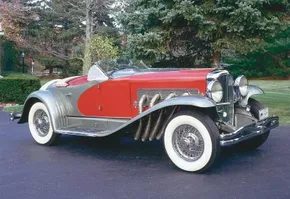
If the standard Model J felt imposing, the supercharged SJ was simply awe-inspiring. Production numbers were tiny—only about 36 chassis were built, each commanding a staggering $11,750. Why the premium? Because pushing a centrifugal blower to deliver six psi of boost at 4,000 rpm required hardware that wouldn’t disintegrate. Aluminum alloy connecting rods were swapped for much sturdier tube-steel units. The result? 320 horsepower.
But Augie Duesenberg wasn’t satisfied with 320. He half-heartedly experimented with “ram’s horn” exhaust manifolds and dual carburetors, expecting marginal gains. Instead, the dyno readout hit 400 horsepower. Only three cars ever received this specific high-output setup.
SJ performance is well-documented history. A stock unit could hit 104 mph in second gear and exceed 125 mph at its top speed. In 1935, Ab Jenkins took a streamlined aerodynamic speedster—the later famous Mormon Meteor—and ran it on Utah’s Bonneville Salt Flats for 24 hours. It averaged 135 mph. Jenkins also sustained 152 mph for a full hour and clocked a single lap at 160 mph. Naturally, that salt-flats monster used the 400-horsepower “ram’s horn” engine. Despite its raw speed, the SJ remained surprisingly usable on public roads. It was, quite simply, incredible.
Beyond brute force and luxury, these Duesenbergs possessed a dynamic balance lacking in many high-priced contemporaries. The Model J wasn’t “trucky.” It didn’t steer like a tank. You didn’t need Herculean leg strength to operate the clutch or brakes. Yes, it understeered. But the steering was so exquisitely accurate that the issue was easily managed. A wide-open SJ with the exhaust cut-out open throbbed louder than most extroverts could tolerate. Close the cut-out, and it purred no louder than a healthy Cadillac Sixteen.
The SSJ Specials and the JN Detour
Only two Model Js came close to being true “sports cars.” These were the SSJ specials, unofficially dubbed so by enthusiasts. Built by the Cord-owned Central Manufacturing Company under the La Grande name, they used a shortened 125-inch wheelbase. Both cars were first driven by movie stars. Gary Cooper owned one. Clark Gable was loaned the other as a demonstrator but never bought it. Both survive today in museums. Performance data is scarce, but with 400-horse “ram’s horn” engines and a chassis 17 inches shorter than the standard wheelbase, they must have been shattering fast.
Another variant appeared in 1935: the JN. It was an attempt to modernize an aging design. Wheels shrank from 19 inches to 17 inches. Fenders were skirted. Taillights became bullet-shaped. Bodies sat lower on the frame rails. Supercharged JNs earned the SJN designation. But confusion reigns here. Blowers were later removed from some SJs, while others were added to originally unblown models. At least 45 cars had a supercharger at some point in their lifespans.
Then there is the persistent myth that any Duesenberg with pipes snaking out from under the hood is supercharged. Beautiful external plumbing was often disconnected from any internal supercharger. It was aesthetic, not functional.
Under E.L. Cord, the company’s goal wasn’t profit. It was to build magnificent, cost-no-object cars as flagships of Cord’s industrial empire. The plan was to sell 500 Model Js and launch a new design. The Depression delayed sales. Cord’s empire collapsed in 1937, before a new design was ever needed.
The End of an Era
Fred Duesenberg died five years prior, killed in a car accident while driving an SJ. August continued working but failed to revive the marque in 1947. Subsequent efforts were equally fruitless. Fred’s son, “Fritz,” floated a “modern” Duesenberg sedan in 1966. Two nephews cooked up an abortive Cadillac-based sedan in 1980. Numerous postwar replicas followed, ranging from splendid to schlocky.
None had the heart and soul of Fred. As automotive journalist Ken Purdy wrote: “[Fred Duesenberg] died content … [He] had done what is given few men to do … chosen a good course and held unswervingly to it … With his mind and his two good hands he created something new and good and, in its way, immortal. And the creator is, when all is said to be done, the most fortunate of men.”
For more on defunct American cars, see:
- AMC
- Oldsmobile
- Plymouth
- Studebaker
- Tucker