It wasn’t just bad luck. It was a collision of ego, delayed execution, and a market that vanished while the car was still on the drawing board. The Edsel is often laughed at. A comedy of errors. But look closer. The idea wasn’t terrible. The timing was catastrophic.
One historian put it best: “Its aim was right, but the target moved.”
The 1954 Blueprint That Missed the 1957 Market
In 1954, Ford Motor Company was back from the brink. The late-40s near-collapse was ancient history. Ernest R. Breech, board chairman, was riding high. Dearborn management wanted to copy General Motors’ playbook: a five-brand hierarchy. They already had Ford. They had Mercury. They had the new Continental Division. They needed a second medium-price make to sandwich between Ford and Mercury.
At the time, the medium-price segment was exploding. In 1955, Pontiac, Buick, and Dodge built nearly two million cars combined. The logic was sound. Build a car for that demographic. Sell 100,000 units. Easy.
But car manufacturing has a three-year lag. You plan in 1954. You build in 1957. By the time the Edsel rolled off the line in late 1957, the economic bubble had burst. The medium-price market shriveled from 25% of sales down to 18%.
Ford wanted 100,000 sales for the 1958 model year. They built 63,000. That number looks bad until you realize it was an all-new brand launch during a recession. It was actually decent. Then the floor dropped out.
1959 saw fewer than 45,000 sales. 1960? A token 3,000 units. By November 1959, the brand was dead.
How “Edsel” Became the Name (And Why It Wasn’t)
Here is the irony. The name “Edsel” was never the first choice. It was the backup plan that stuck.
Ford solicited names from everywhere. They even asked Marianne Moore, the poet. She suggested “Mongoose Civique,” “Turcotinga,” and “Utopian Turtletop.” The ad agency sifted through 6,000 submissions. The winners were Ranger, Pacer, Corsair, and Citation. These became the model designations.
But Breech hated them. He didn’t like any of the top picks. The project had been internally called the “E-car.” “Edsel” floated up as an early prospect. It honored Henry Ford’s son, Edsel Ford, who died in 1943. It was also the father of then-president Henry Ford II.
The Ford family hated the idea. They publicly denied the name would be used. Breech didn’t care. When the decision stalled, he stepped in. “I’ll take care of Henry,” he said. He did. Edsel it was.
Was it a mistake? Maybe. But the car’s positioning was the real problem.
Super Mercury or Just Another Ford?
Originally, the Edsel was supposed to be a “super Mercury.” More expensive. More powerful. A step up.
In reality, it landed between Ford and Mercury. But the design wasn’t the radical departure people had rumored for two years. It was safe. Conservative. If the car had arrived with the aggressive styling the industry expected, maybe it would have cut through the recession noise.
Instead, it arrived late. It arrived in a shrinking market. And it arrived with a name that some buyers found unfortunate, though that’s mostly a myth manufactured by salespeople after the fact.
The real killer wasn’t the name. It was the three-year gap between the idea and the reality. By the time the Edsel existed, the world that needed it was gone.
1958 Edsel: The Horse-Collar Controversy and FE Engine Specs
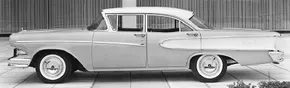
The 1958 lineup split into two distinct camps based on chassis architecture. At the entry level, the Ranger and mid-tier Pacer sat on the 118-inch wheelbase shared with the standard Ford of that era. Wagons got a slight tweak, riding on a 116-inch span. Move up the food chain, and the Corsair and top-shelf Citation borrowed the longer 124-inch Mercury frame.
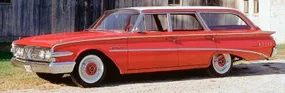
Body styles followed the hierarchy. The Ranger offered a broad selection: two- and four-door sedans, hardtops, a two-door Roundup wagon, and four-door Villager wagons seating six or nine passengers. The Pacer dropped the two-door wagon and sedan but added a convertible. Its wagons wore the Bermuda badge. The Corsair stuck strictly to two- and four-door hardtops. The Citation gave you those same hardtops plus a soft-top option. Prices hovered between $2500 and $3800.
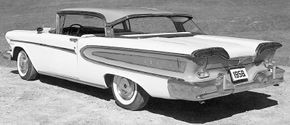
Styling was the 1958 Edsel’s most defining—and divisive—feature. The vertical “horse-collar” grille dominated the front. Critics hated the slim horizontal taillights, with one cynic comparing them to ingrown toenails. Yet, the car avoided the massive fins plaguing competitors. Compared to the flashy 1958 Buick and Oldsmobile, the Edsel looked restrained. Almost tasteful.
Inside, gadgets were mandatory for 1958. You could opt for Teletouch Drive, an automatic transmission controlled by pushbuttons in the steering wheel hub. A “cyclops eye” speedometer rotated a drum to show the number. Power assists covered most functions, though the rearview mirror remained manual.
Under the hood, Ford’s new FE-Series big-block V-8s provided the muscle. Lower series models got the 361-cubic-inch engine making 303 horsepower. The Corsair and Citation used the massive 410-cubic-inch unit, pushing 345 horsepower. The Edsel moved quickly. But roadability, braking, and workmanship were poor. Typical for the time.
First-year sales disappointed. Ford responded by shrinking the 1959 lineup. All 1959 models moved to a single 120-inch wheelbase. They were essentially reskinned Fords. Offerings included six- and nine-seater Villager wagons, a Corsair convertible, a Ranger two-door sedan, and four-door sedans, hardtop coupes, and hardtop sedans in the Corsair and Ranger trims.
Why the 1959 Edsel Failed to Save the Brand
Engines multiplied across the lineup, but the strategy felt reactive. The Ranger and Villager trims could still pull the 292 cubic inch Ford V-8, rated at 200 bhp. Yet, Ford Division slipped in a new no-charge option: a 145-bhp 223 inline-six. It was a direct response to the sudden fuel economy panic sparked by the ’58 recession. Buyers were scared of gas prices. Edsel listened.
Corsairs kept the standard 225-bhp 332 V-8, another Ford hand-me-down. The big 361 V-8 lingered as a $58 option across the board. Here is the thing about the ’59 models: they were lighter. That weight loss meant the 361 could hammer 0-60 mph in 10 seconds flat or less. Not bad for a mid-tier luxury car.
Styling Shifts and Price Cuts
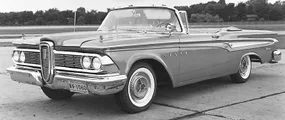
The flamboyance of ’58 got dialed back. Grille-mounted headlights replaced the previous setup. Windshields grew taller. Taillights moved into the rear panel, looking more conventional, less alien. Prices dropped too. Along with the weight and the model count. The most expensive ’59, a ragtop Corsair, started around $3100.
Dearborn pulled the plug in November 1959. The brand was done.
They tried one last gasp with downpriced, stripped-down ’60 models. These cars were even more Ford-like than the ’59s. A halfhearted effort to clear inventory. The Corsair nameplate vanished. The 361 V-8 disappeared. What was left? Two Villager variants. Five Rangers. The 292 V-8 got detuned to a meek 185 horsepower. And a new 352 V-8 option arrived, pushing 300 bhp.
Too little. Too late.
The 1960 Edsel: Detroit’s Final Bow Before the Falcon Saved Ford
The ’60 model year brought a fresh coat of paint to the Edsel’s identity. Stylists scrapped the vertical grille that had defined the brand since launch. In its place? A split-horizontal setup. It looked suspiciously like the Pontiac from ’59. Pure coincidence. That’s what Ford said. The rear featured four vertical ovals housing tail and backup lamps. Slim chrome moldings ran along the upper bodysides. It was cleaner. Less confused.
Inside the mechanicals, nothing changed much. You could still get two-speed or three-speed automatic transmissions. Power steering was on the table. So was air conditioning. Prices stayed firm. The Ranger convertible started at $3000. Load it up with options and you’d hit $3800. The base Ranger two-door was the cheapest entry at $2643.
But everyone knew the writing was on the wall. Edsel was dead. The question wasn’t if it would end. It was how many ’60s would actually roll off the line. Some almost didn’t. The ragtop Ranger saw just 76 copies. The nine-passenger Villager? A mere 59 units. It marked the end of Detroit’s biggest public flop since the Tucker.
“Edsel” now shows up in dictionaries as a synonym for “loser”
That’s the legacy. Unfair, considering Edsel Ford’s actual history. Dearborn reportedly spent $250 million on the project. Was it a total loss? No. The plants built for Edsel production left Ford with surplus capacity. When the 1960 Falcon launched and immediately dominated the compact market, that extra space came in mighty handy.
Had the Edsel been a truly different car, launched three to five years earlier or later than 1958, it might still be around. Instead, it stands as a monument to cynicism. An era when Detroit thought buyers didn’t know the difference between style and substance. They did.
Looking for more history on defunct brands? Check the links below for deep dives into other automotive ghosts.
More Automotive History
- AMC
- Duesenberg
- Oldsmobile
- Plymouth
- Studebaker
- Tucker
- Classic Car Image Gallery
- Classic Muscle Car Image Gallery