There is a distinct lack of poetry in running out of gas. With a combustion engine car, the experience is brutally binary. You hit the reserve light. You feel a spike of anxiety. You keep driving until the fuel line runs dry. The engine cuts out. Dead stop. It is inconvenient, sure, but it is also final. You pop the trunk, grab a jerrycan, pour a little liquid gold into the tank, and drive away. Simple.
Electric vehicles do not work that way. The anxiety is not a single event; it is a slow, creeping torture. You are obsessed with the percentage. Even with modern range, seeing that number drop below 10% triggers a primal fear. The energy is your lifeblood, and it is leaking away.
But what actually happens when the screen hits 0%? Nobody wants to find out naturally. The risk of being stranded is too high. So, the ADAC—the German automobile club—decided to force the issue. They took six popular EVs to their 2.2-kilometer test track to see exactly how these machines behave when the battery hits the floor.
The results were a study in controlled panic. The cars involved were the VW ID.3, BYD Seal, Volvo EX40, Nio EL6, Tesla Model Y, and Kia EV6. Unlike a gas guzzler, where the needle just ticks left until it hits the ‘E’, an EV changes its personality. It does not just stop. It goes through a choreographed three-step waltz to warn you that your mobility is ending.
The First Phase: Subtle Warnings
The descent begins between 80 and 40 kilometers remaining. That is roughly 20% to 25% of the battery. At this stage, the car is still polite.
A small orange icon might pop up on the dashboard. A discreet message asks you to look for a charger. Nothing alarming. The car drives normally. The HVAC runs at full blast. The acceleration is sharp. You could ignore it if you wanted to, though you’d be foolish to do so. This is the grace period. The car assumes you have a plan.
The Second Phase: The Squeeze
Then comes the drop toward 10%. This is where the character changes. The messages become louder. More urgent. Some models trigger audible alerts that buzz in your ears. The psychological pressure ramps up.
The car starts making demands. It suggests turning on Eco mode. It begs you to kill the heating. Or the AC. Or both. The temperature in the cabin will drop, but the range will stay stable.
Performance degrades, too. The throttle response becomes sluggish. Press the pedal, and the car hesitates. It holds back power to conserve energy. It is like driving through molasses. The message is clear: find a charger. Take the next exit. Do not argue with the machine.
“In this situation, better to take the first exit towards the nearest charging station.”
The behavior is not uniform. Each manufacturer has its own philosophy on how to nag the driver. Some are passive-aggressive with messages. Others are aggressive with sound. But the intent is the same. Stop drawing from the well before it runs dry.
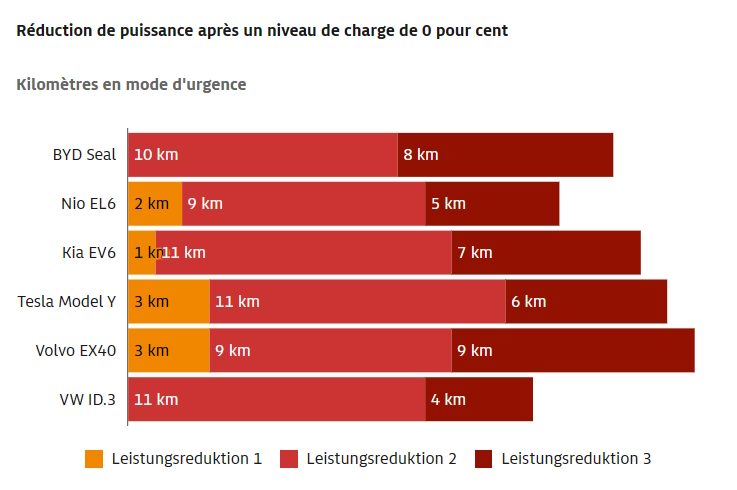
When the percentage drops to 10%, the tempo shifts. You feel it. The acceleration lags. The top speed plummets. It’s your car’s way of saying, “This is getting serious.” Some models flash a turtle icon. Others switch to a countdown of kilometers remaining, ticking down like a bomb.
At 5% charge, the BYD Seal does something odd. It replaces the distance readout with dashes. It’s as if the software refuses to calculate the end. It mirrors the panic of a combustion engine hitting empty. One moment you have 20 km of range. The next, nothing. Five of the six cars in the ADAC test kept showing the percentage down to that final, dreaded zero.
Life After Zero
Does the car stop dead at 0%? No. It enters a reserve mode. A hidden buffer. In the ADAC test, the six electric vehicles rolled another 15 to 20 kilometers after hitting zero. But don’t celebrate yet.
The moment this reserve activates, speed collapses. Power vanishes. You’re lucky if you can break 50 km/h. It’s a last-ditch effort to limp toward a charger. The experience is less like driving and more like playing Russian roulette with your powertrain. You have to accept that the car could stall at any second.
For most models, including the VW ID.3, you can restart the motor. It might give you a few meters of crawl. Just enough to push the car closer to the station. The ADAC advises against using this reserve. It’s risky. In winter, or if your battery is degraded, that reserve might be nonexistent. You could be stranded with a phantom 1% showing on the dashboard.
The Physics of Being Stuck
Whether it’s a phone or a car, dropping below 20% regularly harms the battery chemistry. Deep discharges stress the cells. But when you’re truly stranded, what are your options?
Tow truck. Specifically, a flatbed. Never tow an EV with its wheels on the ground. If you drag the car, the electric motors act as generators. They spin, creating uncontrolled voltage that can fry the inverter and other electrical components. That’s a expensive mistake.
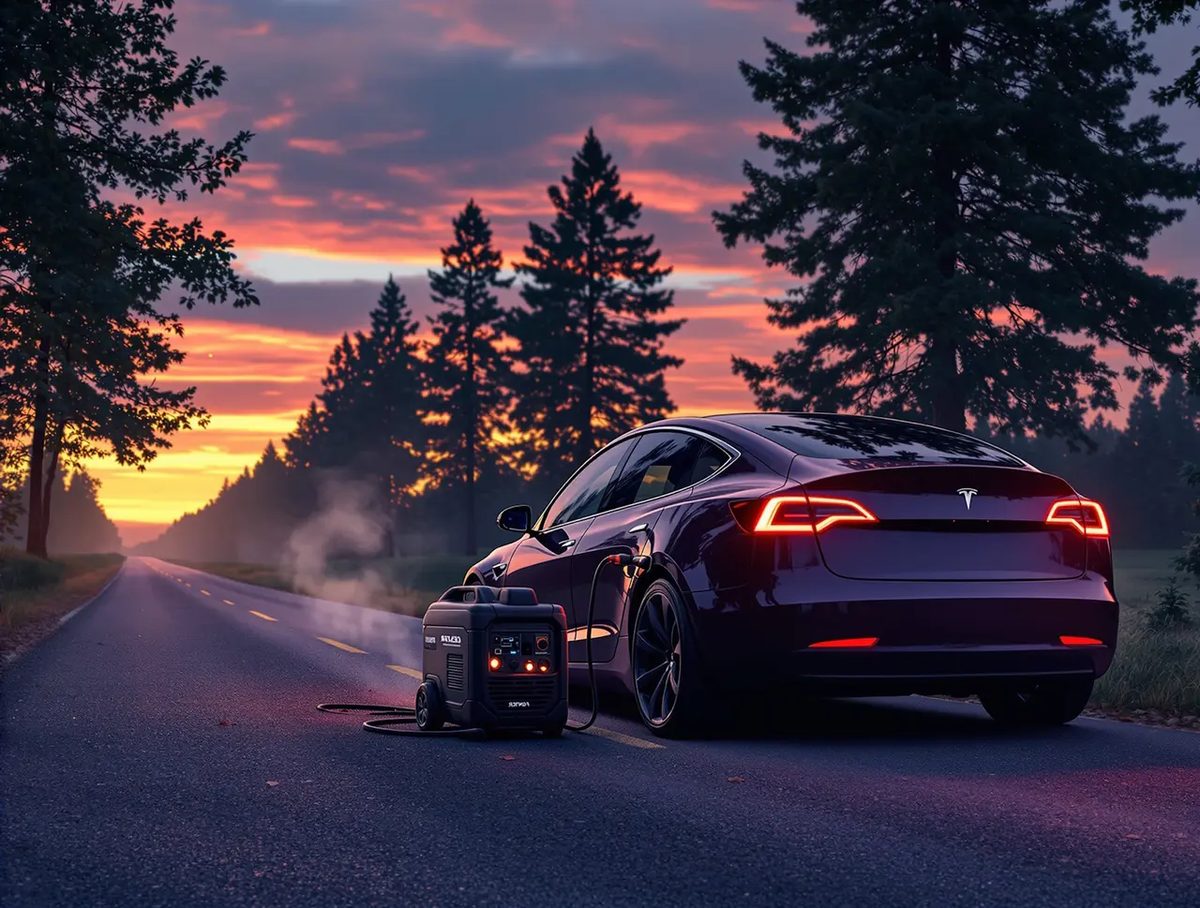
You could try a portable power station. Think of it as a heavy, bulky jerry can for electricity. It works. But the payoff is poor. Charging enough to gain 10 km of range might take an hour of waiting.
Or, you look for a good Samaritan. If another EV driver is willing to share energy via a Type 2 connector, you can squeeze out about 5 km. It takes patience. And goodwill. In a world where range anxiety is real, kindness might be the only thing that keeps you moving forward.