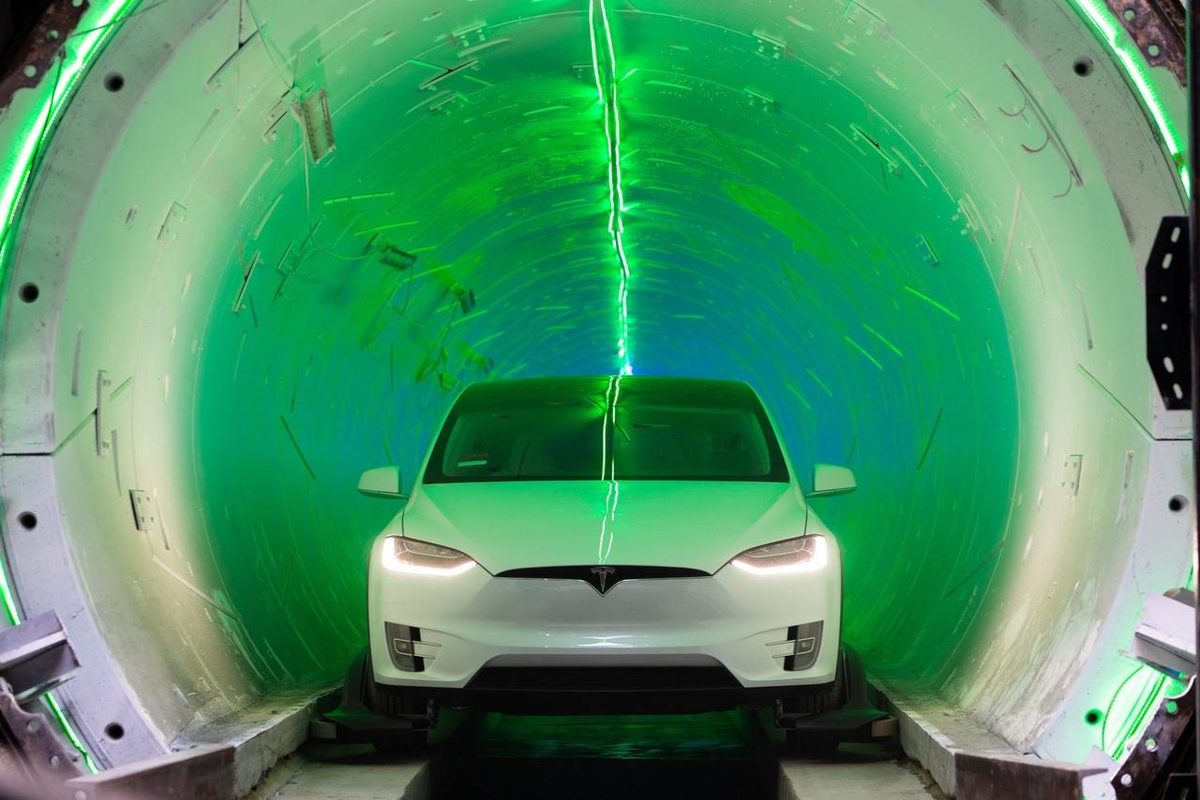
This idea was born out of a dead end. In 2016, while stuck in Los Angeles traffic, Elon Musk proposed a radical idea on Twitter. The idea was to dig a tunnel under the city and let cars drive freely. This tweet sparked the birth of The Boring Company. They dug a 2.3-kilometer-long test tunnel under SpaceX’s headquarters in Hawthorne, California. The company currently has an agreement with Las Vegas to build a network that will serve the convention center hosting the Consumer Electronics Show.
Proof of concept requires real-life testing. The Boring Company decides to prove the value of underground travel with a drag race. Two Tesla Model 3 models started together. One entered the tunnel. The other took the surface streets. They both headed to the same meeting point at the exit of the tunnel.
The results were one-sided.
The tunnel car hit 200 km/h inside the tube. It arrived in about 1 minute and 15 seconds. The surface car sat at a red light. It took almost 5 minutes to reach the same place. The efficiency gap is undeniable.
But there’s a problem.
The footage reveals the missing pieces of the original puzzle. The Model 3 in the tunnel had not been fitted with the mechanical guides announced in December. Musk’s team proposed small wheels that unfolded from the front axle. It can lock onto rails in narrow tunnels, allowing standard cars to drive autonomously at high speeds.
Have they given up on that idea?
Musk confirmed on Twitter that the guide wheels were not used. One follower asked if the station’s platform system had been decommissioned. Musk simply replied, “Roughly that’s it.” They traveled at a speed of 204 km/h in an enclosed space using only Autopilot. There are no physical guides. There are no railroad tracks. Only software and fast cars.
The question is, is this a one-time gimmick or a permanent change in strategy? Mechanical controls add complexity. Removing them simplifies vehicles, but also raises questions about the safety and capacity of fully autonomous networks. If guides were truly dropped, how will The Boring Company manage multi-lane traffic?
Currently, the tunnel is in operation. Its speed is genuine. The time saved is huge. It is still unknown whether the guides will return.