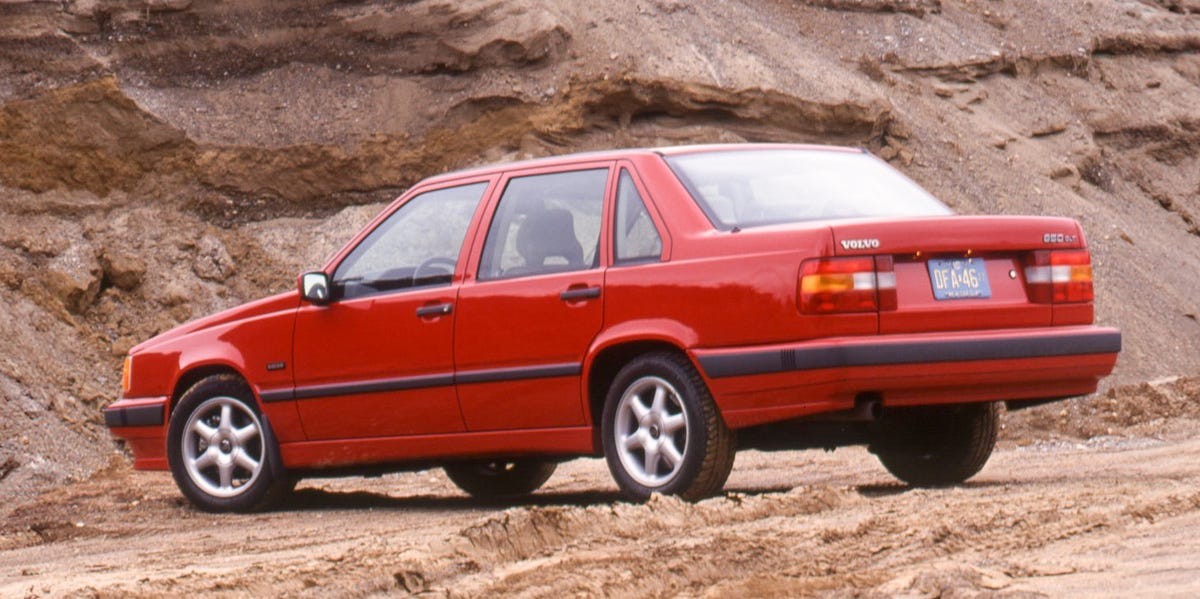
The 1993 Volvo 85GLT arrives, and the first thing you notice is nothing. Really. It looks just like every other Volvo since the dawn of time. Sensible. Safe. Beige in spirit, even if it’s silver. You’d think after six years in development, the Swedes could have thrown us a curve. Instead, we get a car that looks like it was drawn by an accountant with a protractor.
Familiar faces build brand loyalty. That’s the theory. We aren’t buying it. But here’s the twist: inside the boring shell beats a radical heart.
Front-Wheel Drive? Really?
This is the first front-drive Volvo sold in America. Period. It’s a massive departure for a company that treats the rear axle like a religious text. The engine is mounted sideways, too—a transverse inline-five. Anyone who has tried to jam an inline-five sideways knows this is heresy. Or genius. Maybe both.
It pays off though. The 850 is about eight inches shorter than the massive 960 flagship. It weighs 3229 pounds—almost 300 lbs less. But thanks to that new front-drive packaging, it’s roomier. More legroom in the front and back. It’s like a 960 went on a rigorous CrossFit program and shaved off the excess flab. Leaner. Tightly wound.
Under the hood sits a new 2.4-liter inline-five. Think of the 960’s six-cylinder engine and yank one cylinder out. It has double overhead cams and 20 valves. Aluminum block. Lightweight. Compact.
It makes 168 horsepower. The torque is broad and usable, thanks to a variable intake system. Short runners stay shut at low RPMs; open up when you’re cruising. It optimizes the charge. Clever stuff.
“The engine is basically the 960 without the drama.”
Transmission choices? A five-speed manual with a cable linkage or an automatic with four speeds. The auto has three modes: sport, economy, or wet/winter. Yes, winter is its own gear mode. Who doesn’t love a button for snow?
Suspension wise, we have struts in the front and a semi-trailing arm in the rear. The rear design allows for a tiny bit of passive rear-wheel steering when you’re turning hard. It’s a small thing. But in Volvo speak, it’s a shout from the rooftops. Handling usually doesn’t make it into their vocabulary.
Safety First (Still)
Volvo equals safety. That’s the other half of the synonym. “Sensible” and “Safe.” They go together.
Standard features include driver and passenger airbags. The belts have mechanical tensioners and shoulder straps that auto-adjust for your height. All three rear passengers get three-point belts too. There’s a built-in child booster seat in the rear center armrest—a nice touch.
The body is braced against side impacts with cross-beams and reinforced B-pillars. Brakes feature a three-channel ABS. Standard. You’d expect no less.
Does it work? Does this mix of traditional safety and new hardware gel?
Yes. It works well.
It’s not the fastest thing in the lot. But it’s balanced. Climb in, and the quality hits you. Hard. The materials feel solid. The layout makes sense. The power driver’s seat? Comfort incarnate. We drove this from Phoenix to Ann Arbor. Two days. Fourteen-hour shifts. No fidgeting. If TV makers added these seats, nobody would ever go outside again.
The engine pulls hard. It sounds a bit like a vacuum cleaner—that familiar inline-five whine. But performance is brisk for the segment. Zero to sixty in 7.9 seconds. Top speed 132 mph. Without the 740 Turbo around, the 850 leads the fleet now.
The five-speed manual has a polished feel. But the clutch grabs hard. You need concentration. Smooth shifting takes effort. And while the manual implies sport, the pedal spacing betrays you. Try braking and downshifting. It’s awkward. Enthusiastic driving wasn’t top priority for the designers.
Ride quality? Resilient. Almost soft. Road imperfections vanish. Handling doesn’t suffer much. We pulled 0.79 g in the corners. The chassis gives a slight hint of oversteer at first. But the rear holds. Understeer disappears. It’s secure. Predictable. But with enough bite to entertain someone who likes to carve an entrance ramp occasionally.
Base price: $24,45 for the well-equipped GLT. Air, heat, heated seats, eight speakers. Our test car had leather, sunroof, alarm, CD, and fog lights. Final sticker: $28,20$. It stands out in the showroom. The best looking Volvo since 1981? Debatable. But definitely the most desirable.
The Counterpoints
Martin Padgett Jr. argues this is the magic formula. Volvo engineers found a way to add nimbleness to a boring family sedan. It grips. It drives with Audi-like confidence. The gearbox is notchy. Steering is heavy. Brakes are progressive. But it drives better than a stone. The problem? It looks like a housecoat. The designers missed a chance to make it beautiful. All that money spent. On boring lines. Aimed only at loyalists who don’t care what it looks like.
Larry Griffin hates the cubism. “WHACK!” goes the metaphorical axe. He says the angular look died a decade ago. Even the Vikings look better than this car. It looks like a shipping carton. He wants softer edges. He also wants the drivetrain tweaked. But he loves the vents. And the wheels. Big. Smooth. Easy to shine. No complicated spokes to clean brake dust from. A photographer’s dream.
Mary Beth Lewis dislikes the hunched stance. She prefers squares. But even she admits the body styling is the weak link. Driving it? Different story. Like an Audi 100. Tailored. Supple. Eager to move. The rear seat is spacious. The child seat is clever but limited—it’s only good for kids 50 to 80 lbs, using a three-point belt. Other brands use five-point harnesses for smaller kids. Quibbles exist. The climate control buttons are ugly. The clutch travel is long. But drive it beyond the paint and it works.
What happens next? Will buyers care that the 850 handles? Or will they buy it for the airbags? We’ll wait and see. The car is ready. The question remains if the audience is.