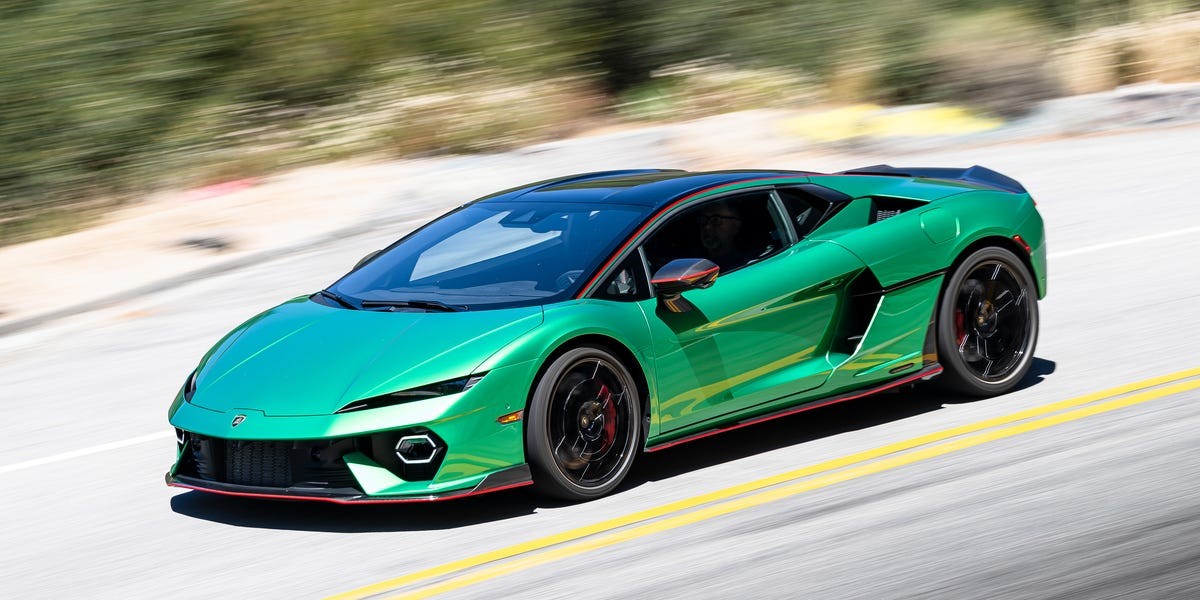
Why the new Lamborghini Temerario is faster and cheaper than the Revuelto
I saw it first as a rumor in a corner of the factory.
When I visited for the Revuelto launch, a covered car sat quietly away from the press scrums. Temerario. The whisper was simple. Small car. Big brother gets all the attention. The Revuelto would lead the charge.
The Temerario was the support act.
We just drove it. The whisper was wrong.
Cost matters here. The Temerario undercuts its sibling by about $200,0 00. Size matters more. It is nearly ten inches shorter. Smaller usually means compromised. Here? It feels like freedom. The weight is lower. The presence is sharper. It doesn’t shrink from the legacy. It sidesteps the bloat.
How the Temerario’s hybrid V8 outpaces the naturally aspirated Revuelto
The difference starts under the skin. Not just skin deep. Structural choices drive the price tag down, not cutting corners but shifting engineering priorities.
Audi helps. The Temerario uses a brand new aluminum spaceframe built at a German plant in Neckarsulm alongside the R8 assembly lines. It is proven tech. It is lighter to produce at this scale. The Revuelto demands carbon fiber. Carbon is stiff. It is exotic. It is also wildly expensive to build on-site at Sant’Agata Bologonese.
Then the engine.
Four liters. Twin turbocharged. 789 horses. All from the internal combustion unit. The redline is ungodly. 10,000 RPM. It screams.
The Revuelto runs naturally aspirated twelve cylinders. Traditional. Beautiful. Less peak torque density. The Temerario swaps cylinder count for boost.
Electric motors bridge the gaps. A 147 hp motor sits between the engine and transmission. It smooths shifts. It manages energy flow. Out front, a pair of axial flow AC motors drive the wheels independently. No driveshaft runs through the cabin floor. A 3.4 kWh battery packs the space behind the seats.
Total system output? 907 horsepower.
Math nerds might pause. Three electric motors equaling roughly 440 hp combined. Yet the battery limits output to 187 hp at a time. The system manages the load intelligently. The result is instant torque vectoring across the front axle. It pulls hard. It corners vicious.
Acceleration stats: Is the 2026 Lamborghini Temer quicker than the older model?
You want numbers? Here they are.
2.1 seconds to 60 mph.
The Revuelto hits it in 2.2.
The Temerario is a tenth quicker. At 100 mph the gap widens to two tenths. 4.4 vs 4.6 seconds.
The quarter mile? 9.4 seconds at 150 mph.
The Revuelto manages 9.7 seconds. Top speed out of the quarter is lower because it simply hasn’t reached its top velocity yet in the limited distance. Both are plug-in hybrids. They recharge terrifyingly fast when in Corsa mode. Every launch started with a full battery. No excuses. Just speed.
“It screams to 60 mph… a tenth quicker than the Revuelto.”
The launch is explosive. Electric front torque hooks instantly. The turbo V8 kicks in. The sensation is violent but controlled. You do not feel left behind by the larger car. You leave it in the dust. Literally.
Cornering performance: How the Temerario handles Virginia International Raceway
Speed in a straight line is easy for anyone with money and batteries. Grip requires engineering finesse.
We drove them around Virginia International Raceway ‘s Grand Course. Specifically Lightning Lap. The Temerario finished 0.4 seconds slower than the Revuelto.
Slower? Yes. But listen.
It was down slightly on pure cornering grip numbers on the skidpad. 1.08 g s versus the Revuelto ‘s 1.10 g’s. Tire sizes tell part of that story.
Temerario tires
255/35-20 (Front)
325/30-21 (Rear)
Revuelto tires
265/35-20
345/30-21
Larger contact patch for the big car. Does it need more rubber? The Temerario weighs only 91 lbs more on the scales. Laughable weight difference for the traction delta. The lighter curb weight offsets the smaller footprint mostly. It tracks true. It bites.
Steering effort feels clairvoyant. There are no hydraulic pumps assisting. Electric signals do the work. You can feel every millimeter of camber change through the rim. No numbness.
Torque vectoring at the front axis handles the rest. You aim where you want to go. It turns that way. Understeer is virtually nonexistent. You point it at the apex and it sticks there. The feedback loop between tire slip and driver input is immediate. Raw. Honest.
Which driving mode actually lets the 4.0 V-8 engine breathe?
Daily driving requires adaptation. The interface is dense. Clunky even.
Start up and the engine sleeps. Front axles run on electric juice alone for four miles. If you select Strada (City mode) this behavior persists indefinitely or until thermal sensors decide combustion is necessary. Strada mode mutes everything. The transmission short shifts aggressively to save juice. Fans whine. Mechanical sympathy reigns over adrenaline.
Strada mode feels sterile.
Shift to Sport.
The character improves but stays restrained. You have to wrest it out of gear manually to hear the song. Engage the paddles. Rev to 8000 RPM. Then the turbochargers catch up to reality.
Only when forced does the V-8 reveal its personality. And then? Oh. The exhaust note builds linearly up to the 10,000 RPM cliff. It sounds like metal tearing and laughter simultaneously. It is visceral.
The steering wheel adds complexity. Ten buttons on the spoke backs. Another cluster on the face. Turn signal stalks? Absent. You hunt through digital inputs or buttons harder to master than those in a Tesla. It takes practice to operate lights without looking.
Also watch out for the suspension. No memory settings on the axle lift system. Every trip off road means hitting the raise button again. Your brain will forget. The bumper won’t care.
The bottom line
Walk into Sant’Agata. They show you the carbon fiber. The heritage. The V-12. You nod. You pay the premium.
Come back here. Test the 2026 Lamborghini Temerario . Feel the electric front wheels snap you into a corner while the twin turbo V-8 whines toward oblivion. You notice how quick the straight lines are. How the 147 HP front motors pull you through traffic instantly. You realize the aluminum spaceframe feels taut and alive.
Was the marketing narrative wrong about this being a little brother? Absolutely.
Is the interface annoying? Sure.
Is it fast enough to make the twelve cylinders feel archaic? In every practical sense on the track, yes.