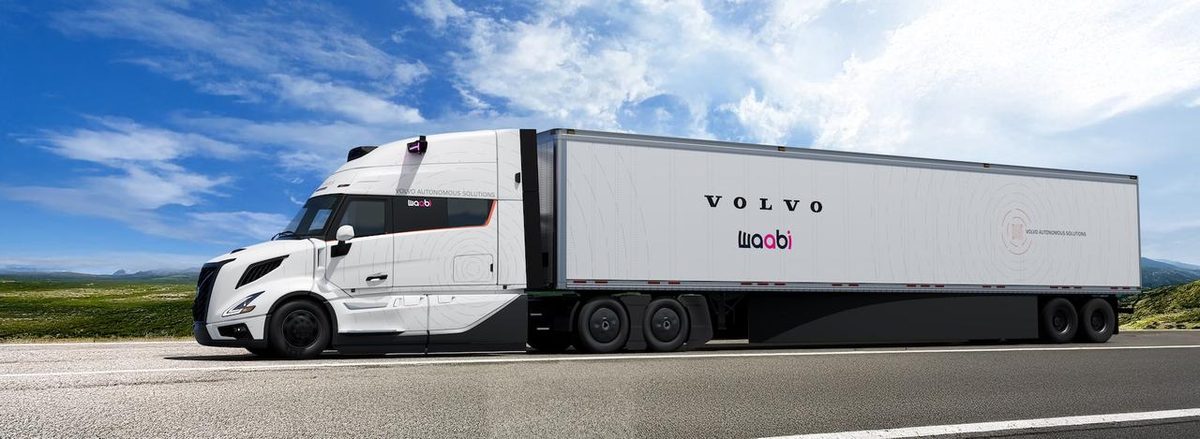
The heavy-hauling landscape just got a serious update. Waabi and Volvo have officially announced a partnership, merging their respective strengths to tackle one of the freight industry’s most stubborn problems: driver shortages. This isn’t just a press release for the sake of optics. It is a strategic alliance aimed at delivering safer, more efficient, and sustainable autonomous transport solutions. By combining Waabi’s software prowess with Volvo’s hardware dominance, they are positioning themselves to challenge established players in the autonomous trucking market.
Integrating the Waabi Driver into Volvo’s Fleet
The core of this collaboration is an “vertical integration” strategy. This means Waabi’s self-driving software, known as the Waabi Driver, is being deeply embedded into Volvo’s existing hardware. Specifically, it will power the Volvo VNL Autonomous, a truck built with redundant safety systems designed to handle operations without human intervention.
These vehicles are not being built in some experimental garage. They will be produced at Volvo’s factory in New River Valley, Virginia. The truck rests on Volvo’s proprietary autonomous technology platform, which is designed to be versatile enough to meet various operational needs and use cases. Waabi’s contribution is crucial here. Their technology allows these autonomous trucks to adapt safely to different road situations. This enhances both safety and efficiency in freight transport.
“By combining Volvo’s expertise in automation and safety with Waabi’s cutting-edge technology, the two companies intend to redefine safety and efficiency standards in autonomous transport.”
This move gives Volvo a concrete alternative to competitors like Tesla with its Semi truck, or Otto, whose trucks have already demonstrated autonomous delivery capabilities. It positions the Volvo-Waabi duo as a serious contender in a market where reliability is everything.
Why This Partnership Matters Now
The freight industry is in a crisis. There is a severe lack of drivers in both North America and Europe. This partnership is a direct response to that vacuum. It is about more than just technology; it is about survival for the logistics sector.
Vol brings decades of experience in building safe, durable trucks. Waabi brings the AI and machine learning capabilities needed to navigate complex real-world driving scenarios. Together, they aim to set new benchmarks for what autonomous trucking can achieve. The goal is to redefine standards, not just meet them.
Testing and Timeline
The companies have set a clear target for the next phase. Testing of this new technology is scheduled to begin in 2025. This timeline is aggressive but realistic given the current state of development.
Starting tests in 2025 opens the door for a broader rollout. It signals a move toward large-scale adoption of autonomous trucks on American roads. This isn’t a distant future concept. It is an imminent shift in how goods will move across the continent.
The success of this partnership will depend on execution. Can Waabi’s software handle the unpredictable nature of highways? Can Volvo’s hardware withstand the long-term wear and tear of autonomous operation? The answers will determine if this alliance reshapes the industry or remains a niche experiment. One thing is certain, the road to fully autonomous freight is about to get a lot more crowded.