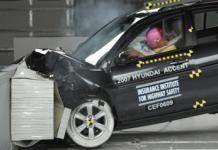
Front airbags have been saving drivers’ lives for decades. It has prevented thousands of deaths since it was standardized in the early 1980s. The speed of this mechanism is frightening. In a head-on collision, the system is triggered within a tenth of a second. This window is just enough time for your brain to process the shock before the bag absorbs it.
Three different components make this possible. The first is the bag itself. Woven from thin nylon fabric, it folds securely into the steering wheel hub or passenger side dashboard. Most people don’t see it until they need it.
The second part is the sensor. The electronic trigger is tuned to detect specific deceleration curves. It only activates if it hits a solid brick wall at 10 to 15 mph (16-24 km/h). It is not triggered by the slightest impact. The threshold is high enough to avoid false alarms, but low enough to detect serious events.
The third element is the inflation system, and this is where chemistry comes into play. Airbags do not use compressed air from a tank. It uses a similar reaction to solid rocket boosters. Sodium azide (NaN3) and potassium nitrate (KNO3) are mixed in the generator.
This chemical reaction is powerful and fast. Large quantities of hot nitrogen gas are produced. The gas expands so quickly that the nylon bag literally bursts through the plastic covering of the steering wheel and dashboard. When your face hits the inflated cushion, the effects have already begun.
Then deflation. It happens almost instantly. The bag is not sealed. It has small holes or vents that allow the gas to escape. This is intentional. If the bag stays completely full, it acts as a solid wall and can do more damage than the impact itself. In about a second, the bag collapses and creates space for movement and rescue.
Airbags save lives not because they are soft, but because they are timely.
The chemistry behind this process is precise. Nitrogen is an inert gas, so it won’t react with your skin or the interior of your car. However, sodium azide is toxic before the reaction. Potassium nitrate speeds up the burning of toxic byproducts, leaving behind most of the nitrogen and solid oxides that the fabric filters out.
For technical details about gas laws and related chemical reactions, analyze stoichiometry with a resource like Gas Laws Save Lives. SaferCar.gov and NHTSA’s official safety guidelines provide information on child safety and proper positioning. General Motors’ Goodwrench video also provides a visual explanation of the mechanical deployment.
Technology has developed. Modern systems use dual-stage inflators, which adjusts the force according to the severity of the crash and the size of the occupants. However, the basic principles are the same. A chemical reaction produces a gas. The gas fills the bag. This bag prevents your head from hitting the steering wheel. It’s simple physics. This is a dangerous chemical reaction. It happens before you can blink.
Why are we still afraid of airbags? Because they are violent. They deploy with the force of a punch. But without this force, the bag won’t expand fast enough. trade-off