The cruise control keeps the speed constant. Lane Assist keeps you in the middle. But the little cameras on your bumper? They just sit there. They are perfect for last-minute driving towards a tight curb, but for the rest of the journey they remain unused when the car is handling the heavy lifting. Why should they collect dust?
We can’t even find all the sensors in your vehicle. Each car manufacturer has its own range of options and uses. Then automatic braking occurs. If the car knows it needs to stop and can, why not let it stop?
These features are not science fiction. They exist now. Some, like cruise controls, have been around for decades with incremental upgrades. As buyers demand safer, cocoon-like vehicles, safety technology previously reserved for premium trims is becoming standard. Automakers may give these kits different names, but the underlying mechanics are largely the same. Manufacturers are creating new systems by combining anti-crash and anti-scratch tools. The latest version is the traffic jam assistance.
Traffic jam assistant mechanics
The traffic jam assistance is intended to make crawling through gridlock less exhausting. It utilizes the vehicle’s existing anti-collision and anti-scratch tools to help the vehicle glide smoothly even in the worst road conditions. It is not a new hardware platform. It’s a layer of software that reuses what you already have.
“Traffic Jam Assist is expected to be available on new Volvo vehicles in 2014.”
This particular implementation is based on the integration of lane-keeping aids and adaptive cruise control. The system does not require the driver to constantly adjust speed or steering inputs during stop and go periods. It handles the micro-adjustments. This reduces the cognitive load. The goal is comfort disguised as safety.
Why are car manufacturers pushing this now
The marketing side is obvious. New features increase sales. But the technical logic is also true. By combining old tools, manufacturers get new safety features without having to reinvent the wheel.
Does this make your commute better? Likely. Does it make you a better driver? No. This means that the car simply does more work. And as these systems become standard, the line between “driver assistance” and “autonomous driving” will blur. We are still a few years away from widespread adoption in 2014, but the direction is clear. The car takes care of the boring parts.
The question is not whether the technology works. It’s about whether you trust it enough to let go of the wheel.
The Logic Behind the Assist
It turns out that the real traffic killer isn’t the traffic jam itself, but the mental fatigue of watching the brake lights in front of you flash red for hours on end. Volvo’s answer is to remove the driver from the equation entirely, at least at low speeds. This is not about autonomy in the science fiction sense. It’s about survival in the parking lot.
The system, often called traffic jam assist, is only activated when the speed drops below 31 mph (about 49.9 km/h). Besides that, you’re on your own again. It is essentially an extension of the Adaptive Cruise Control and Lane Keeping Aid technologies that Volvo introduced in the 2012 model year. The two functions now communicate with each other. One handles the longitudinal distance to the car in front. The other takes care of the lateral direction and makes sure you stay in the middle of the lane.
“The goal… is to make driving more relaxing.”
This combination allows the car to imitate the movements of the vehicle in front. When the car goes around a pothole, your Volvo recognizes the tire tracks and reflects the movement. It controls the throttle, brakes and steering rack. You press a button and give up control.
How other manufacturers deal with traffic congestion
Volvo is not the only one trying to solve this problem. Audi, Volkswagen, Cadillac, Mercedes-Benz and Ford all use similar systems. However, the details of implementation vary considerably, especially with regard to driver engagement.
Mercedes requires constant physical contact. Their system uses sensors on the steering wheel to recognize hands. Remove them and the system will be disabled. That’s a hard limit.
Ford has a different approach. Their system monitors the environment. If it detects erratic behavior in adjacent lanes or erratic speeds, it just won’t hold the line. It provides audio warnings that prompt the driver to regain control. Volvo’s approach is more passive and focuses on gentle, predictable support rather than aggressive intervention.
Safety or luxury?
Volvo markets this as a safety feature. The logic makes sense: fewer sudden stops and starts means fewer rear-end collisions in stop-and-go traffic. They tested prototypes with consumers for over a year and refined the feedback loops to match actual expectations.
Still, the company admits that customer demand has driven this development. It’s a luxury. Comfort. It uses safety technology to create comfort.
There is a secondary benefit that is more difficult to measure. By smoothing the flow of traffic, this technology could actually reduce congestion. It addresses the symptoms of human error rather than the root cause of limited infrastructure. Whether that’s enough to clear the freeway remains to be seen.
Trust the machine
The real question is not whether the technology works. It’s about whether you can let go.
Driving requires instinct. You feel the weight of the car shift. You feel the gap. Traffic Jam Assist removes this sensory input. Sit down. You watch the steering wheel turn by itself. It’s quiet. It’s efficient.
For some, it’s also scary.
The system is designed to be transparent. It shows you what it sees. It explains why it steers to the left or brakes softly. But trust is a binary switch. You either believe the sensors are more accurate than your eyes, or you don’t.
Volvo relies on the former. They’ve built a cage of sensors and algorithms to protect you from the chaos of the commute. The question is, will you step inside it?
SARTRE Road Train reality
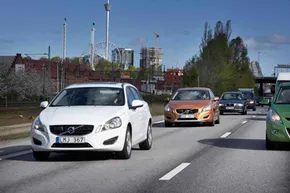
Volvo didn’t just guess that the traffic jam assistant would work. They did tests. Real. The goal was simple: to see if the technology could really alleviate the misery of the gridlock. This brings us to the SARTRE project. The name sounds like it applies to massive Australian road trains, but Volvo’s definition is narrower. Here, “road train” is a convoy of passenger cars. They use advanced cruise control systems to follow each other along a pre-planned path.
Drivers participate in this stream via touch screen. You give the commands to join or leave. They communicate with other cars in the queue. But once you’re in, you’re largely out of the driving game. The system takes over the load. It’s not magic. It is a stack of existing safety tools. Adaptive cruise control. Blind spot monitoring. Park assist. These are not experimental prototypes. These are proven technologies that Volvo’s internal diagnostics can read with terrifying precision.
The results were startling. In some test runs, the cars maintained a bumper-to-bumper safety distance of less than 13 feet (3.9 m). It’s tight. It is aggressive. But it worked.
Why Europe? Why not the US?
Volvo sees these volvo traffic jam assist as a viable alternative to public transport. You get the privacy of your own car with the convenience of automation. It saves energy. It takes up less road space than a dispersed group of individual drivers. However, there are caveats. You can’t just hop into the northbound line of cars. The train must be scheduled. It has to be coordinated. It must be driven by a professional driver.
There are still questions. How does the convoy handle an unexpected road disaster? How does it react to chaos? So far, Volvo’s tests have been exclusively European. It is unclear whether this concept will be successful in the United States.
Part of this hesitation is regulation. US safety regulations are a disjointed mess. They have federal standards. Then there are state-level rules that add additional restrictions. Every car sold in a given state must meet these local standards. This is a nightmare for a car manufacturer. Developing new technologies becomes almost impossible when the finish line is constantly changing. Sometimes a ubiquitous innovation fails in a restrictive market.
Europe is easier for Volvo. It’s their home turf. The regulatory landscape is more navigable. They had to make sure the tools worked before custom-calibrating them for other areas. But the US is still a wild card.
Autonomous Endgame
If this sounds like a detour, it’s not. The ultimate goal is fully autonomous driving. A car that moves with as little human intervention as possible. Volvo cites studies suggesting about half of all drivers would be comfortable in a self-driving vehicle. There is also a practical reason for this push: distractions. Texting. Calls. The potential to reduce accidents by eliminating human error is enormous.
Volvo quickly makes one thing clear. This technology does not replace driver judgment. If the driver touches the controls, they override the automation. Always. Provided, of course, that the driver is awake.
The progress of recent years has eclipsed decades of stagnation. Automakers are moving faster than they admit. But the pace is deliberate. It’s controlled. Why? Because sudden leaps are dangerous. If we went from simple cruise control to fully self-driving cars overnight, people would be terrified. They wouldn’t try. They would reject it.
By gradually introducing features, regulators and consumers can adapt. Traffic jam assistance is the next step. It is meant to close the gap. When it hits the road in 2014, consumers should be ready. But prepared for what exactly? The line between assisted and autonomous is blurring day by day. We’re just along for the ride.