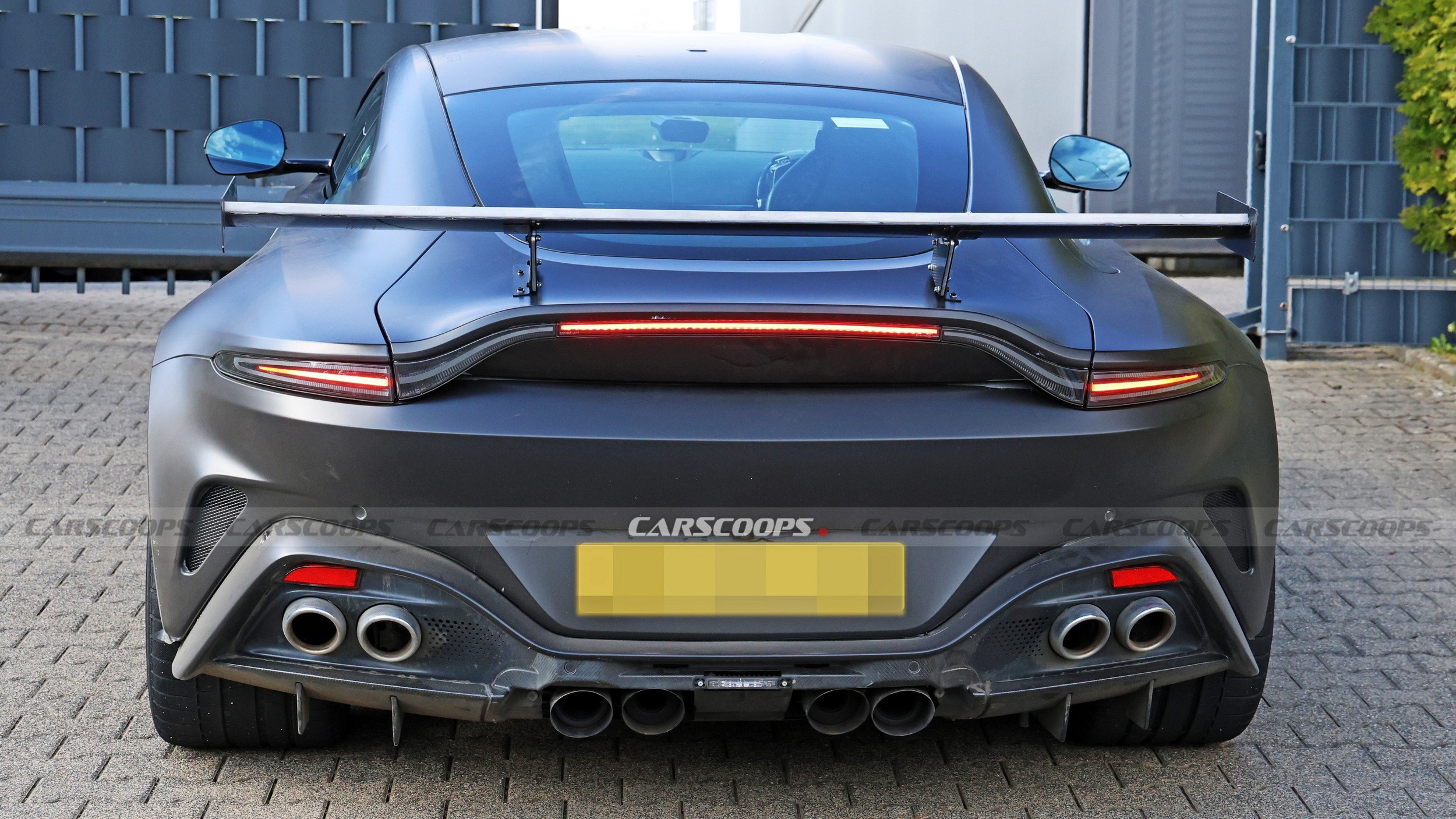
A new Aston Martin prototype has been captured undergoing rigorous testing at the Nürburgring, signaling the development of a more aggressive, track-focused evolution of the current Vantage. The test vehicle, sporting a distinctive eight-exhaust pipe configuration and a fixed rear wing, suggests that the British automaker is preparing to push the boundaries of its entry-level sports car.
Decoding the Visual Clues
At first glance, the exhaust setup appears radical. However, in the world of automotive prototyping, appearances can be deceptive. It is highly probable that the eight tailpipes are not all functional.
- The Likely Setup: The four central pipes, which already show signs of heat discoloration, are almost certainly the true exhaust outlets.
- The “Fake” Pipes: The outer four pipes likely serve as placeholders or aesthetic carry-overs from the standard Vantage model to maintain a familiar silhouette during early testing.
Beyond the exhaust, several key aerodynamic and structural changes distinguish this prototype from the standard production model:
* Enhanced Aerodynamics: A more pronounced front splitter and a prominent, fixed rear wing designed to increase downforce.
* Performance Hardware: The car features 21-inch Y-spoke forged alloy wheels, paired with drilled brake discs and high-performance green calipers.
* Revised Bodywork: While it currently uses standard Vantage bumpers, the production version is expected to feature a bespoke body kit and a more aggressive rear diffuser.
Performance and Engineering Expectations
While Aston Martin has not officially confirmed the specifications, the technical direction of this project is becoming clearer.
The current Vantage lineup relies on an AMG-sourced 4.0-liter twin-turbo V8. While the standard Vantage produces 656 hp and the Vantage S reaches 671 hp, the engine’s architecture suggests there is significant headroom for further power increases.
The most critical upgrades may not be under the hood, but beneath the chassis. The prototype is likely receiving a specialized suspension setup tuned for the circuit. There is strong speculation that this development is being overseen by Aston Martin Racing (AMR), the division responsible for the brand’s successful GT3 and GT4 race cars. This would align the road car more closely with its racing counterparts, offering a more direct connection between driver and track.
Why This Matters
This development reflects a broader trend in the high-performance automotive market: the “de-tuning” of road cars is over. Manufacturers are increasingly creating “halo” versions of their base models to satisfy a growing demand for track-ready, road-legal machines. For Aston Martin, a high-performance Vantage serves two purposes: it reinforces the brand’s racing pedigree and provides a more accessible way for enthusiasts to experience the performance of their more expensive hypercars.
Whether this model will carry the official AMR branding —similar to upcoming performance variants of the DB12—remains to be seen. However, the presence of this prototype suggests a limited-run, highly specialized sports car could arrive within the next two years.
The testing of this prototype indicates that Aston Martin is moving toward a more specialized, track-centric identity for the Vantage, bridging the gap between daily drivers and dedicated race cars.