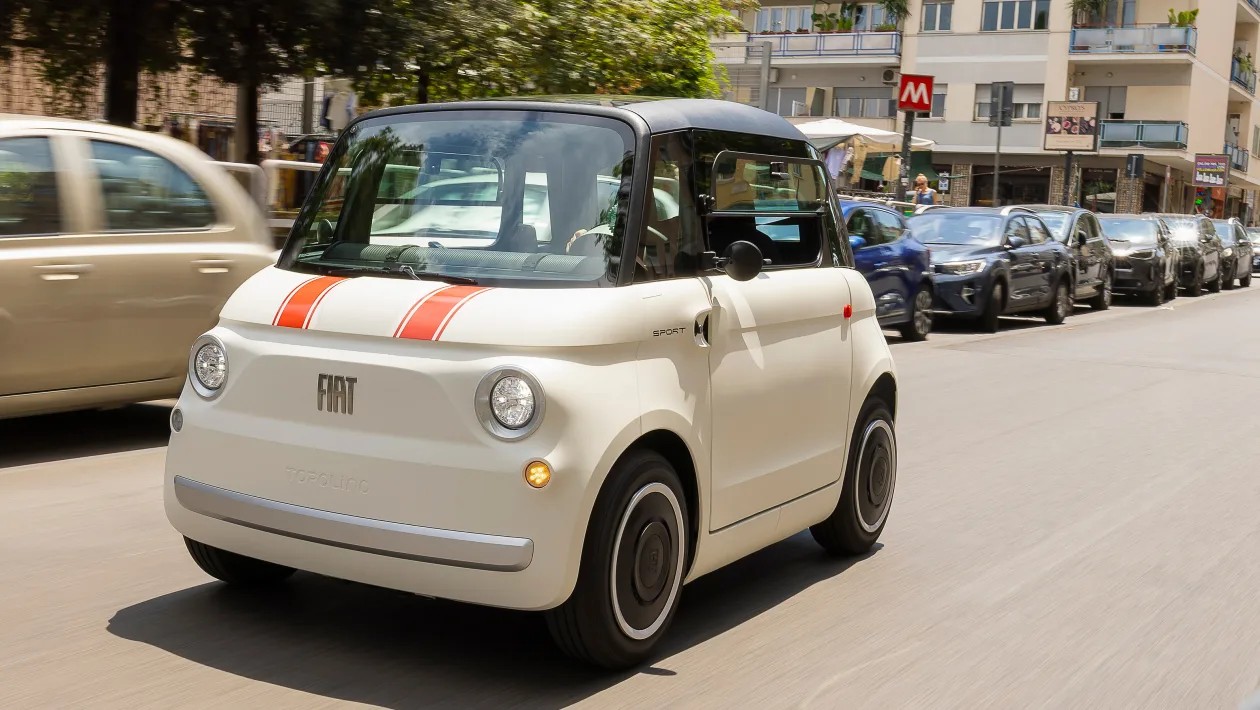
Cheap cars are supposed to be practical. Useful. The kind of thing you drive to buy milk when your main car is in the shop. The Fiat Topolino defies that logic.
It costs £9,000. That’s pocket change for the super-rich or a rounding error for fleet buyers who don’t think about depreciation. For the rest of us, it’s a luxury purchase wrapped in quadricycle legislation.
Who is this for?
Hardly anyone with actual driving needs. But for sheer, unadulterated joy, it has a case. A fragile one, sure, but it exists.
Not technically a car
Let’s clear up the nomenclature. In Europe, the Topolino isn’t a car. It’s a quadricycle. That regulatory loophole allows it to sidestep many safety and emission rules that bog down “proper” vehicles. It shares its bones, its battery, and its motor with the Citroën Ami. Same chassis. Same limitations.
Fiat dressed it up though. The design borrows heavily from the original 1936–1955 Fiat Topolino (meaning “Little Mouse”). It looks chic. In the context of Rome’s chaotic streets or Vatican City’s tight alleys, it feels like it belongs. Drop it in a suburb and it looks like a lost golf cart.
Which it basically is. We tried one on a UK course first. Then Rome. The latter was the proper test.
The specs that won’t surprise you
Range? 46 miles.
Battery? 5.5kWh.
Power? 8bhp.
Top speed? 28mph.
It’s the Ami’s numbers with a different paint job. The charge time is glacial, taking four hours on a maxed-out 2.3kW charger. You cannot leave the city with this thing. Do not attempt it.
Driving a brick
Unsurprisingly, the drive mirrors the Citroën. It’s funny until you hit an incline or need to overtake.
The throttle pedal actually has some decent calibration, a surprise given the price point.
The steering, however, is raw. No assistance. It doesn’t self-center. It feels unpolished, almost naive, yet surprisingly light. That combination makes the car feel oddly mature for what it is, or at least coherent.
The suspension is stiff. Rigid. Bumps are transmitted directly through the seat and floor. There is no sound insulation either. An electric motor is silent, yes, but the outside world screams through the cabin. Pass a truck and your teeth rattle. It is unpleasant at any speed.
Interior life
Striped box on the dash instead of a glove box? Sure. Handbang stripes inside the “Dolce Vita” compartment? A nice touch.
Air conditioning? Absent.
Fiat threw in a removable fan mounted to the dash. At 35 degrees Celsius in Rome, that fan wasn’t a gadget, it was survival gear. The seats slide but don’t bolster you. If you’re lucky, the doors keep you in when cornering.
The turning circle is 7.2 meters. The wheelbase is 1.73 meters. Parking in Rome wasn’t just easy; it was trivial. This is the Topolino’s killer app. Narrow streets where SUVs fear to tread? This thing fits.
The awkward market fit
Who buys this? Fleets mostly. Hotel shuttles, airport transfers (Luton Airport uses Ami vehicles already), theme parks, Vatican officials looking for cute popemobiles.
Private buyers will be few. At £9k, the Dacia Spring or Leapmotor T03 are cheaper, proper cars with real ranges and speeds.
The Topolino remains a toy. A stylish, Italian-designed toy with a limited shelf life and a niche appeal. You can buy the roof sunblind or a rear luggage rack (the latter essential, as the cargo space barely holds a rucksack), but you’re paying for charm.
Charm doesn’t pay the electric bill. But on a summer morning, cruising slowly through cobblestone streets with nothing to lose and nowhere to be in a hurry
what if you just let the world buzz by