The era of the budget-friendly convertible is rapidly fading from the automotive landscape. Where once car catalogs were filled with affordable drop-tops—often repurposed from humble hatchbacks—the market has shifted. The “Juke effect” has seen drivers migrate toward crossovers, trading the open air for the elevated seating position and panoramic glass roofs of SUVs.
However, two stalwarts remain, offering a final chance to enjoy the sun (or, in this case, the snow) without breaking the bank.
The Survivors: Mazda vs. Mini
In a market dominated by high-riding crossovers, two manufacturers continue to champion the traditional roadster and cabriolet formats for under £30,000.
The Purist’s Choice: Mazda MX-5
The Mazda MX-5 has been a cornerstone of the enthusiast market since the late 1980s. Now in its fourth generation, it remains a benchmark for driver engagement.
– Price: Starting at £28,585 for the 1.5-litre Prime-Line (130bhp).
– Value: When adjusted for inflation, the current entry price represents a genuine bargain.
– Character: It remains the gold standard for lightweight, rear-wheel-drive fun.
The Practical Alternative: BMW Mini Convertible
The Mini has offered a folding soft-top since 2004 and has recently entered its fourth generation. While it lacks the pure driving dynamics of the Mazda, it offers a different kind of utility.
– Price: The 161bhp Cooper C (2.0-litre turbo) starts at £28,955.
– Versatility: Unlike the MX-5, the Mini provides usable rear seats and a larger boot, making it a more viable daily driver.
– The Trade-off: The Mini utilizes a front-wheel-drive layout and an automatic-only transmission, prioritizing ease of use over raw handling.
Testing the Limits: A Swedish Winter Mission
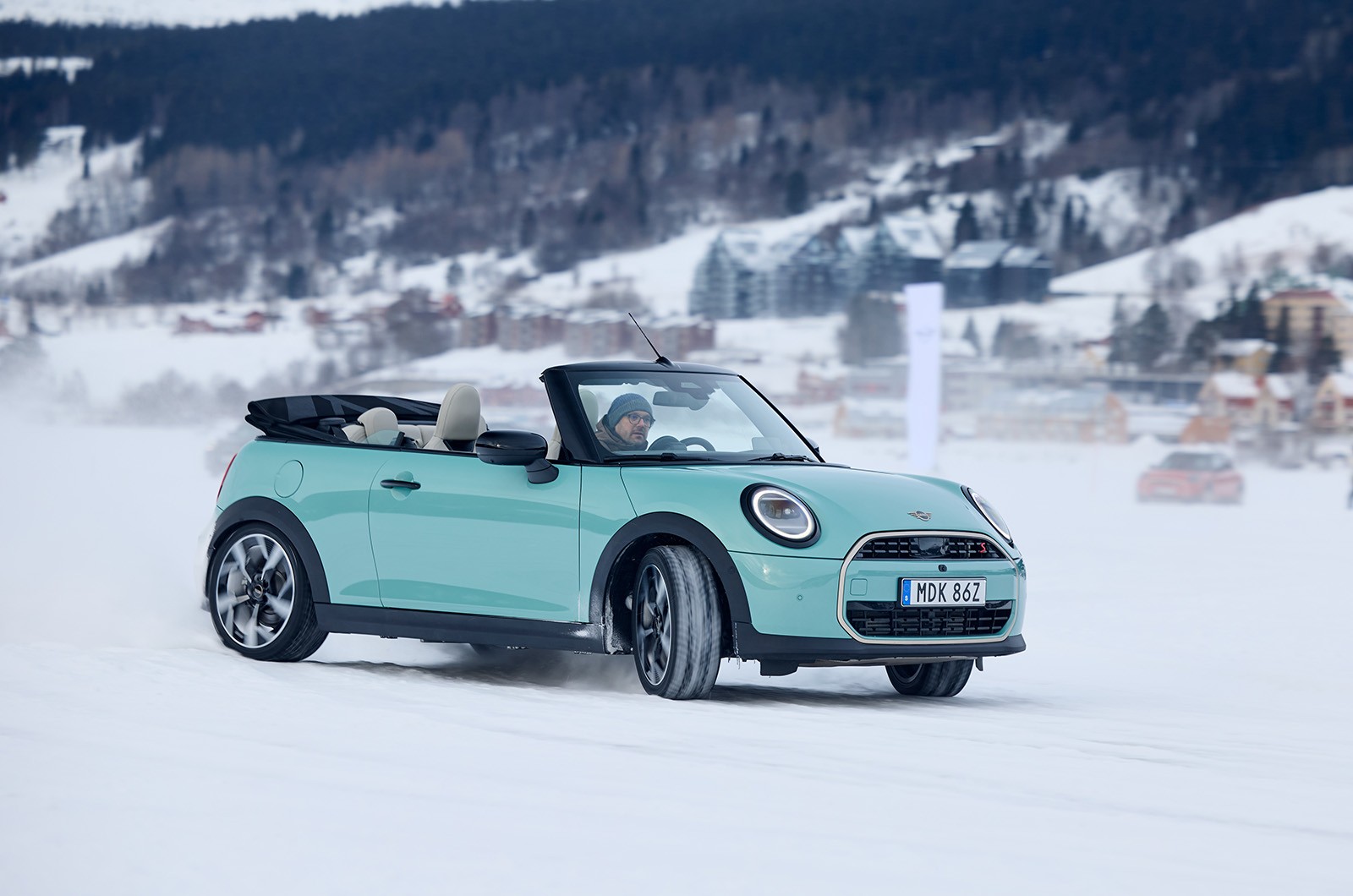
To truly test the character of the new Mini, we are heading to Sweden. While most owners keep their roofs up to preserve cabin warmth, we are doing the opposite.
We are testing a 201bhp Cooper S, equipped with specialized Nokian Hakkapeliitta studded tires to handle the sub-zero temperatures. The goal is to see how a modern, tech-heavy convertible performs in extreme conditions where “top-down” driving is usually considered madness.
The Mini’s infotainment system even features an “Always Open Timer,” which currently shows this specific test car has had its roof retracted for nearly 22 hours straight.
Why This Matters
The disappearance of affordable convertibles is more than just a change in styling; it marks a fundamental shift in consumer priorities. As manufacturers move toward more profitable, high-riding segments, the specialized joy of a lightweight, open-top car is becoming a niche luxury rather than a mainstream option.
The Mini and the MX-5 represent the final frontier for drivers who prioritize the sensory experience of the road over the perceived safety and utility of a crossover.
Conclusion
As the automotive industry pivots toward SUVs, the Mazda MX-5 and Mini Convertible stand as rare, accessible survivors of a disappearing breed. They offer a final opportunity to experience true open-air motoring before the segment vanishes entirely.