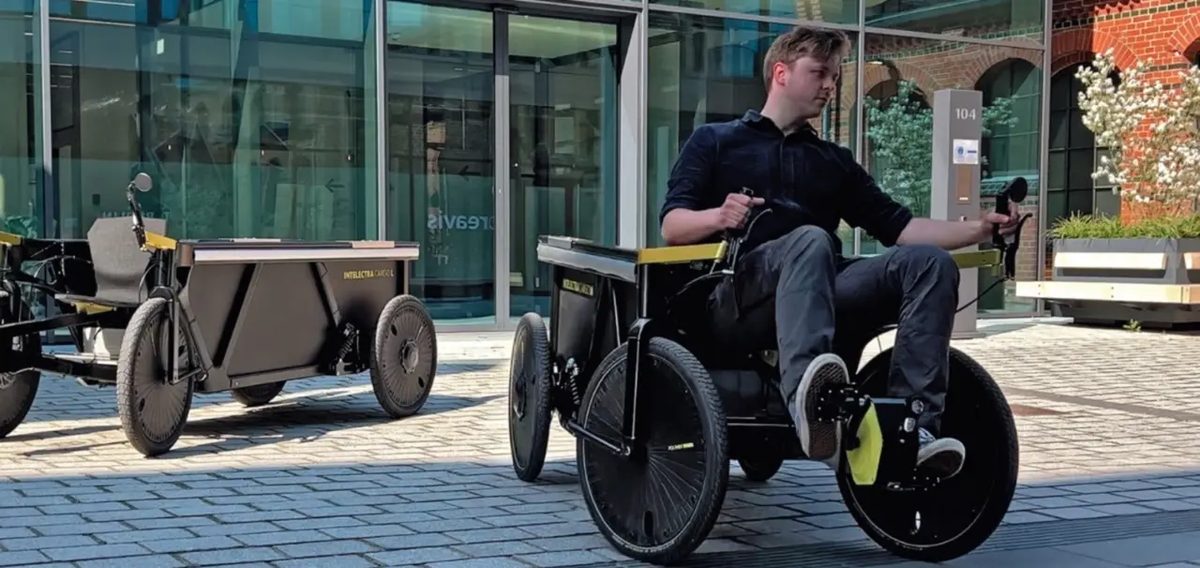
Most people think of electric cargo bikes as simply modified tricycles or strollers for school rides. Dynamic Drives Intelectra, a Giessen, Germany-based startup, declined to respond to a request. It sits in the awkward middle ground of being half vehicle, half trailer, and completely utilitarian. A four-wheel pedal cargo bike designed to pull a payload of over 450 kg. The weight of the machine itself is 122 kg. It only needs to weigh around 328kg before you have to worry about tipping over or breaking an axle.
You might think that the rider’s legs do the heavy lifting. it is not. not much. Intelectra uses a smart but somewhat intuitive transmission. When you press the pedals, you don’t turn the steering wheel directly. Rather, your effort turns the dynamo. With this setting, you can get up to 250 watts of energy from your feet.
Where does this energy go? Equipped with a 1400 Wh battery.
The battery is powered by two 125 W hub motors mounted on the rear axle. The actual driving force is obtained from the engine. When you pedal harder, the intelligent controller converts the higher pedaling speed into increased motor power. This system uses human effort efficiently to charge the batteries that keep you going. Sounds very inefficient. This is actually an elegant way to extend the range and control the power supply.
Instead of directly driving the wheels, Intelectra uses pedal power to charge the battery and create its own hybrid power circuit.
Downloading is another story. The battery in the device can be fully charged in just 1 hour and 30 minutes using a standard socket. The distance when fully charged is about 93 kilometers. This is important for a vehicle of this size. Regenerative braking returns energy to the battery during deceleration. You constantly get back potential energy.
Why is it built this way? Direct drive pedals have dead zones. When you stop pedaling, the movement also stops. Intelectra separates the human contribution from the spinning of the wheels. Gives energy to the battery. The battery provides torque to the engine. This allows for smoother acceleration and better control of heavy loads carried by the load. It’s more than just a bicycle. More than a pallet with pedals.
Dynamic Drives appeals to the idea that people are willing to pay for the flexibility of transporting large amounts of cargo without having to tow a trailer or look for license plates on a full-size van. In most jurisdictions, Intelectra does not require a driver’s license. No need for a garage. You have to be willing to pedal to keep the lights on and the wheels turning.
The design choice emphasizes a change in thinking about last-mile logistics. You don’t need an internal combustion engine to move 450 kg. We need efficiency. And a lot of patience. The riders are still training. The difference is that exercise is measured in accumulated watt-hours and not just in the distance walked.
It doesn’t apply to everyone. Handling feels different when pulling a truck full of building materials and furniture. The focus shifts. The braking distance increases. But for the city
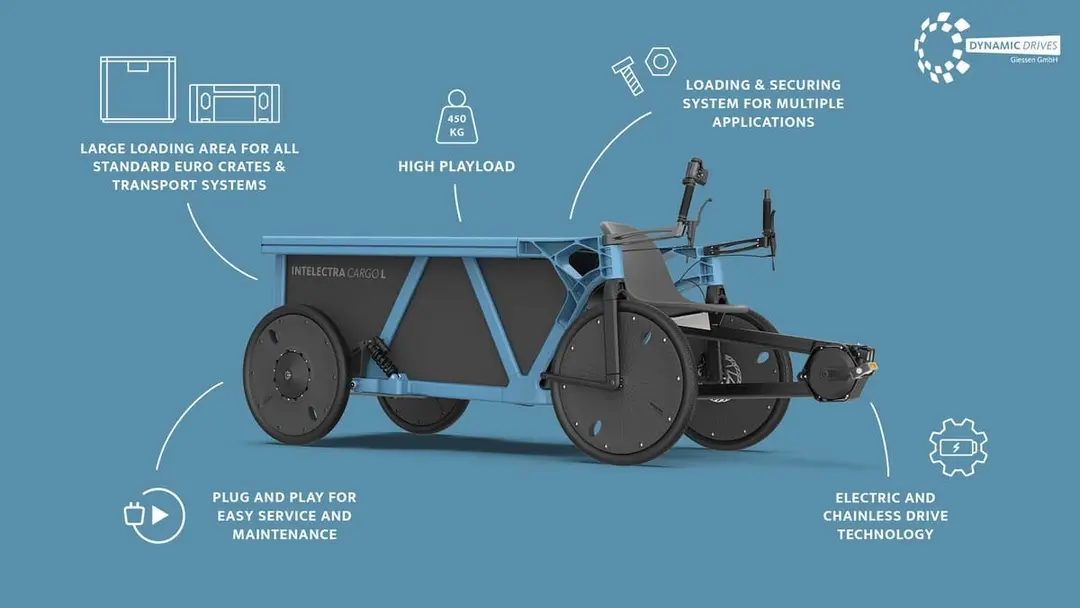
Rear wheel drive regenerative braking and front seats
The layout is flipped. You sit in the front. The driver’s seat is in front of the luggage, not behind it. To change direction, grab the handlebars attached to either side of the seat. It feels more like driving a special vehicle than riding a bicycle. The back of the large trunk is reinforced with an aluminum frame. The rear suspension adjusts automatically according to the load. The heavier the load, the stronger the support. Light loads stay softer. This ensures stable driving without manual adjustments.
Regenerative braking plays an important role here. The rear wheels are responsible for driving and use regeneration to effectively slow the vehicle down. This setting minimizes wear. No chain. There is no belt. Traditional transmission systems do not degrade over time. The manufacturer claims that Intelectra requires little maintenance. They can travel 30,000 kilometers before needing major repairs. Maintenance costs are significantly lower compared to internal combustion engines and complex transmission systems.
The road is narrow and there is little traffic.
Why build a vehicle in tight spaces? Because city roads are often impassable for normal trucks. Intelectra goes where trucks can’t. It also accesses alleys and pedestrian areas where large logistics vehicles cannot. Speed is not a priority here. The maximum speed must not exceed 25 km/h. This is consistent with restrictions on e-bikes in many jurisdictions. It is designed to be slow. Safety and maneuverability come before speed.
The vehicle replaces traditional delivery vans in densely populated urban areas. You can turn corners faster. Parking is easy. Avoid situations where a large number of vehicles slow down due to traffic jams. No gearbox means less moving parts to break. This reliability is very important for commercial operators who cannot afford downtime.
Prices and options
Deliveries are scheduled to start this fall. The basic price is 9,250 euros. This number identifies the nuclear vehicle. Does not include extra batteries. On long-distance routes, one or two additional power sources may be needed. Adding options can quickly increase costs. You can carry an assistant or additional luggage on the passenger seat. The roof provides additional coverage and gives the Intelectra a strange, almost wild west station wagon look. It is both functional and unique in appearance.
Intelectra offers a unique solution to last mile delivery challenges. The design of the front seat and the rear drive solution offer stability and ease of use. The regenerative braking system increases efficiency. Low maintenance requirements reduce long-term costs. Although they are not suitable for high-speed transport, they can move in tight spaces, which makes them indispensable in urban environments. The combination of affordability, reliability and accessibility makes it a strong contender in the growing electric vehicle market. Whether this will reshape urban logistics remains to be seen, but the design is certainly striking.