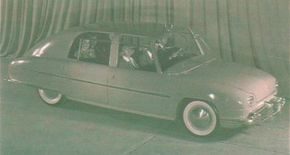
The war ended. The skies went quiet. And Beech Aircraft Corporation, suddenly staring down the barrel of a post-war recession with no military orders to save them, decided to pivot. They dipped a toe into the automotive market with the 1946 Beechcraft Plainsman concept car. It was their only attempt. It was also a desperate gamble for corporate survival.
This wasn’t some random corporate whim. The crossover between aviation and automobiles has a long, messy history. Henry Ford didn’t just build the Model T. He built the Tri-Motor “Tin Goose” passenger plane. It wasn’t a hobby. It launched regular U.S. airline service in the 1920s. BMW? They made aero engines before they ever assembled a chassis. Bristol in England didn’t enter the car business until the late 1940s, and they did it using prewar BMW technology. Daimler-Benz, Hispano-Suiza, Rolls-Royce—they all danced between the runway and the road.
So the 1946 Beechcraft Plainsman wasn’t an anomaly. It was an aircraft manufacturer’s literal idea of what a car should be.
Why Beechcraft Entered the Auto Market
Development started in late 1945. V-J Day had just happened. America was high on victory and starving for metal. Consumers had been denied new personal vehicles for nearly four years. The market was a frenzied seller’s paradise.
It attracted every wannabe auto tycoon with enough cash and enough hubris to think they could beat Detroit. Beech wasn’t just playing with fire. They were trying to stay warm. Like other aviation firms in ’45 and ’46, they faced a future with zero new contracts and bleak prospects for civilian flight sales.
The company spent $50,000 to design this “super-modern” passenger car. The goal was simple. Save the corporate neck. If airplane sales stayed grounded, maybe the car would keep the lights on. Maybe it would teach Detroit a thing or two.
The 1946 Beechcraft Plainsman Concept Car Styling
The Plainsman surfaced in 1946. It looked like those wildly predictive “cars of the future” that used to staple the pages of wartime and postwar tech magazines. Novel? Absolutely. But the novelty wasn’t just for show. It was a functional response to a company that needed to survive.
The design wasn’t just about aesthetics. It was about engineering heritage. Beech had spent decades mastering aerodynamics, lightweight structures, and precision manufacturing. They applied that logic to a two-door sedan. The result was a vehicle that prioritized airflow and structural integrity over the chrome-heavy excesses of the era.
It was a bold move. A risky one. And ultimately, it didn’t save the company from its aviation roots. But for a brief moment in 1946, you could buy a car built by the same people who built warbirds.
“An aircraft manufacturer’s idea of what an automobile should be.”
The Plainsman didn’t go into production. But it remains a fascinating artifact of a time when the boundaries between flight and ground transport were far more porous. It was a concept car born from necessity, not marketing.
For more on concept cars and the production models they forecast, check out:
-
Concept Cars
-
Future Cars
-
Consumer Guide auto show reports
-
Classic Cars
The Beechcraft Plainsman: Aviation Glass in a Sea of Chrome
The 1946 Beechcraft Plainsman concept car didn’t just borrow from airplane design. It practically lived inside a hangar. Built by the aviation giant Beechcraft, this styling exercise mixed automotive ambition with aerospace aesthetics. The result? A car that looked like it could take off, but landed with a thud.
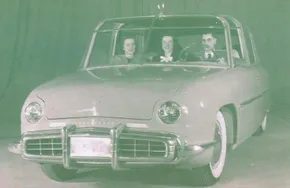
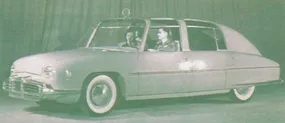
The most immediate thing you’d notice is the greenhouse. It was tall. Towering. Designed to give the driver upward visibility, the cabin featured auxiliary panes above the main windshield and door windows. Thin bars separated these sections, wrapping around from one back door to the other like a cage. The windshield itself was divided but curved radically both outward and upward. It screamed cockpit. It didn’t scream passenger car.
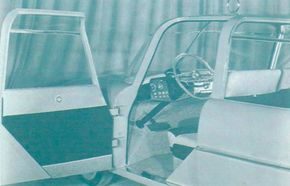
Doors were cut into the roof to make entry and exit easier. This suicide-door configuration foreshadowed the Tucker and, much later, the 1963 Corvette Sting Ray coupe. The high roofline provided towering headroom, even with chair-high seats. The rangy external dimensions gave plenty of maneuvering room for the shoulders, elbows, and legs of six adults.
The bench-type driver’s seat offered four-way electric adjustment, still a novelty in 1946. To the right of that seat was a separate two-person “double lounge.”
Even more than spaciousness, the 1946 Beechcraft Plainsman interior stressed safety and simplicity. Door panels, for example, were flat and protrusion-free. (Solenoid-activated pushbuttons substituted for conventional door handles both inside and out.)
Instruments and controls were sensibly grouped around the steering wheel in an otherwise spare-looking dash, though Beech planned to include an “economy meter” giving a continuous mpg reading, and even a two-way mobile telephone (hence the circular roof-mount antenna). The speedometer was in direct driver view above the steering column in a small, black, hooded pod.
There were no seatbelts — surprising for an aircraft maker — but leather-covered rubber “crash pads” adorned the dash and the tops of the front seats. The roof structure was allegedly quite strong despite its slim A-pillars, which also aided visibility — a safety plus.
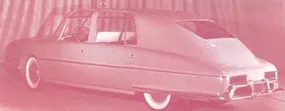
The rear view of the 1946 Beechcraft Plainsman was not a beauty to behold. Those “blind” roof quarters made the back end look bulky, and the tiny rear window? It was practically a slit. This created a bizarre paradox. The designers were obsessed with visibility to the sides and ahead, yet they sacrificed rearward sightlines entirely. You couldn’t see where you were going when backing up. It was a design flaw that felt odd for a vehicle that claimed to be the future.
Aerodynamics vs. Reality
Apart from that towering roofline, the Beechcraft Plainsman fit right into the late-1940s mold of the “bathtub” car style. Everything was rounded, smooth, and enclosed. But this wasn’t just for looks.
Wind-tunnel tests confirmed what the curves suggested: the Plainsman had legitimate aerodynamic efficiency. The air moved over it cleanly. It was designed to slice through the atmosphere better than the boxy sedans of the era. The goal was clear. Reduce drag. Increase speed without adding horsepower.
Performance Expectations
The concept car promised more than just style points. The aerodynamic shell was intended to boost fuel economy and high-speed stability. In the mid-1940s, efficiency was a major selling point. Materials were scarce. Gas was rationed. A car that could do more with less was the dream.
The Beechcraft Plainsman embodied this dream. Its streamlined body wasn’t just aesthetic. It was functional. The rounded lines reduced air resistance significantly. This meant lower drag coefficients. Lower drag meant better highway performance. It was a forward-thinking approach to automotive engineering.
However, the concept never made it to production. The post-war automotive landscape shifted rapidly. Consumers wanted style, yes, but also practicality. The Plainsman’s blind rear window and cramped visibility were deal-breakers for the average driver. Its aerodynamic advantages were compelling in a test tunnel, but they didn’t solve the fundamental issue of daily usability.
The car remains a fascinating artifact of a time when aerospace technology met automotive design. Beechcraft brought their plane-building skills to the road. The result was a vehicle that looked faster than it could ever be. The aerodynamics were real. The execution, in terms of market viability, was not.
The One-Off That Never Left the Garage
Beechcraft didn’t just make planes. They tried to make cars too. The 1946 Beechcraft Plainsman concept car promised a 160 mph top speed and 30 mpg fuel economy. Those numbers were insane for the era. They were also entirely theoretical.
Only one prototype existed. It never saw a full performance test. The car died in the garage before it could prove its worth.
Yet the engineering inside that single unit was years ahead of its time. Most observers expected a rear-engine layout because of the rear-mounted engine. It used an air-cooled, horizontally opposed four-cylinder adapted directly from Beech’s aircraft engines.
But the packaging suggested something weirder.
Electric Drive Without a Differential
There was plenty of room for that engine up front. Beech planned to mount it there to feed an innovative four-wheel electric drive system. This setup eliminated the differential. It removed the propshaft. It got rid of the clutch and the transmission.
No transmission meant no tunnel. No interior floor hump meant more legroom for passengers.
The exact mechanics of this patented system were never fully disclosed. Likely because it was protected by patent law, details remain sparse. What we know is that the engine drove a generator. That generator sat in a soundproof compartment.
“Wheel control was evidently independent.”
Beech claimed this electric drive offered two major advantages. First, automatic torque apportioning to wheels with better grip. Call it embryonic traction control by any other name. Second, a “reverse current” feature. Stepping on the brake activated dynamic braking. It was a sort of early anti-lock system.
Standard hydraulic drum brakes still existed. You just had to push the pedal slightly harder to engage them.
Air Shocks That Read the Road
The suspension was only slightly less radical than the drivetrain.
Detroit later became famous for “air ride” setups using flexible rubber bladders. The Beechcraft Plainsman used aircraft-type air shocks instead. These adjusted damping automatically based on load and weight distribution.
A manual override switch allowed drivers to select a softer setting. This ensured a smoother ride on very rough roads. The damping rate was likely varied by the electric generator itself.
Lightweight Aluminum and Wind Tunnel Data
Beechcraft came from aviation. They knew weight was the enemy. They knew drag was the thief.
They chose aluminum for the exterior panels and inner structure. The shape was tested in a wind tunnel. The results were impressive for a car that didn’t look particularly sporty.
Beech engineers credited the efficiency to the electric drive. Styling alone wouldn’t have achieved those numbers. The body hardly looked “wind-cheating.” But the electric powertrain did the heavy lifting.
At a steady 60 mph, the Plainsman returned more than 25 mpg. In town speeds, it hit 30 mpg. It would top 160 mph despite the small engine.
We’ll never know if the prototype could actually do these things. The car sat idle. The patent expired. The idea vanished into the annals of automotive “what-ifs.”
One car. One set of specs. Zero track time.
The Ghost on the Assembly Line
It promised to be the future of driving. The marketing copy was bold, claiming acceleration was “considerably greater than that of the best conventional automobiles.” In the post-war haze of 1946, that wasn’t just a claim. It was a promise of a new era. But promises don’t build factories.
The Beechcraft Plainsman never saw a production line. It never touched a showroom floor. It remained exactly what it was: a concept. A gleaming piece of aluminum and ambition that hovered above reality like a prototype that forgot to come down.
Why did it die? The reasons are a mix of engineering hubris and economic reality. The car relied on a turbine engine that, while promising on paper, was a nightmare to maintain. It lacked torque at low speeds. It guzzled fuel. And in 1946, the American public wasn’t ready to trade the reliability of a carbureted V8 for the whining jet engine of the future.
Why the Plainsman Failed to Launch
The Turbine Problem
Beechcraft was an airplane manufacturer. They built planes. They knew how to make things fly. They did not know how to make things crawl.
The turbine engine was the heart of the Plainsman. It was smooth. It was powerful. But it was also inefficient at idle. Modern drivers understand that most driving happens in stop-and-go traffic. The turbine hated it. It required massive airflow to spool up. The result? A car that was slow to launch and thirsty in the city.
“The turbine offered power, but it lacked the low-end punch that defined American driving.”
Economic Realities
Post-war America was changing. The war had ended. Factories were switching back to consumer goods. But the cost of production was high. The Plainsman required specialized manufacturing techniques. Aluminum body panels. Complex turbine integration. It was expensive to build.
Meanwhile, companies like Ford, GM, and Chrysler were mass-producing vehicles on established lines. They had economies of scale. They had dealer networks. They had trust. The Plainsman had none of these. It was a one-off experiment in a market that wanted predictability.
The Design Was Too Far Ahead
The styling was sleek. The wings were inspired by the P-51 Mustang. The cabin was futuristic. But it was also unconventional. The steering wheel was small. The seats were low. The visibility was poor. It didn’t look like a car. It looked like a cockpit.
Consumers weren’t ready to sit in a cockpit. They wanted comfort. They wanted familiarity. The Plainsman offered neither. It was a bold statement. But bold statements don’t sell cars. Familiarity does.
The Legacy of the Plainsman
The Beechcraft Plainsman is a footnote. A curiosity. A “what if” that never was. It sits in museum archives as a reminder of a time when car companies looked to the skies for inspiration.
But it also serves as a cautionary tale. Technology alone doesn’t drive adoption. Market needs do. Engineering elegance doesn’t sell cars. Reliability does. The Plainsman was ahead of its time. But being ahead of your time can be a fatal flaw.
Why It Matters Today
We see similar stories today. Electric vehicles. Autonomous driving. Hydrogen fuel
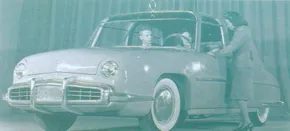
The 1946 Beechcraft Plainsman concept car didn’t end in a smoldering wreck. Beech Aircraft walked away cleanly. They set a production price tag of $4,000 to $5,000. In 1946 that was steep. It would have limited sales to a tiny slice of the market. That same cash bought a Cadillac limousine back then.
Volume could have dropped the price. Beech had the manufacturing scale to make it happen. But they never made it.
Wichita vs. Willow Run
Kaiser-Frazer leased the massive Ford bomber plant at Willow Run in Michigan. It was the largest factory in the world at the time. Beech’s complex in Wichita, Kansas was close behind. It spanned nearly one million square feet. Three-quarters of that space was pure manufacturing floor. They had the capacity. They had the money. They just lacked the will to pivot.
The Cold War Saved Beech
By late 1947 the geopolitical map was shifting. The Cold War started heating up. Crises erupted in Berlin, Palestine, India, and China. The US government poured $22.5 million into new aircraft orders. Beech Aircraft was flying high again.
They dropped the car idea entirely. They never looked back. It was the right call.
A Narrow Escape
Look at the competition. Tucker became a cautionary tale within three years. Kaiser-Frazer stumbled under management blunders. Even established independent makers showed distress. If the Beechcraft Plainsman had entered production, it might have become a major corporate headache.
Aircraft involves war sometimes. Cars are hell on wheels year-round. Ask any local Edsel dealer. Beech got lucky. The timeline worked out in their favor.
For more on concept cars and the production models they forecast, check out:
-
Concept Cars
-
Future Cars
-
Consumer Guide auto show reports
-
Classic Cars