My ceiling is leaking. I am standing there with a bucket, watching my expensive Persian rug turn into a swamp, while outside, it is raining. I need to go out. I need to buy caulking. The roads are slick. The asphalt is a sheet of glass.
Most people think driving in wet weather is just “driving with the wipers on.” It’s not. It is a completely different skill set. Bad habits die hard. You get used to dry pavement, good traction, and predictable stops. When the sky opens up, those habits kill you. Or at least, they strand you on the side of a two-lane highway while you try to figure out why your car won’t stop.
We are going to strip away the bad habits. You have to unlearn what you know. Here is how to keep your car on the road and your spinal cord intact.
Stay Center Lane to Avoid Standing Water
It seems counterintuitive. You see the middle of the road and you think, “That’s where the other cars are. I should be safe on the side.” Wrong.
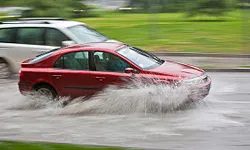
Roads are built with a crown. The center is slightly higher than the edges. This is by design. Water runs off that center hump and drains toward the gutters. When it rains, the edges become pooling zones. Standing water is the enemy. Hydroplaning happens when your tires lose contact with the road because of that water layer.
If you drive near the curb, you are driving through the deepest water. The center of your lane is the driest spot available. It isn’t dry like a desert. It’s just the least wet. By staying in the center of your lane, you minimize the risk of hitting a puddle deep enough to hydroplane.
The road is highest in the middle. Water drains away from the center hump, meaning the edges hold the most water. Drive in the center to avoid it.
Headlights Are Mandatory, But Flashers Are Forbidden
This one is basic, but people skip it. Turn on your headlights. All of them. Low beam.
The goal here is visibility. You need to see the road. But more importantly, other drivers need to see you. Rain reduces contrast. White cars disappear against gray skies. Dark cars disappear against wet asphalt. Headlights make you a visible object.
Do not use your high beams if there is oncoming traffic. The light reflects off the water droplets in the air, creating a white wall of glare. You will see nothing. Low beams cut through better.
What about hazard lights? If you are moving with traffic, leave them off. If you are stopped or moving significantly slower than the flow of traffic due to weather conditions, some states allow them. But generally, flashing lights confuse other drivers. They don’t know if you are turning or broken down. Stick to low beams and a clear brake light signal.
Reduce Speed and Increase Following Distance
You probably have a “normal” following distance. Three seconds. Four seconds. In the rain, that is not enough.
Wet roads reduce tire grip. Your tires have less contact with the asphalt because of the water film. Braking distances increase by 40 percent or more. If you are going 60 mph in the rain, you are stopping like you are going 85 on dry pavement.
Cut your speed. Not by 10 percent. By a third. If it is raining hard, slow down to 30. Then double your following distance. Give yourself eight to ten seconds of space

We often treat our headlights as purely personal aids, big flashlights keeping the dark at bay. But in a downpour, the primary function isn’t illumination for you. It’s visibility for everyone else.
During a storm, sunlight vanishes. The world turns into a gray, overcooked oatmeal. In that murky gloom, seeing a pair of lights helps other drivers realize there is an object in the mass besides raisins. You need your headlights so you can be seen.
But there is a limit. You want to be seen, not blinded.
Don’t Drive With a Blind Windshield
If you can’t see the road, don’t drive.
It sounds obvious, yet people drive with viewports covered in enough water to sustain a goldfish ecosystem. Knowing the route by heart doesn’t help when you can’t see the stopped car three feet ahead. You might miss a pedestrian wandering confused in the gloom. You could miss a bridge abutment.
When visibility drops to zero, pull off safely. Stop. Wait it out.
Don’t Drive Through Flooded Roads
Water on the road is a trap.
If you see water flowing across the pavement, do not cross. Not a little bit. Not an inch. Drivers often assume a shallow stream is harmless. They are wrong. Rainwater currents are stronger than they look. Cars have been swept hundreds of feet. Drivers have lost their lives trying to grab tree limbs or escape submerged vehicles.
Even if the water is still, the bottom is invisible.
Beneath that surface lies potholes deep enough to swallow a car. Broken glass. Nails from passing trucks. If you can’t see the pavement, do not risk it. Stop a safe distance away or find a detour.
Drive Slowly for Conditions
Speed kills, but in rain, it’s instantaneous.
Adjust your pace. The road is slippery. Stopping distances double. Triple. Drive at a speed that allows you to stop if the world turns out to be worse than you think.
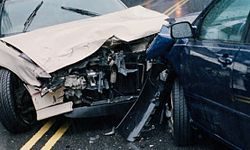
Driving in the Rain: Why Speed Limits Don’t Apply When Wet
Speed limits are arbitrary numbers designed for dry pavement and clear visibility. They tell you what is “safe” when the asphalt is good. When the sky opens up and the road surface becomes a mirror, those numbers are essentially fiction. Drive significantly slower. The worse the weather, the slower you need to be.
The primary threat in wet conditions is hydroplaning. This isn’t about flying seaplanes or fishing expeditions. It’s a specific mechanical failure where your vehicle behaves like a boat instead of a car with tires.
Under normal conditions, tread patterns channel water away. The rubber stays in contact with the road. You have grip. You have control. But there is a threshold. When you exceed it, the tire cannot displace water fast enough. The car lifts onto a thin layer of water. Traction vanishes instantly.
This is catastrophic.
When hydroplaning occurs, steering inputs do nothing. Braking does nothing. The car is effectively disconnected from the ground. Most drivers don’t realize they are losing traction until they panic and slam on the brakes. That’s when the skid starts. It’s better to avoid reaching hydroplane speeds in the first place.
How to Recover from Hydroplaning
If you feel the steering wheel go light and the car drift, don’t freak out. You will want to. Resist the urge.
- Do not hit the brakes. Locking up wheels on water guarantees a spin.
- Ease off the accelerator. Let engine braking and aerodynamic drag slow you down.
- Hold the wheel straight. Do not try to correct the drift. If the rear slides out, steer into it gently, but keep the front wheels pointed where you want to go eventually.
- Wait for contact. As speed drops, the tires will break through the water film. Traction returns. Suddenly, you are back in control.
Once you regain control, exit the roadway immediately. Pull over. Let your adrenaline crash. You just survived a potentially deadly mistake.