Winning the lottery changes everything. Naturally, your first instinct is to buy a car. But what you drive depends entirely on your budget and the specific vibe you want to project. Spend $50,000 and you have endless options. A new Corvette. A Hummer H2. A mix of domestic and foreign sedans. It’s easy.
Spend $100,000 and things tighten up. You’re looking at a BMW 760Li. An S600 Mercedes. Maybe a Porsche Cayenne.
The premium brands you see on TV—Mercedes, BMW, Jaguar, Volvo—top out around that six-figure mark. Go beyond $100,000 and you enter a different world. This is where hand-built Ferraris and Lamborghinis live. Or where the ultra-luxury sedan reigns. For decades, that throne belonged to Rolls-Royce.
Then came a new contender.
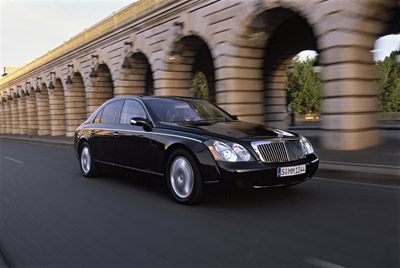
Enter the Maybach. Pronounced “my-bok.”
The Maybach isn’t just a badge. It’s a statement. The brand launched two main models: the 57 and the 62. Prices range from $300,000 to $400,000. Production is strictly limited. Only about 1,000 units are handmade each year.
Is it a smart way to spend lottery winnings?
Understanding what makes these cars special helps you recognize them on the road. It helps you know what’s under the hood. Let’s look at how the brand was born.
The Birth of the Brand
Why You’ve Never Heard of Maybach (Until Now)
Rolls-Royce gets all the headlines. Everyone knows the name. Maybach? Not so much.
There’s a reason for that silence. The brand has been sleeping since the mid-1900s. DaimlerChrysler dug it up recently to serve as their ultra-luxury flagship. But the history goes back much further.
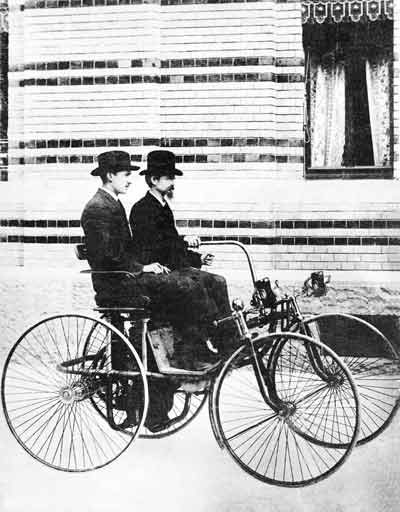
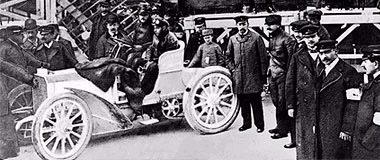
Wilhelm Maybach met Gottlieb Daimler in the 1860s. They started a company in 1885 to build internal combustion engines. Their first real success was a 0.5-horsepower engine that year. Two years later, they showed off the first four-wheel automobile at the Paris Exhibition.
It looked odd. Four huge wheels, like bicycles. No steering wheel. You used a rudder-like lever to turn.
French audiences loved it. It kicked off the auto boom in France.
Their collaboration birthed the world’s first 4-cylinder car engine in 1898. That engine powered the first Mercedes, launched in 1900. Mercedes took off. Today, the name means quality.
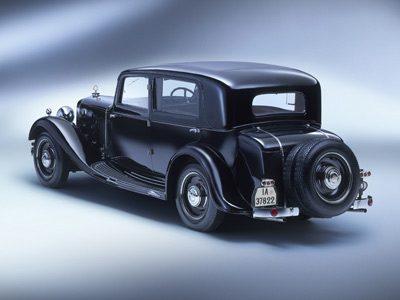
Wilhelm Maybach left in 1907 to start his own firm. His son, Karl, ran the show. They built high-end luxury cars. V-6s. V-12s. Pure excess.
The line ended with the Maybach type SW 42 in 1940. A V-6 powered beast. One of the last great pre-war luxury sedans.
The Return of Ultra-Luxury
Between 1921 and 1941, Maybach didn’t just build cars. It set a benchmark. The company produced fewer than 2,000 units over two decades. Each one was a statement of excess. Quality was absolute. Then the brand vanished.
DaimlerChrysler remembered the name. In 2003, they brought it back. The goal was simple. Create an ultra-luxury vehicle that outclassed everything else on the road.
What Defines a Maybach?
If you see a Maybach on the street, you know one thing immediately. It costs more than most houses. Prices typically range from $300,000 to $400,000. That is not a typo. You are paying for silence. You are paying for leather that smells like history.
The interior is designed for four passengers. Not five. Four. The back seats are the real stars. They recline. They massage. They are so quiet that the engine is just a distant memory.
Why Choose Maybach Over Mercedes-Maybach?
The distinction matters. The original Maybach was hand-built. The 2003 revival was built on Mercedes-Benz platforms. Specifically, the Mercedes-Benz S-Class. But that’s where the similarity ends.
| Feature | Original Maybach (1921-1941) | 2003 Revival (Maybach 57/62) |
|---|---|---|
| Production Volume | < 2,000 cars | Limited series |
| Target Audience | Royalty, industrialists | CEOs, celebrities |
| Engineering | Bespoke, hand-assembled | Mercedes S-Class base, heavily modified |
| Price Point | Indefinite (wealthy only) | $300k – $400k+ |
The 2003 models were not just badged S-Class sedans. The chassis was lengthened. The suspension was retuned. The insulation was thicker. The result was a car that floated over potholes.
Who Was It For?
This was not for the driver. It was for the passenger. The Maybach 57 and 62 were designed for people who hired chauffeurs. The rear seats faced forward or could be turned around. Privacy glass was standard.
The price tag excluded most people. Even within the luxury market, Maybach sat at the top. It was a rolling office. A moving lounge. A statement of wealth so quiet it was almost insulting.
The Legacy Continues
Today, the name appears on Mercedes-Maybach models. The GLS SUV. The S-Class. The philosophy remains. Ultra-luxury. Ultra-exclusive. But the 2003 revival was the bridge. It proved that the name still had power.
Would you pay $400,000 for a car that mostly goes nowhere?
The answer depends on who you ask. For the target buyer, it was a no-brainer. Silence is expensive.
Maybach Lineup Breakdown: 57, 57 S, and 62 Models
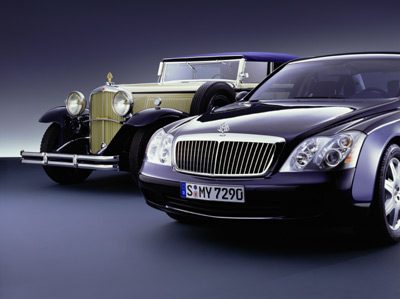
DaimlerChrysler handed down three distinct flavors of luxury: the Maybach 57, the Maybach 57 S, and the Maybach 62. The naming convention is brutally literal. The 57 and 57 S stretch to 5.7 meters. The 62 hits 6.2 meters. You get the math.
Beyond that scale difference, the two standard models are nearly twins. The 62 trades nothing for its length. Every inch of extra metal goes straight back to the rear passengers. More legroom. That is the entire point of the longer wheelbase.
The 57 S Special Edition
Enter the Maybach 57 S. It arrived in December 2005 as a performance-oriented outlier. The “S” stands for special, but the specs scream sport.
Under the hood sits a twin-turbo 6-liter V-12. That is not a mild upgrade. It is the powertrain meant to pull this heavy limousine with intent. DaimlerChrysler paired that massive engine with a sport suspension setup. The chassis is stiffer. The ride is sharper. You lose a bit of the cloud-like float, but you gain actual handling capability.
Rear Seat Dynamics
The 57 S offered interior and exterior tweaks unavailable on the base 57. But the 62 had its own exclusive card to play.
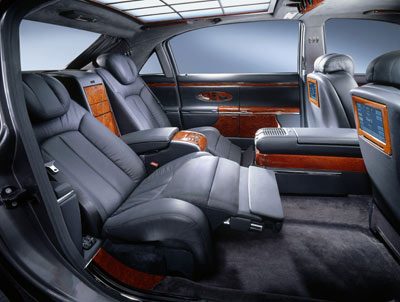
Because the 62 has that extra space in the rear cabin, it could offer fully reclining rear seats. The 57? Not so much. The cabin is tight. You cannot fold those back into a bed position without your knees hitting the dashboard. The 62 solved that geometry problem. You get a lounge. You get a sleeping berth.
Why Length Matters in Ultra-Luxury
It sounds like a trivial detail. More metal equals more space. But in this segment, space is the product.
When you are paying for a chauffeur-driven vehicle, the rear seat is your office, your bedroom, your sanctuary. The difference between 5.7 meters and 6.2 meters is not just cosmetic. It is functional. It is the difference between sitting and lying down.
The Maybach brand understood that. They did not just build big cars. They built different experiences based on scale. The 57 was for the executive who wanted presence. The 62 was for the executive who wanted privacy. The 57 S was for the executive who wanted to drive themselves at a reasonable pace without falling asleep at the wheel.
Three models. One platform. Different purposes. The engineering was straightforward. The pricing was not.
The Maybach 62’s Roof-Mounted Theater
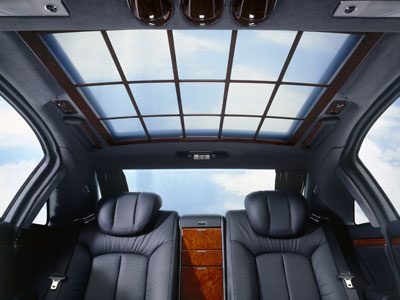
The rear cabin of the Maybach 62 didn’t just offer comfort; it offered a view. While the exterior screamed understated power, the interior was designed for observation. The crown jewel of that observation deck was the electro-transparent panoramic glass roof.
It wasn’t just a sunroof. That term feels too small for a piece of engineering that cost more than your first car. This was a massive skylight, stretching over both the rear seats and the central armrest. You could watch the rain hit the pavement without getting wet. Or watch the stars if you parked in the right spot.
“The 62 also offers a huge skylight in the roof (known officially as the electro-transparent panoramic glass roof).”
The technology behind it was called electro-transparent. It sounds like sci-fi, but it’s simple enough. Apply voltage, the glass turns opaque. Cut the power, and it goes clear. You didn’t need curtains. You didn’t need shades. You just needed a switch.
For the passengers in the back, privacy was absolute when they wanted it. The glass could block out the entire world. Or let the sky in. It was a statement about control. The driver controlled the car. The rear passengers controlled their environment.
It’s a feature that screams luxury, but it also screams complexity. What happens when the electronics fail? Does it stay clear? Does it stay dark? Nobody knows. Because by the time you own a Maybach 62, you probably have a mechanic on speed dial.
The roof itself is curved. It follows the lines of the bodywork. It’s not a flat pane of glass slapped on top. It’s integrated. Seamless. Expensive to replace, too.
But when it works, it works beautifully. You feel less enclosed. The cabin breathes. Even with the windows up and the doors locked, the air feels lighter. The light feels warmer.
Is it worth the extra cost? Maybe. If you value the ability to look up while someone else drives, then yes. If you prefer a traditional hardtop, then no. The Maybach doesn’t ask for compromise. It offers options. And one of those options is the sky.
How the Maybach’s Electrochromic Roof Works
The glass in this skylight can be electronically changed between clear, frosted, or completely opaque depending on your mood. The laminated glass pane on the inside of the panoramic roof contains a layer of liquid crystal foil made from electrically conductive polymer material. It becomes transparent when AC voltage is applied.
This isn’t just tinting. It’s active control.
The Opulence of the Maybach Interior
Inside a Maybach, the interior is designed for opulence. The smart glass fits right into that promise. You aren’t just buying a car. You are buying privacy on demand.
The technology allows the roof to shift states instantly. No blinds. No shades. Just voltage.
Why does this matter? Sun glare. Heat. Privacy. All solved with a switch. The conductive polymer layer is the key. It rearranges its crystals when the current flows. Clear to cloudy. Cloudy to black.
It is a small detail that defines the experience. And for Maybach buyers, details are everything.
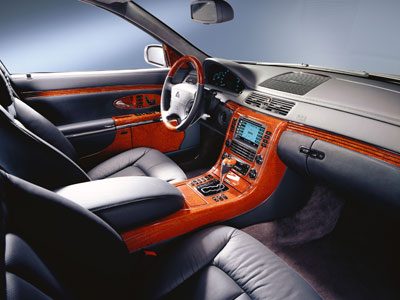
Inside the Future: Luxury as a Lifestyle
“It has every creature comfort you can imagine, and several that you may have never thought of.”
Step inside, and the boundary between a vehicle and a mobile living room dissolves. We aren’t talking about heated seats or a premium sound system here. This is a different breed of engineering, where the goal is to turn dead time into productive or restorative hours. The feature list isn’t just long; it’s obsessive.
Start with the climate control, but twist it. Standard HVAC units keep you cool. This setup includes a built-in refrigerator, complete with its own dedicated compressor. You aren’t just chilling a beverage; you’re storing a meal. It’s a small detail that fundamentally changes how you approach long hauls or stopovers.
Then there is the roof. DaimlerChrysler leaned heavily on the electro-transparent panoramic glass design we’ve seen before. But they didn’t stop at transparency. Embedded within that glass are solar cells. They don’t power the drivetrain—that’s a common misconception with these concepts—but they do something arguably more useful for a luxury sedan. They run a ventilation system while the car is parked. You pull away from a hot asphalt lot, and the interior is already at a comfortable temperature, cooled by energy harvested when you were miles away.
Safety, too, is treated with overwhelming redundancy. Ten airbags is a number that makes most modern buyers blink. The breakdown is specific: four for the front occupants, four side-impact units for the sides, and two curtain airbags protecting the head area. It’s overkill by contemporary standards, but in the era this concept was designed, it was the bleeding edge.
The air quality control matches that intensity. Charcoal and pollen filters scrub the incoming atmosphere, ensuring that what you breathe is cleaner than the air outside. Ambient lighting sets the mood, obviously. But the real conversation starter is in the center console. Writing desks unfold from the armrests.
Yes, desks.
Why? Because for the target demographic—the CEO, the diplomat, the executive who treats the car as an extension of the office—time spent in transit is billable time. You aren’t just commuting. You are closing deals. The car becomes a rolling office suite, insulated from the weather, the noise, and the chaos of the road.
It’s a lot of technology crammed into one chassis. A fridge. Solar-powered cooling. Ten airbags. A desk. It’s not just a car. It’s a statement about what mobility could be, if we stopped caring about horsepower and started caring about hours.
The question isn’t whether it’s practical. It’s whether we’re ready to accept that our cars are finally taking on roles beyond just getting us from point A to point B. We’ve been talking about connectivity and automation for years. This was the prototype for it all. The hardware was there. The software just hadn’t caught up to the ambition.
And now? We’re still chasing that level of integration, just in a more digital form.
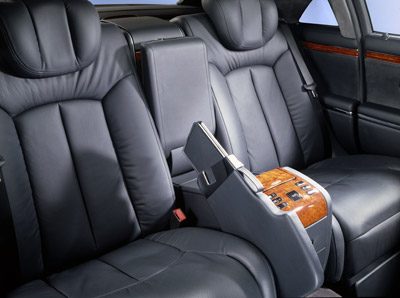
The rear cabin of the Maybach 62 wasn’t just about leather and wood. It was a mobile lounge. Each of the two rear bucket seats featured a folding table. These didn’t pop out from nowhere. They emerged from special compartments built directly into the sides of the rear center console. One on the left. One on the right. Business meetings? Or just a place to rest a drink while you stared out at the passing world.
Then there was the tech. In 2002, this was next-level stuff.
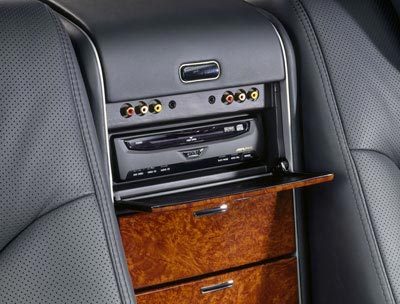
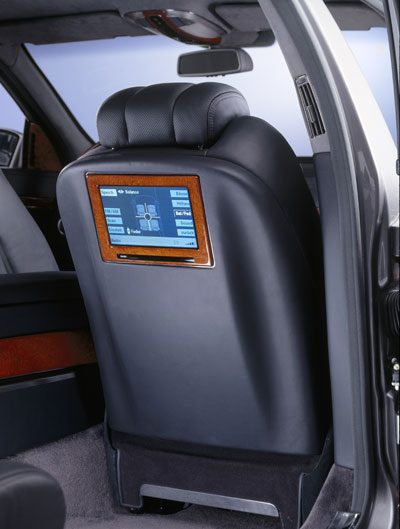
Every Maybach 62 came with a DVD player for the rear passengers. Two screens were embedded directly into the backs of the front seats. Think about that integration. No bulky consoles taking up legroom. Just screens.
The system also included a TV tuner. You could watch broadcast television in motion. And a 6-disc CD changer. It wasn’t just any changer. It came with cordless headphones. No wires tangled in your lap. Just pure, isolated audio.
This wasn’t standard luxury. It was bespoke technology.
DaimlerChrysler pulled back the curtain on something that felt less like a sedan and more like a black-ops vehicle. We are looking at the 2000 Dodge Intrepid EGD (Executive Governmental Division), a car built for people who value privacy over speed. The visual cues are immediate and aggressive.
Privacy Is the Priority
The first thing you notice is the glass. It isn’t just tinted. The rear and side windows are covered with actual curtains. Yes. Fabric drapes designed to block the view from the outside world. If you were sitting in the back seat, you could pull them shut and disappear. It’s a level of seclusion usually reserved for limousines or armored SUVs, not a mid-size sedan platform. This isn’t about style. It’s about security.
Technology That Anticipates
Inside, the tech feels ahead of its time for 2000. You get two dedicated cell phones. Not one. Two. This suggests a split between communication and security, or perhaps redundancy for high-stakes environments. The connection between driver and machine is almost magical until you think about the mechanics.
The car uses a fob transmitter for both automatic door unlocking and ignition. You approach the vehicle, and the locks pop. You touch the gear-selector knob, and the engine turns over. There is no physical key in your hand to start the car. It’s a hands-free experience that feels like science fiction when you’re used to juggling keys and locks.
Comfort Meets Function
Heated seats and a heated steering wheel are standard. In a government or executive context, comfort isn’t a luxury; it’s a requirement for long hours. You want to be warm. You want to be focused. You don’t want to be distracted by the cold.
Why This Matters
The Intrepid EGD wasn’t sold in showrooms. It was a custom build for specific high-profile users. It shows how DaimlerChrysler leveraged their engineering to create a niche product. They took a reliable platform and added layers of privacy and convenience that justified the cost.
The curtains stay up. The phones stay charged. The engine starts before you even touch the dashboard. It’s a machine built for silence and secrecy.
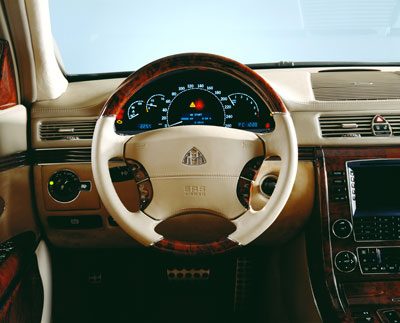
Luxury Beyond the Driver’s Seat
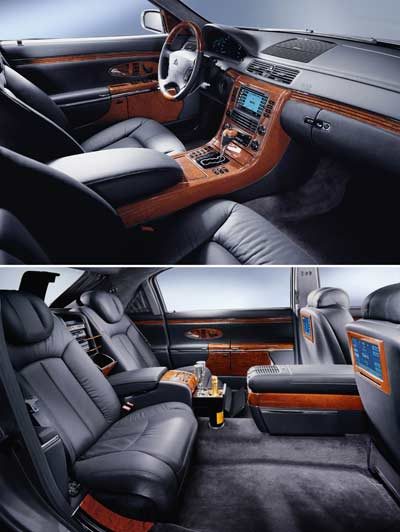
The rear passenger experience was treated with the same obsessive attention as the cockpit. DaimlerChrysler didn’t just offer legroom; they engineered a first-class lounge for the back. The star of the show? Optional fully-reclining rear seats with built-in massage. You weren’t just sitting. You were being worked on.
Privacy and communication were handled with tech that feels standard now but was cutting-edge then. An intercom between front and rear seats meant the driver could hear the rear without turning around. Want total isolation? A retractable window between front and rear seats slid up. It could electro-frost when desired, turning clear glass into opaque privacy glass at the touch of a button.
Sound didn’t just play. It enveloped. The Bose® sound system, 600 watts with 21 speakers filled the cabin. Every frequency had its own outlet. Navigation was built in. Self-monitoring tires tracked pressure and health. Telediagnostics could report issues before you even knew they existed.
Inside, warmth came from nature. 100 wood veneer accent pieces lined the dash and doors. Leather throughout wrapped every surface you touched. It wasn’t just a car. It was a statement that the journey mattered as much as the destination.
Security takes a sharp turn with the Maybach Guard. This isn’t just a plush sedan with a tinted window. It is a fortified fortress disguised as luxury. The protection rating hits B4-level security. That sounds like a number on a spec sheet until you realize what it actually means.
A blunt instrument attack. A baseball bat. A crowbar. It won’t dent the frame. A handgun firing up to .44 caliber at point-blank range? Also ineffective. The passengers inside remain untouched. The vehicle remains mobile.
The engineering here is the key differentiator. You can’t retrofit this kind of protection after the fact. The Maybach Guard is built from the ground up on the assembly line. Every bolt, every panel, every layer is integrated during production. That is why the exterior looks identical to a standard Maybach. No bulging arches. No thickened pillars visible to the naked eye. Just seamless, deadly elegance.
Security is not an add-on. It is the foundation.
The internal architecture is a marvel of material science. Reinforced steel runs through the roof. It lines the rear wall. It reinforces the firewall, the doors, and the floor. But steel alone isn’t enough. Enter Kevlar® blankets. These aren’t the cheap stuff from discount stores. These are the same ballistic blankets used in high-grade body armor. They sit behind the steel, absorbing the kinetic energy of any bullet that penetrates the outer layer.
Bulletproof glass seals the deal. Every single window. And the seams? They have special overlapping protection zones. A bullet trying to slip through the gap between a door and its frame finds a wall of composite material instead.
Survival isn’t just about stopping the shot. It’s about getting away. The fuel tank is protected. If a stray round finds it, it doesn’t ignite. The run-flat tires allow you to drive even if the rubber is shredded. You aren’t stuck on the side of the road waiting for a tow truck while danger closes in.
Communication is handled by a specialized alarm system. Each seat has an activation button. Panic is instant. The intercom system allows you to speak with people outside without cracking a window. You can command, negotiate, or scream for help while remaining sealed in your steel cocoon.
But what happens when you hit the road?
Performance comparisons inevitably lead to the 2004 Rolls-Royce Phantom. It’s the natural rival. The Maybach Guard and the Phantom sit at similar price points. They weigh roughly the same. The level of craftsmanship is comparable. They attract the same buyer demographic—people who value privacy as much as prestige.
The difference lies in the mission. One is a rolling palace. The other is a rolling bunker. Both are exquisite. Both are expensive. But only one was designed to keep you alive when the world turns violent.
Which do you choose when the choice is between style and survival? The line between them is thinner than you think.
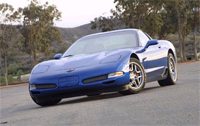
Comparing the Maybach 57 to a Chevrolet Corvette
The comparison between a Maybach 57 and a Chevrolet Corvette seems absurd on paper. One is a massive luxury sedan. The other is a raw, two-seat sports car. The Corvette boasts a high-performance engine, a lightweight fiberglass body, and a suspension tuned for cornering. The Maybach 57 is an auto-yacht. It weighs nearly 3,000 pounds (1,360 kg) more than the Corvette. That is almost twice the mass. It is also nearly 4 feet (1.2 meters) longer.
Yet the numbers tell a different story.
0-60 mph and Braking Stats
You would expect the Corvette to dominate. You don’t. In the 0 to 60 mph (0-97 kph) acceleration test, the two cars are dead even. Both clock 4.9 seconds.
The gap widens only slightly at higher speeds. In the 0 to 80 mph (0-129 kph) acceleration test, the Maybach is actually a tenth of a second quicker. It hits 80 mph in 7.8 seconds. The Corvette takes 7.9 seconds.
Keep in mind that a Porsche Boxster completes the 0-60 run in just over 6 seconds. The Corvette is fast. But the Maybach keeps pace.
Braking tells an even stranger tale. The heavy Maybach stops better than the featherweight Corvette.
From 60 mph (97 kph), the Maybach 57 stops in 121 feet (37 meters). The Corvette needs 134 feet (41 meters).
The difference is smaller from 80 mph, but the trend holds. The Maybach takes 212 feet (65 meters). The Corvette requires 214 feet (65 meters).
Slalom Performance Surprises
The slalom test should have been a blowout. Given the weight disparity and length difference, the Corvette should have obliterated the Maybach.
It didn’t.
The speed through the 700-foot slalom was incredibly close. The Corvette hit 62.4 mph (100.4 kph). The Maybach managed 60.4 mph (97.2 kph).
Why does a huge car like a Maybach match a sports car like a Corvette in performance?
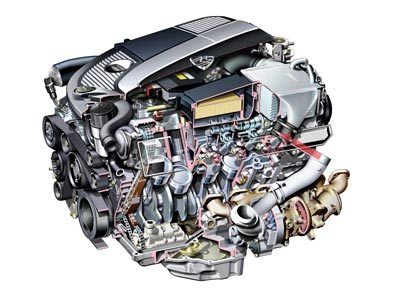
The comparison starts under the hood. On paper, the Corvette has the displacement advantage. Its big-block V-8 pushes 5,665 cubic centimeters. The Maybach’s V-12 engine sits at 5,513 cc. But numbers don’t tell the whole story. This is a high-tech setup. The Maybach uses three valves per cylinder. The Corvette sticks with two. Overhead cams handle the breathing in both, but the Maybach adds variable valve timing. It also features variable-length intake manifolds. Then there are the turbochargers. Dual units with an intercooler generate 18.9 psi of boost.
The result is 543 horsepower. The Corvette makes 350. That’s a massive gap. Yet, the power-to-weight ratios end up nearly identical. The extra power compensates for the Maybach’s luxury weight. It’s not about raw output alone. It’s about how that output is managed.
Braking and Suspension Control
Stop the car, and you find more engineering. The Maybach has huge disc rotors. They measure 14.8 inches in the front and 14 inches in the back. Most cars use four brake calipers. The Maybach uses six. Two calipers sit on each front wheel. This redundancy is computer-controlled. The CPU decides which calipers to activate. It determines the pressure for each one.
Software adds features you can’t get in a standard sports car. Take panic stops. If you lift off the accelerator rapidly, the system notices. It predicts you’ll hit the brakes in milliseconds. During that gap, the computer pre-positions the brake pads against the rotors. Activation becomes instant.
Handling the slalom requires another layer. The Maybach uses air shocks. They auto-level the vehicle during acceleration. They work during cornering too. Braking triggers adjustments as well. Internal dampers are adjustable. You control the stiffness. Engineers stripped out comfort to make it behave like a sports car. Every piece of technology serves that goal.
“We’re comparing the Maybach with the 2003 50th Anniversary Corvette, using spec sheets for the two cars from Road & Track magazine.”
How to Buy a $300,000 Car
Buying a Maybach isn’t like buying a Ford Focus. The price tag alone filters out 99.9 percent of the market. Only a thousand units are made per year. The audience is tiny. You won’t see mass-market ads on TV. Or in glossy magazines.
The strategy is personal. It begins with direct mail. Potential buyers receive a hand-delivered coffee-table book. It details the car’s history and the new model’s features. Mercedes-Benz calls it an intensive direct-marketing campaign. The book costs $50. But the presentation matters more.
For the top 160 individuals in Australia’s BRW Rich 200 list, the book arrives in a high-gloss timber box. The box costs about $300 to craft. It features the buyer’s name in brass on the lid.
Once you contact the company, you get a personal liaison. They handle the transaction. You have two options for ordering:
– Travel to the Maybach Studio in Sindelfingen, Germany.
– Visit select Mercedes-Benz dealers with on-site Maybach sales centers.
The press release from 2002 explains the philosophy. Stylish architecture. Exclusive furnishings. Cutting-edge communications technology. Even if you can’t visit Sindelfingen, video conferencing bridges the gap. Staff answer questions about purchase and equipping.
US sales centers use plasma displays. You can try different trim and color options via computer software. It’s a showroom experience tailored to the ultra-wealthy.
Price Per Pound Analysis
The sticker price seems outrageous. Look at the cost per pound. The math changes. Here is how the Maybach compares to other expensive things:
- Space Shuttle: Costs $2.1 billion. Weighs 170,000 pounds. That equals $12,000 per pound.
The Maybach doesn’t come close to aerospace prices. But it’s still a significant investment. The value lies in the engineering density. And the exclusivity.
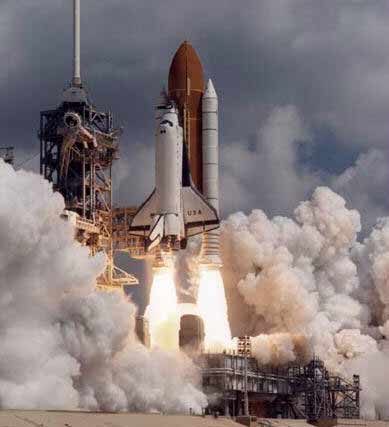
You look at a pile of gold and see wealth. You look at a Lear jet and see status. But if you break it down to a single unit of mass, the numbers get weirdly specific.
Consider the cost per pound.
Gold sits at roughly $400 per ounce in the 2003 market. That translates to $6,400 per pound. It’s heavy, dense, and incredibly expensive. Not because it’s useful for carrying you around, but because it’s rare and shiny.
Now look at a Learjet 45. These things cost about $10 million. The empty weight is roughly 15,000 pounds. Do the math. You’re looking at $650 per pound.
That’s expensive for a vehicle. But not as expensive as the metal in the vault.
Then there’s the high-end carbon fiber bicycle. A top-tier machine costs around $3,000 and weighs just 20 pounds. That puts the cost at $150 per pound.
Finally, the Segway. A personal transporter that cost $5,000 when it launched, weighing in at 80 pounds. That’s $62.50 per pound.
The hierarchy is clear. Gold is the most expensive way to move nothing. The jet is pricey but gets you across the continent. The bike is efficient. The Segway? It’s the cheapest way to buy a pound of machinery, provided you actually need to stand on it and hover in a mall.
Which one represents better value? Depends on what you’re trying to lift.

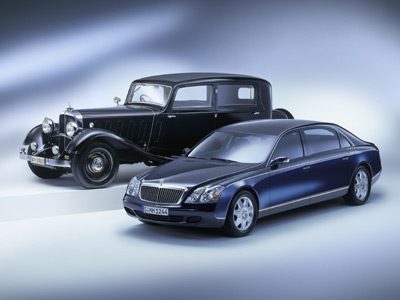
When you strip away the showroom polish and look at the raw material, luxury automotive pricing starts to look less like an art form and more like a brutalist exercise in weight and expense. It’s not just about the badge on the grille. It’s about how much you pay for every single pound of steel, leather, and glass.
Take the Maybach, for instance. This is not a car for people who check their gas mileage. It is a rolling palace. With a price tag hovering around $300,000 and a curb weight of 6,100 pounds, the math is staggering. If you divide the cost by the mass, you get a figure of roughly $49.10 per pound.
“You aren’t just buying transportation. You are buying heavy, opulent inertia.”
That number is absurd. It’s higher than the cost per pound of gold in some contexts when you factor in the labor and engineering. The modern Maybach carries the ghost of its predecessor, the DS 8 Zeppelin from 1930. That lineage matters. The Zeppelin wasn’t just a car; it was a statement of industrial power during an era when German engineering was trying to prove it could match the best of the world. Today’s Maybach, produced under the DaimlerChrysler umbrella at the time of these figures, continues that tradition of excess. It’s heavy. It’s expensive. And it costs nearly fifty dollars for every pound of its existence.
Compare that to the two-wheeled counterpart. Enter the Harley Davidson VSRC (Victory Street Racing Concept). It’s a different beast entirely. The price? $18,000. The weight? A mere 600 pounds.
Do the division. $30 per pound.
Why Weight Matters in Luxury Valuation
The contrast is stark. The motorcycle is lighter and cheaper overall, but its cost-per-pound metric is surprisingly lower than the Maybach’s. Or is it? Let’s look closer.
The Maybach sits at $49.10/lb.
The Harley sits at $30.00/lb.
This creates an interesting hierarchy in the world of luxury vehicle pricing. Most people assume that because a car costs more in absolute terms, it’s “more expensive” in a relative sense. But when you look at cost per pound, the dynamics shift.
Which is the better value?
If you define value as “how much metal do I get for my dollar,” the Harley wins. If you define it as “how much status do I get for my dollar,” the Maybach might still hold its ground, despite the inefficient mass.
The Maybach vs Harley Davidson comparison isn’t just about horsepower. It’s about how we perceive weight. We associate weight with safety and solidity. We associate lightness with agility and speed. But in the luxury segment, weight is often a feature. It dampens the road. It isolates the cabin. It makes the car feel like a ship.
The History of Heavy Metal
The 1930 DS 8 Zeppelin set the tone. It was a luxury cruiser designed for long, slow ja
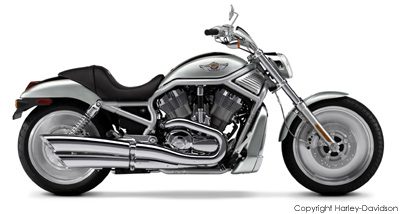
Let’s talk about value. Specifically, the absurdity of it.
You are looking at a 2003 VRSCA V-Rod. It’s a motorcycle. A good one, sure. But let’s put its price tag in perspective using a different kind of heavy metal.
Consider the USS Ronald Reagan.
This isn’t just a ship. It’s a floating city powered by nuclear reactors. It costs $4.3 billion to build. It weighs 90,000 tons when fully loaded.
Do the math on that weight.
$24 per pound.
That is what it costs to build a piece of steel that moves itself across an ocean, carries a squadron of fighter jets, and doesn’t need refueling for decades.
Now look at the V-Rod.
It was Harley-Davidson’s answer to the Japanese muscle bikes. It didn’t use their traditional air-cooled V-twin heritage. Instead, they partnered with Porsche to build a liquid-cooled, DOHC, 60-degree V-twin engine. It made 115 horsepower. It had a top speed that scared traditionalists.
The 2003 VRSCA launched at around $13,999.
Let’s compare the cost per pound again.
A V-Rod weighs roughly 500 pounds wet.
$13,999 divided by 500 pounds is roughly $28 per pound.
You are paying $4 more per pound of steel and aluminum for a motorcycle that goes 130 mph, than you are for a nuclear-powered aircraft carrier that goes 30 knots.
Why does this matter?
Because the V-Rod proved that Harley could engineer a real performance machine, not just a lifestyle symbol. The VRSCA wasn’t about comfort. It was about torque. 95 lb-ft of it.
It was fast. It was heavy. It was expensive.
But compared to a $4.3 billion warship, it was a bargain.
Think about that next time you see one cruising down Main Street. It’s not just a bike. It’s the cheapest way to buy $24-a-pound efficiency in the world.
Almost.
The reactor still needs to be managed. The bike just needs gas. And oil changes. And a lot of attention.
But hey, at $28 a pound, it’s almost cheap.

The math on luxury vehicle ownership is often more brutal than the sticker price suggests. To get a sense of scale, look at the cost-per-pound for different vehicles. A Hummer H2 weighs 6,400 pounds and costs $52,000. That breaks down to $8.13 per pound. A Ford Focus weighs just 2,600 pounds with a $14,000 price tag, landing at $3.57 per pound. The disparity in manufacturing and brand value is stark.
But the real question for high-net-worth individuals isn’t just buying price. It’s the monthly burn rate. What does it actually cost to lease a Maybach? The answer depends entirely on how you view depreciation.
The Residual Value Factor
A lease is not a loan. It is a rental agreement where you pay for the vehicle’s depreciation over a set term. The critical variable here is the residual value —the estimated worth of the car at the end of the lease.
With a standard sedan like a new Ford Focus, the residual value takes a heavy hit. If you drive it for four years, it loses 70% of its value. A $14,000 car ends up worth only $4,200. You are essentially paying for the $9,200 in lost value, spread across 48 months. Add an 8% money factor (interest rate) to that depreciation, and your monthly payment sits at $267.25.
Maybach operates on a different economic plane. These cars hold their value remarkably well. The residual value remains high because demand for these ultra-luxury machines outstrips supply, and they are often treated as collectibles rather than disposable transport.
The Maybach Lease Calculation
Let’s break down the numbers for a Maybach costing $300,000 new. We are looking at a four-year lease with no money down.
If we assume the car retains $200,000 in residual value after four years, the depreciation is $100,000. At a 5% interest rate, this results in a monthly payment of $3,134.38.
But what if the market is softer?
If the residual value drops to $150,000, the depreciation climbs to $150,000. At the same 5% rate, the monthly payment jumps to $4,079.39.
Interest rates also play a massive role. If we keep that lower $150,000 residual value but increase the interest rate to 8%, the monthly payment balloons to $4,661.94.
Small shifts in residual estimates and interest rates create huge swings in monthly obligations. You can experiment with these variables using online tools like the leasing calculator at InfoChoice.com.
The Opportunity Cost
Is $4,600 a month a lot? It depends on your asset allocation.
If you took that $4,600 monthly commitment and applied it to a mortgage at a 7% interest rate over 30 years, you could purchase a home valued at approximately $700,000. That is a tangible asset. A Maybach lease is a pure expense. The car will not be yours at the end of the term. You simply return it.
Buying Outright vs. Leasing
Some buyers prefer to own the asset immediately. If you choose to buy the Maybach outright and finance it over 48 months at 8% interest, the monthly payment is $7,323.88.
This is nearly double the high-end lease payment. However, you walk away with a $300,000 car (minus depreciation) that you can sell, trade, or keep indefinitely. With the lease, you have no equity. You have a payment and a set of keys you eventually hand back.
For deeper dives into the engineering and history of these vehicles, check out Motor Trend’s first drive of the 2