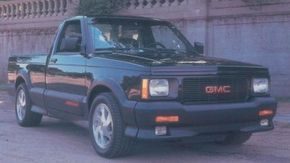
That was in 1991. The auto industry is obsessed with widebody muscle cars and expensive exotic cars. Then GMC dropped the Syclone.
This is more than just a truck. This is a statement. Based on the compact Sonoma, this car has a wheelbase of just 108.3 inches and a bed length of 6 feet. Looks like a practical car. It behaves like a sports car. In a very short time, this was the fastest production pickup on the planet.
Many people remember it for its speed. But the engineering behind that speed is messy, complicated, and amazing.
Engine: Vortec V-6 turbocharged
GMC did not start from scratch. It starts with the standard 4.3-liter EFI Vortec V-6 found in standard Sonomas. Its stock engine produced 160 horsepower. boring.
In the case of the Syclone, they dismantled it.
They added a liquid intercooler turbocharger. Boost is set at 14 psi. The compression ratio is reduced to 8.35:1. Fuel injection, special pistons and oil coolers were used. A dual exhaust was added because the stock system couldn’t handle the flow.
result?
280 horsepower at 4400 rpm. Torque is 350 lb-ft at 3600 rpm.
This was huge in the early 90s. It competed with the best muscle cars of its time. But power alone is only half the story.
Suspension and handling dynamics
Sonoma stock is currently high. The Syclone is 2 inches lower.
GMC installed a “Sport Calibration” suspension. At the front, a separate slow torsion bar and a thick support bar kept it planted. The rear has a solid axle with semi-elliptic springs. Bilstein gas shocks are standard equipment.
The tires? Meaty. The P245/50VR-16 Firestone Firehawk is mounted on turbine aluminum rims.
Why is this important?
That’s because just adding 350 pound-feet of torque to the rear wheel drive will get the tires spinning all the way. So GMC introduced all-wheel drive.
This system is manufactured by BorgWarner. Accepts viscous coupling. The torque distribution is 35% to the front wheels and 65% to the rear wheels. The limited-slip differential still helps when driving.
This is not just marketing. This is necessary engineering. Without it, the Syclone is just a sliding brick.
Brakes and chassis features
GMC claims the Syclone is the first pickup to feature a four-wheel anti-lock braking system (ABS).
This is the problem.
The rear brake is a drum type. Not discs.
This is an odd detail in the review. It has the latest ABS logic. It has amazing turbo torque. However, the braking performance depends on the rear drum brake. It worked. This works well. However, this highlights the urgency of the development cycle.
Interior and exterior design
The Syclone is only available in one color, black.
The lower frame is finished with matte black aerodynamic upholstery. It has a red “Syclone” badge on the side. Looks very aggressive. Looks fast.
The interior of the car is equipped with shaped bucket seats. floor changer. Leather-covered tilt wheel. Big analog instruments. Tachometer and turbo boost gauge are standard equipment.
Equipped with luxurious features. Air conditioner. stereo cassette. cruise control. colored glass. Power accessories.
We also have Lexxus TruxCover tonneau cover. Yes, it’s a Lexus. A luxury brand. For trucks.
This is a contradiction. Fast, loud, cramped, luxury style truck.
Performance data
How fast?
Acceleration from 0 to 60 mph takes less than 5.0 seconds.
It runs the quarter mile in 13.4 seconds.
When you look at these numbers, it’s the same story with contemporary supercars. It’s not just about trucks. Supercars.
Production is limited. About 3,500 units per year. Available for two model years only. 1991 and 1992.
Advantages and disadvantages of collectibles
“Syclone” is now a cult classic. Why?
Advantages:
– The first factory compact hot rod pickup truck.
– Faster than most modern cars.
– A Luxury cab with all the options imaginable at the time.
– Better ride quality than you would expect from a lowered pickup truck.
Disadvantages:
– It is clearly designed to run, not work.
– noisy. exhaust