Most “concepts” today are just spies in tuxedos. Thinly veiled production models waiting to hit showrooms next week. Boring.
But that wasn’t always the case. Once upon a time the label meant something radical. Cutting-edge design. Fertile imagination pushed to the absolute limit. We’ve got eighty years of weird metal to sift through, barely scratching the surface. Let’s go.
Buick Y-Job (19 General Motors calls this the first concept car. Historians say the 1933 Volvo Venus Bilo beat it there.
Doesn’t matter who started the party, does it? What matters is Harley Earl. GM’s design boss got famous for this. He built the Y-Job to prove he could do anything.
Hidden headlights. Electric windows. A roof that retracts and hides under a hard tonneau. It looked nothing like any car on the road. It set the DNA for American automotive design post-World War II. Aggressively futuristic for 1939.
Buick LeSabre (1) Earl didn’t stop there. The LeSabre arrived in 1951 like a rocket landing in your driveway. It captured the jet-age optimism perfectly. And maybe too perfectly.
Sitting a foot lower than regular cars. A 335hp V8 engine roaring underneath. Huge tailfins sweeping back toward eternity. This one actually had a smart trick: if it started raining the powered roof would automatically close itself.
It sparked a trend. America’s Big Three spent the next decade trying to fly cars over the asphalt. Strap in. It’s going to be wild.
Ford XL50 (2) Imagine getting in a car in 1953 that feels less like a vehicle and more like a living room. That was Ford’s plan.
The XL50 had a push-button transmission. No stick shift to ruin the mood. Just effortless cruising. But look at that windshield. It wraps all the way around. A giant fishbowl problem waiting to happen. Ford knew this. So they added air conditioning. Because if you have to look out everywhere you have to be comfortable doing it.
There’s a telephone too. And built-in jacks for flat tires. Because apparently 1953 Fords needed emergency infrastructure before they could sell luxury.
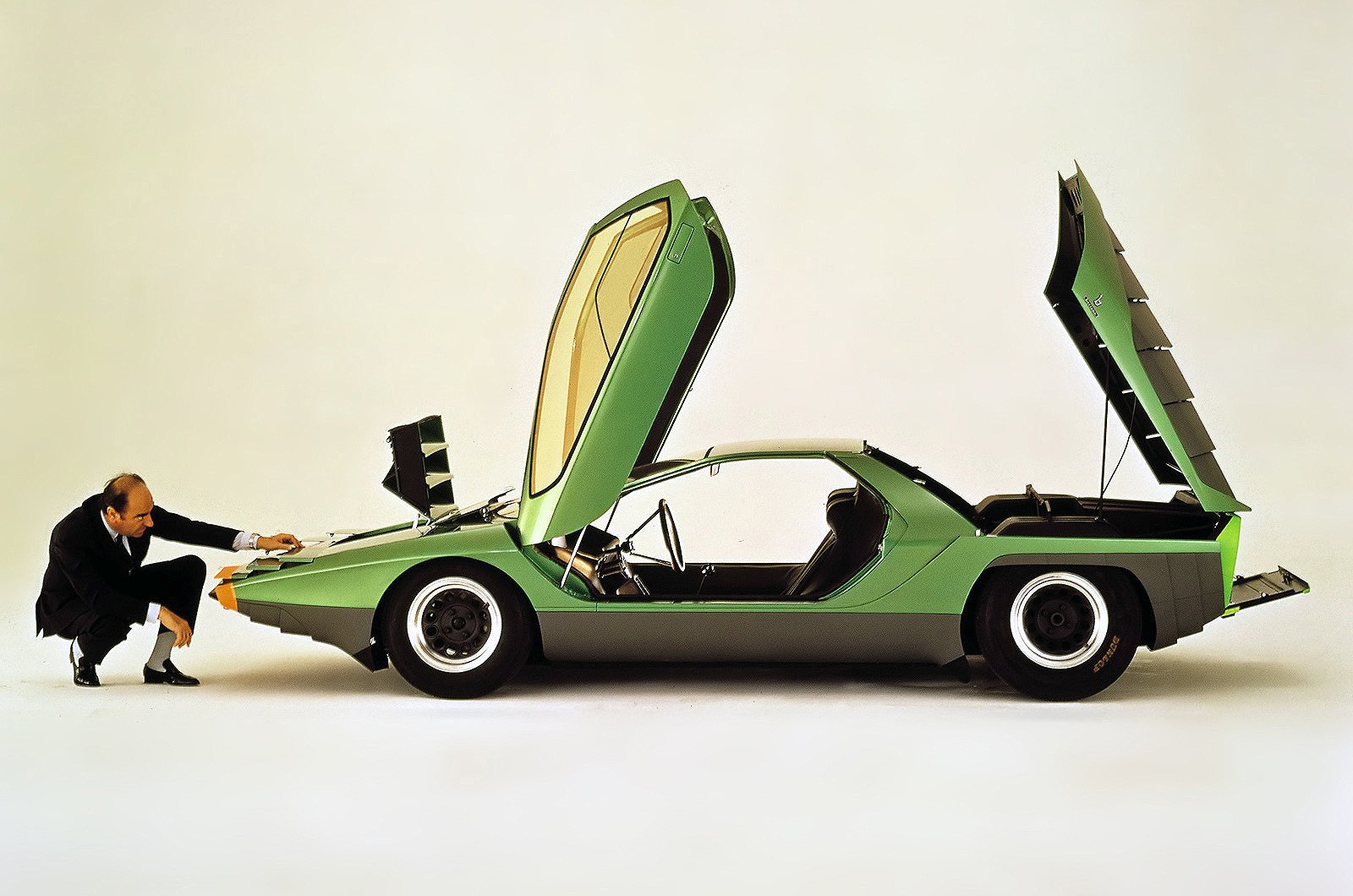
Alfa Romeo BAT (25) Europe watched. And laughed. And then built something sharper. Bertone wasn’t interested in fishbowls or jet exhausts. They cared about airflow.
The BAT 5 is slippery. Aggressively so. A drag coefficient of 0.23 was insane then. Even now it’s respectable. They wanted speed through aerodynamics rather than horsepower.
And it worked. A modest 100hp engine. An 1100kg body. It still hit 120 mph. The follow-up BAT 7 in 1955 dropped that number to 0.19. Less car. More slip.
Buick Wildcat I (24) Glass fiber construction in 1954? Really? Harley Earl was getting into materials science while everyone else stuck to steel.
The Wildcat II had a “flying wing” front end. No separate fenders. Just smooth continuous lines. If you focus on the center section it looks terrifyingly close to the original Corvette. Because it was. Earl used concepts as testing grounds. The Corvette wouldn’t exist in its current form without these wild experiments.
De Soto Adventurer I (25) Chrysler went cosmic.
Most cars tried to look fast on the ground. De Soto decided to aim for orbit.