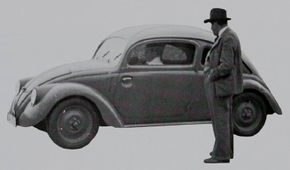
History loves a good twist, especially when it involves a car that became a global icon while technically never being sold to the public in its original form. The era from 1931 to 1945 covers the first generation of what we know as the Volkswagen Beetle. It’s a story full of irony, intrigue, and surprise. These early prototypes and limited-run models didn’t see high-volume commercial production. They were interrupted by the outbreak of World War II. But they laid the direct groundwork for the reliable, low-cost vehicles that would eventually conquer roads worldwide.
The concept of a “people’s car” isn’t new. Henry Ford achieved it first with the Model T. But Ferdinand Porsche, a brilliant engineer, had a different vision for the German public. He wasn’t alone in this dream. Adolf Hitler also wanted a Volkswagen. For Hitler, a cheap car for the masses was a tool to solidify his power as Germany’s absolute ruler.
With the Fuhrer’s backing, Porsche began work on a machine that was simple yet sophisticated. The result had a distinctive beetle-like shape. He didn’t invent the wheel here. Porsche heavily borrowed from existing European small car designs. However, just as production was starting to gain momentum, war broke out. The future of the little car became uncertain.
The 1931-1933 Volkswagen Beetle
The initial phase of this project was defined by experimentation and prototype building. Porsche’s early designs in the early 1930s were raw. They lacked the refinement of the later “People’s Car” that became famous. These early iterations were crucial for testing concepts that would define the Beetle’s legacy.
The collaboration between Porsche and the German state set the stage for automotive history. It wasn’t just about engineering; it was about political will. Hitler’s patronage provided the resources Porsche needed to push beyond standard automotive boundaries.
Porsche’s design philosophy focused on simplicity. This was a response to the complex, expensive cars of the era. The beetle shape wasn’t just aesthetic. It was functional. It reduced drag and maximized interior space. European designers had explored similar ideas, but Porsche’s interpretation was unique.
The outbreak of war changed everything. Production lines were repurposed for military use. The civilian Beetle disappeared from showrooms. It didn’t disappear from existence, though. The designs remained. They waited in the shadows of conflict.
The Beetle’s survival wasn’t guaranteed by engineering alone. It was sustained by the political ambitions of one man and the vision of another.
This period from 1931 to 1933 is often overlooked. It’s the foundation. Without these early, flawed, and fascinating prototypes, the streamlined icon of the 1950s might never have existed. The shift from prototype to potential mass production was halted. But the blueprint was ready. The stage was set for the war years and the eventual post-war rebirth.
The story of the Beetle begins here, in the tension between engineering ambition and political reality. It’s a reminder that cars are never just machines. They are reflections of their times. And sometimes, they survive those times in ways their creators never imagined.
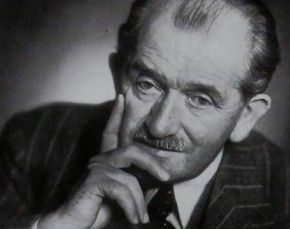
The Dictator and the Designer
It is a dark irony that the Beetle—a car defined by its round, friendly curves and mass appeal—was conceived in the shadow of the Third Reich. The 1931-1933 prototypes didn’t just emerge from engineering drawings. They were born from the collision of two wills: the nationalistic fury of Adolf Hitler and the technical precision of Ferdinand Porsche.
Hitler wasn’t just a dictator. He was a failed artist who understood that a revived economy could buy political loyalty. After taking the chancellorship in 1933, he saw a path to win over a population still broken by World War I and crushed by the Great Depression. The answer was consumerism. A small, affordable “people’s car” (Volkswagen) would provide that economic spark.
Porsche had been working on the same concept for years.
By 1930, the 55-year-old engineer had had enough of working for others. He’d spent decades at Steyr and Austro-Daimler, chafing under constraints. So he opened his own Konstruktionsburo in Stuttgart. An independent design consultancy. He didn’t do it alone.
The Porsche Engineering Team
This wasn’t a solo project. It was a machine built by specific experts:
- Karl Rabe : Chief designer.
- Josef Kales : Specialist in air-cooled engines.
- Erwin Komenda : Body designer and aerodynamicist.
- Dr. Anton Piech : An attorney who would later manage the complex Porsche projects.
They had a clear directive. The car needed to be simple. Affordable. Reliable.
The Technical Blueprint
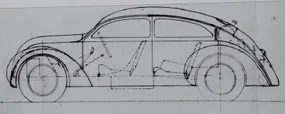
The final design was defined by specific mechanical choices that would define the Beetle for decades.
Engine : Rear-mounted, air-cooled, four-cylinder in a “boxer” configuration. The cylinders lie horizontally opposite each other. This layout lowered the center of gravity and eliminated the need for a complex cooling system.
Suspension : Fully independent. The front used transverse torsion bars. The rear employed swing axles. This meant each wheel could move independently, improving traction and comfort on bad roads.
Chassis : A sturdy platform with a central “backbone” tube. This reinforced the structure without adding excessive weight.
Body : Aerodynamic. Streamlined. It looked like a beetle, which is probably why it kept that name. The two-door sedan shape cut through the wind efficiently for an era before computational fluid dynamics.
“The Volkswagen was characterized by a rear-mounted, air-cooled four-cylinder engine… and an aerodynamic beetle-shaped two-door sedan body.”
This combination of components wasn’t just about style. It was about function. The boxer engine was robust. The torsion bar suspension was simple to repair. The backbone chassis was tough. Porsche had engineered a car that could survive the roads Germany planned to build, and the regime that demanded it.
Engineering the Simple
Porsche’s genius wasn’t in inventing the wheel. By the early 1930s, the concepts were already out there. His real breakthrough was packing high-level sophistication into a car that, on the surface, remained surprisingly simple.
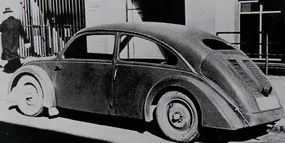
It took prior experience to get there. Look at the Wanderer project. The Porsche Bureau was hired to design a small sedan for the German automaker. Production started in 1932. That car wasn’t just a standalone effort. It was a stepping stone.
Shortly after that sedan hit the streets, Wanderer merged with Audi, DKW, and Horch. The result was Auto-Union. That corporate shift didn’t just change the logo on the grille. It changed the engineering DNA. The merger led directly to the adoption of a swing-axle rear-suspension layout. A simple structural change. A complex outcome.
The NSU and Zündapp Detours
The suspension setup wasn’t just a prototype. Porsche patented the independent front suspension with transverse torsion-bar springs. It was a specific engineering choice. One that would stick.
Then came the commissions. Zündapp and NSU were motorcycle makers. They wanted to enter the auto market. They needed small, cheap cars. Porsche drew up the blueprints.
The NSU Type 32 stands out. It used an air-cooled four-cylinder “boxer” engine. That layout became a staple. The lessons learned here were sharp. They defined the later Beetle.
Neither project launched. The cars stayed on paper. But the engineering DNA survived. It moved forward. Into the Volkswagen era.
Shaping the 1934-1936 Beetle Prototype
By 1934, the concept solidified. The Volkswagen Beetle wasn’t born from a vacuum. It was distilled from the failed Zündapp and NSU studies.
Key elements carried over. The rear-engine layout. The air-cooling system. The torsion-bar suspension. These weren’t new ideas. They were refined ones.
The NSU Type 32’s boxer engine provided the template. Reliable. Simple. Cool. Essential for a mass-market vehicle. The Beetle inherited this philosophy.
Why does this matter? Because the early prototypes show the evolution. The Beetle wasn’t a sudden genius stroke. It was an iterative process. A series of rejected designs leading to one survivor.
The 1934-1936 period was the crucible. Porsche’s early sketches met the harsh reality of German industrial needs. The result was a car designed for utility. Not luxury.
This shift in focus defined the brand. Function over form. Durability over flair. It set the stage for the Type 1. The car that would change everything.
The Price Tag That Broke the Market
Jakob Werlin didn’t just know the right people. He knew the Führer. The Mercedes-Benz executive pulled strings in the early 1930s to get Ferdinand Porsche into Hitler’s orbit. The context was simple. Germany needed cars. The new Autobahnen were being poured, concrete stretching across a recovering nation. But the cars to drive on them? Too expensive for the masses.
Hitler wanted speed. He wanted access. He wanted a machine that could conquer the new superhighways without bankrupting the average worker.
Engineering the “People’s Car”
Before the meeting even happened, Porsche went on the offensive. On January 17, 1934, he sent a memo. It wasn’t a request. It was a blueprint of what Hitler would demand.
Porsche knew the boss liked efficiency. The memo outlined a vehicle that was durable. It needed to be space-efficient. Crucially, it had to cruise at 100 kilometers per hour. That’s 62 mph. For 1930s engineering, that wasn’t just a target; it was a statement. Fuel economy had to hit roughly 40 miles per gallon. Hills? No problem. The engine had to be air-cooled. Why? Service stations were sparse in rural Germany. Winters were brutal. Liquid cooling systems froze or leaked. An air-cooled boxer engine was simpler. It was robust. It was repairable by anyone with a wrench.
And then there was the capacity. Two adults. Three children. Luggage. The Nazi ideal of the family had to fit in the backseat. But the platform needed flexibility. It had to adapt. Military applications were listed last. A chilling afterthought for a civilian car, but not for a regime gearing for war.
The Impossible 1000 Reichsmark Mandate
May 1934. Porsche and Hitler met face-to-face. Both were car nuts. They bonded over engineering. Then Hitler dropped the hammer.
1000 Reichsmarks.
That was the max price. Roughly $360 at the time. It was faintly absurd. A car that reliable, that fast, for that price? It defied economic logic. It defied manufacturing reality.
Hitler wasn’t entirely blind to the impossibility. He ordered the Reichsverband der Deutsche Automobilindustrie (RDA) to step in. The German Automobile Manufacturers Association had to help develop the Type 60. It was an evolution of Porsche’s earlier Type 32.
The Porsche 985 and the Hand-Built Reality
The RDA provided a grudgingly small grant. Porsche took that money and built the 985-inch-wheelbase design. This became the Porsche 98.
By 1935, two prototypes emerged. They were largely hand-built.
The V1. A sedan. “V” stood for Versuch —experimental.
The V2. A convertible. Party planning dictated the need for open-air joyrides for the regime’s elite.
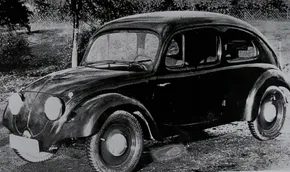
Refinement continued. Late in 1935, a trio of V3 models appeared. Hitler saw them. He liked them. At the 1935 Berlin Motor Show, he ordered them into production.
State Takeover and the KdF-Wagen
The manufacturers fought back.
RDA members complained loudly. Sub-RM1000 production costs threatened their business models. They couldn’t make a profit at that price. They threatened to walk. Hitler was piqued.
He didn’t negotiate. He nationalized the project.
The Volkswagen became a wholly state-run enterprise under the Deutsche Arbeitsfront (DAF). The national labor union. It wasn’t a private enterprise anymore. It was a tool of the state.
One DAF department carried the motto Kraft durch Freude. Strength through Joy. It became the official branding. The car was designated the
The Wartime Humpback: 1937-1940
The early Beetles weren’t just cars. They were tools of the state.
By 1937, the KdF-Wagen program had moved from blueprints to assembly lines. But the world was shifting. War loomed. Production priorities changed overnight.
The result? A distinct, often overlooked variant: the wartime humpback.
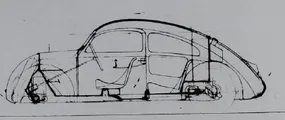
These weren’t the sleek, pre-war prototypes you see in museums. These were functional, stripped-down, and built for utility. The body style changed slightly to accommodate wartime constraints and labor shortages. The roofline dipped. The rear window shrank. It wasn’t a design choice. It was a survival choice.
Production Shifts and Simplification
Between 1937 and 1940, Volkswagen was still figuring out its identity. It was supposed to be “the people’s car.” In practice, it was becoming the regime’s car.
- Labor Shortages: Skilled workers were drafted. Women and POWs filled the gaps. Consistency suffered.
- Material Rationing: Steel was precious. Paint was scarce. Trim was minimal.
- Design Tweaks: The rear window was reduced in size. The roof curve was altered. These changes reduced glass costs and simplified stamping processes.
The 1938-1940 Volkswagen Beetle models reflect this era. They’re rougher. Heavier. Less refined.
Key Differences: Pre-War vs. Wartime (1937-1940)
| Feature | 1937-1938 Models | 1939-1940 Models |
|---|---|---|
| Rear Window | Full size | Reduced size |
| Roof Line | Higher curve | Lower, “humpback” |
| Interior | Minimalist | Even more stripped |
| Production Volume | Low (prototype phase) | Increased (military focus) |
| Exterior Trim | Chromed accents | Painted black/dark |
The 1939 model year marked a turning point. The Nazi government took full control of Volkswagen. Civilian production slowed. Military contracts began.
Why the “Humpback” Matters Today
Enthusiasts often overlook these early models. They’re not pretty. They’re not rare in the same way as a pre-war prototype. But they’re historically significant.
They represent the moment Volkswagen stopped being a dream and started being a reality. A messy, compromised reality.
Collectors today seek these cars for their authenticity. Not for luxury. For history.
A 1939 Volkswagen Beetle with its original humpback roof is a time capsule. It shows how war reshaped industry. It shows how design bends to political will.
Finding One Today
You won’t see many on the highway. They’re too fragile. Too niche.
But in collector circles, they’re prized.
- Rarity: Fewer than 10,000 were made in this window.
- Condition: Most have been restored. Original examples are nearly extinct.
- Value: Surprisingly
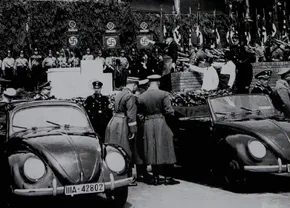
From V30 to the Final Form
The V30 prototypes were the immediate next step after the V3, or KdF-Wagen. They looked closer to the final car. But they still lacked a rear window. The V3s had that problem too. It was a persistent design holdover.
Building a Monument in Concrete
Hitler had made up his mind by 1937. The car would not be built by existing German auto manufacturers. He wanted to strip influence from the Reichsverband der Deutsche Automobilindustrie (RDA). He wanted local jobs. And he wanted a building that screamed power.
The site was picked near Castle Wolfsburg. Northern Germany. About 40 miles east of Hanover. The cornerstone was laid on May 26, 1938. Hitler personally put the stone in place. The plan was to erect a Third Reich monument on the north side of the Mitteland Canal. A massive industrial complex. It rose quickly.
The July 1939 Testing Gap
The timing was tight. Final prototypes, labeled VW39, were nearly identical to the car that would become the Volkswagen Beetle. But they didn’t start testing until July 1939. Production had already started. The gap between prototype and assembly line was dangerously small.
The Prepayment Scheme
Most Germans couldn’t afford a car. Average monthly wages sat at RM300. The KdF-Wagen was out of reach for the average worker. So the Reich created a prepayment plan. It was a way to lock in demand before the cars even existed.
Buyers received booklets. They pasted stamps into them. Each stamp cost RM5. Roughly $1.75 in contemporary terms. Fill the booklet. Redeem it for one car. The government promised the redemption.
“The wish of the Führer . . . fulfilled!”
That’s what the propaganda shouted. They claimed the new town of KdF-Stadt, south of the canal, would produce up to half a million cars a year. Half a million. The price tag was DM990. Both numbers were unbelievable. The town rose. The booklets were sold. The cars were still barely more than clay models.
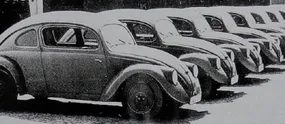
Civilian production didn’t really kick off until August 1940. And even then? It was a trickle. By that point, the Hitler War had been raging for nearly a year. KdF-Stadt wasn’t just building cars anymore. They were ducking British bombs while pivoting to airplane assemblies, engine parts, stoves, V1 rockets—and Beetle-based military vehicles.
The military variants changed everything.
The Kubelwagen Lineup: Engineering the Wehrmacht’s Jeep
The military roster was diverse. It started with the Type 62 Kubelwagen. This was the Wehrmacht’s answer to the Jeep. High clearance. Light weight. Built for the front lines.
But Porsche didn’t stop there. They kept iterating.
The Type 82 followed, with an engine enlarged from 985 to 1131 ccs. More power. Better torque. Then came the Type 82E. It took the KdF sedan body and mounted it on that high-riding Kubel chassis. A strange hybrid. A comfort-seeking military vehicle.
Drive options diversified too.
- Type 86 : This was the Kubel with four-wheel drive. Instead of rear-wheel drive only. Traction mattered.
- Type 87 : A specific variant of the 82E. The weight shifted to 434 units.
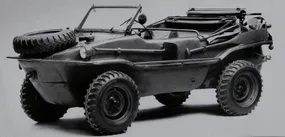
- Type 166 Schwimmwagen : The most successful of them all. An amphibious vehicle. It drove on land. It floated on water.
“Porsche Bureau was heavily involved in engineering all of these (starting as early as 1937)”
The Political Cost of Engineering Excellence
Ferdinand Porsche’s bureau was deep in the engineering of every single one of these machines. Starting as early as 1937. The Schwimmwagen (Type 166) specifically pleased Hitler so much that he made Ferdinand an honorary SS officer.
This distinction came with a steep price.
Postwar, the French used that honorary title to charge Porsche as a collaborator. It didn’t matter that he wasn’t. The paperwork was there. The SS pin was real. The engineering was undeniable.
They had no choice but to treat him as a political figure rather than just an engineer. The lines between innovation and regime support blurred. And Porsche paid for it.
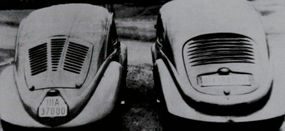
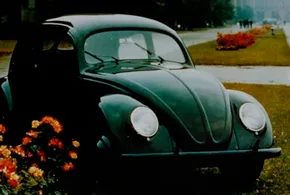
The end of World War II didn’t just wreck the 1944-1945 Volkswagen Beetle. It nearly erased it.
Yet the little car survived.
By late 1944, the Porsches were gone. Ferry, Karl Rabe, and Erwin Komenda fled to the family estate at Zell am See in Austria. There, they began sketching what would become the first Porsche automobile. The war had turned. More than two-thirds of the Volkswagen KdF factory in Wolfsburg lay in ruins.
Spring 1945 brought American troops. Workers, including many Nazi-sentenced slave laborers, started destroying whatever remained. It was chaos. In a bizarre twist, a few English-speaking expatriates surrendered to an American column four weeks before V-E Day.
The partition of Germany changed everything. KdF-Stadt was renamed Wolfsburg. It fell under Allied protection. If it had been just ten miles east, it would have landed in the Russian Zone. Britain held the region instead. That meant the future of the Beetle, the factory, and the town rested with a detachment of the Royal Electrical and Mechanical Engineers.
Major Ivan Hirst commanded them.
Hirst faced a mountain of rubble. His job wasn’t just military oversight. It was resurrection. He had to provide food and shelter to war-weary inhabitants. He restored heat and electricity. He looked at Hitler’s automotive dream and tried to see what could be salvaged.
It wasn’t glamorous. It was gritty.
“We had to rebuild from nothing.”
The Beetle was still a symbol of the regime Hirst’s forces had fought against. But Hirst saw potential. Not just for propaganda, but for survival. The town needed work. The workers needed purpose. The machine needed to run again.
Hirst’s team started small. They cleared debris. They fixed basic utilities. They identified functional components. Slowly, painfully, production possibilities emerged.
This wasn’t just about cars. It was about keeping a town alive. And the Beetle was the only asset that could do it.
The Aftermath of War and the Beetle’s Persistence
It is hard to believe, but much of the German automotive tooling survived the Allied bombing raids. The factories weren’t completely flattened. Engineers and workers dusted off the old equipment. They started building again. But the product wasn’t exactly what you’d expect from a wartime regime.
They produced more Kubelwagens. They also assembled Volkswagen Beetle sedans. These weren’t for the Reich. They were for British and French forces. These allies needed light transport. They needed it fast.
Hirst got the order. It wasn’t a small one. He secured military contracts for 10,000 vehicles. The scale was massive. The workforce exploded. There were only 450 workers at the start. Compare that to the 16,000 employed during the height of the war. By the time production hit its stride post-war, the plant had over 6,000 employees. It was a rapid scaling operation driven by immediate logistical needs.
Records from the era are messy. Disputes over inventory led to conflicting numbers. Some sources say they built 1,785 vehicles by the end of 1945. Others claim the number was closer to 2,490. The discrepancy doesn’t matter as much as the fact that production happened at all.
How did a symbol of Nazi propaganda survive the war that destroyed it?
The Wagen fur das Volk — the People’s Car — remained. It was a modest vehicle. It was simple. It was robust. After the most horrific conflict in human history, it was still alive. Not just alive. It was rolling off the line.