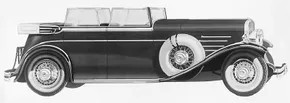
Most car enthusiasts associate air-cooled power with Volkswagen or Porsche. But Franklin holds a unique spot in automotive history as one of the few American brands to truly master the technology. They didn’t just dabble in it. They built it into their DNA from the very first model in 1902. This early start gave Franklin a reputation for quality and innovation that lasted until the company folded in 1934.
The engineering focus was heavily weighted toward weight reduction. While other manufacturers stuck with heavy cast iron for engine blocks and pistons, Franklin used high-grade aluminum. They were so committed to this material that, at one point, they became the largest consumer of aluminum in the world.
Suspension was another area where Franklin stood apart. Competitors typically used half-elliptic springs. Franklin installed full-elliptic springs on all four wheels. The result was a significantly smoother ride and less tire wear. Add a flexible wood frame to the mix and the cabin isolation was exceptional for the era.
Advanced Features Ahead of Their Time
By 1920, Franklin was already offering features that others considered futuristic. They had full-pressure lubrication systems. Automatic spark control was standard. An electric choke was part of the package. These weren’t options. They were baseline expectations for a Franklin owner.
The brand also dropped four-cylinder engines after 1914. Six-cylinder power became the only option. This wasn’t a cost-cutting measure. It was a performance decision.
The aviation boom gave air-cooled engines a massive marketing boost. Charles Lindbergh’s transatlantic flight in 1927 put air-cooled power in the spotlight. The Spirit of St. Louis relied on an air-cooled engine. Franklin saw the connection and capitalized on it.
They named some 1928 models the “Airman” to honor Lindbergh. That same year, all Franklins received four-wheel Lockheed hydraulic brakes. They also switched to a steel chassis. Innovation didn’t stop there. The 1929 models introduced a “silent second” synchromesh transmission. It made shifting gears smoother and quieter than anything most competitors offered.
Entering the Great Depression with Confidence
Detroit automakers were optimistic in the early 1930s. The stock market had crashed, but Franklin had just posted record sales in 1929. Public interest in aviation remained high. The appeal of air-cooling had never been stronger. Franklin believed they were positioned to weather the storm.
Their 1930 lineup included the “145” and “147” models. These featured updated styling and powertrains. Wheelbases measured 125 inches and 132 inches respectively. The most noticeable change was the front end.
Franklin called it a “hood front.” They insisted that a conventional-looking radiator was necessary for sales. But this radiator had functional shutters. A thermostat connected to the first cylinder automatically adjusted airflow through those shutters. It was a clever compromise between aesthetics and engineering.
Under the hood, the six-cylinder engine retained individually cast cylinders and overhead valves. The big change was in cooling strategy. Air was directed to the sides of the block from left to right. Engineers soon dubbed this “side-blast” cooling. It was more efficient than previous designs. The 274 cubic inch engine produced 95 horsepower. It wasn’t the most powerful on the market. But it was reliable. And it was distinctly Franklin.
Franklin never needed to chase trends. It was a luxury marque from the jump, which meant its rigid chassis became the perfect canvas for the era’s most prestigious coachbuilders. Derham, Dietrich, Locke, and Brunn all worked their magic on Franklin platforms, turning basic mechanicals into rolling sculptures.
The 1930 model year brought some genuinely weird and wonderful open-body styles. Take the Dietrich four-door Pirate. You could spec it as a tight five-passenger phaeton or stretch it into a seven-seater touring car. The design gimmick? The running boards were completely hidden behind flared door bottoms. No exposed hardware. Just clean lines that looked almost aerodynamic for the time.
Then there was the Pursuit. A dual-cowl phaeton that stripped away the clutter. No external door handles to mar the sightlines. The upholstery in the front compartment didn’t just cover the seats; it wrapped up and over the outer edge of the doors, mimicking the cockpit design popular in aviation. It was sleek. It was modern. It was distinctly Franklin.
Dietrich also built a four-door, four-seat speedster that was shorter than you’d expect. The body cut off midway over the rear wheels. Most were closed, featuring permanent canvas tops, but if you really wanted the wind in your face, you could pay extra for a full convertible setup.
Aviation Links and Conservative Tastes
Did famous pilots drive Franklins? Yes. Charles Lindbergh, Amelia Earhart, and Frank Hawks all chose the brand for their personal transport. Franklin knew this was good PR and didn’t hesitate to plaster their names over the marketing. But don’t let the aviation pedigree fool you into thinking these were race cars.
The brand never sold on pure sportiness. The customer base was professional. Doctors, lawyers, executives. People who wanted reliability and discretion. Paint colors were conservative. Blackwall tires were standard issue.
Franklin was actually ahead of the curve by selling more sedans than open cars before 1920. That trend held strong through the 1930s. The cars were elegant. They were expensive. And they were conservative.
Sinking Franklin Creates Cheaper Models
The Great Depression hit Franklin hard. Sales plummeted. The company needed a way to keep the lights on without cannibalizing its luxury image entirely. So, they did something drastic. They sunk the brand’s prestige to create cheaper models.
This wasn’t just a minor trim-level adjustment. It was a fundamental shift in strategy. The goal was volume. The result was a dilution of the brand’s core identity.
Customers noticed. The loyalists who had stuck with Franklin for its engineering purity started to drift away. The new, cheaper models were more numerous, but they lacked the soul of the original Franklins. The brand was trying to be everything to everyone, and in doing so, it lost the distinct advantage it had built over decades.
The financials didn’t improve as quickly as hoped. The cheaper cars didn’t attract enough new buyers to offset the loss of the high-margin luxury segment. The brand was stuck in the middle. Not luxurious enough for the elite, not cheap enough for the mass market.
It was a dangerous position to be in. And for a company that prided itself on being ahead of the industry
Sales figures for Franklin in the first quarter of 1930 told a story that looked good on paper but meant nothing in reality. The company claimed its share of the “fine car business” had doubled compared to the same period in 1928. That was a technicality. The Great Depression had effectively erased the market for luxury automobiles. By the end of the calendar year, Franklin’s total sales were less than half of what they had been in 1929.
Desperation drives innovation, or in this case, it drives price cuts. To keep the factories running, Franklin launched the Transcontinent Six (Series 141) in May 1930. It sat on the familiar 125-inch chassis and offered the usual suite of body styles: a closed coupe, convertible coupe, victoria brougham, and a four-door sedan.
Let’s look at the math here. The sedan was the cheapest car in the showroom, yet it cost $2,395. For context, a new Ford Model A cost roughly a quarter of that price. In the early 1930s, that wasn’t just a purchase; it was a significant portion of a solid annual income. The result was predictable. Model-year production collapsed to just 5,744 units.
Cutting the Fat: The 1931 DeLuxe Six
For 1931, Franklin stripped its lineup down. The Transcontinent returned, but the prices were slashed to the $1,800–$1,900 range. That wasn’t cheap, but it was cheaper than before.
At the top of the heap sat the DeLuxe Six. This was a four-model group riding on a longer 132-inch wheelbase. Styling was handled by Ray Dietrich, known for creating sleek, flowing lines. The DeLuxe Six featured “rakish clamshell fenders” and bodywork that actually looked modern for the time. Under the hood, engineers squeezed more power out of the same block. The six-cylinder engine was coaxed up to 100 brake horsepower across all models.
Marketing still leaned heavily on aviation heritage. Ads used phrases like “riding like gliding,” trying to sell the smoothness of an air-cooled engine as a premium experience. It didn’t matter. The Depression was in full swing. Production withered again, dropping to a dismal 2,851 units.
The V-12 Gamble
Franklin needed a miracle. So, they decided to build something crazy. An air-cooled V-12.
The displacement was massive: 398 cubic inches. Power output was rated at 150 horsepower. Franklin advertised it as “supercharged,” which is a bit of a stretch. In reality, it relied on a ram-air effect created by a duct from the cooling fan, pushing air into the cylinders more forcefully at speed. It was brute force engineering disguised as aerodynamic efficiency.
The plan was originally to put this V-12 into the 1931 DeLuxe Six chassis. Financial problems delayed that vision. Franklin hadn’t met payments on certain notes, so the banks stepped in, installing managers to protect their investment. Company president Edwin McEwen also realized the chassis needed to be bigger to handle the V-12’s weight and torque. The result was the 1932 Franklin Twelve, an entirely new vehicle.
It looked nothing like the previous Franklins, except for the air-cooled aspect. The old full-elliptic leaf springs and tubular front axle were gone. They were replaced with semi-elliptic springs and an I-beam axle, a more robust setup for a heavier car.
Syracuse Craftsmanship vs. Factory Lines
Body construction changed, too. For decades, Walker of Massachusetts had built Franklin’s bodies. Now, the Twelve’s coachwork was hand-crafted inside the company’s own factory in Syracuse, New York.
LeBaron, one of the most prestigious coachbuilders of the era, was responsible for the styling. The result was striking. A sharply Vee’d hood cover extended back to meet a jaunty, angled windshield. On a 144-inch wheelbase, the car was physically imposing. It was exotic. It was magnificent.
It was also a commercial disaster.
Sales for the 1932 model year were estimated at just 200 units. To keep the lights on, Franklin sold another 1,700 or so six-cylinder Airmans on the 132-inch chassis. The Twelve was too expensive, too strange, and arrived at the worst possible time. The situation was dire.
The Olympic Compromise
By 1933, Franklin had run out of its own ideas. So, they borrowed someone else’s.
The firm struck a hasty deal with Reo, another automaker that was also floundering in the economic downturn. The resulting car was dubbed the Olympic. It was essentially a Reo Flying Cloud with a 118-inch wheelbase, but with a Franklin six-cylinder engine installed instead of Reo’s powertrain.
The division of labor was efficient. Reo shipped 30 bodies a day from its Lansing, Michigan, factory. The following day, that same number of Olympics rolled out of the Syracuse assembly line, where Franklin installed the engines.
Franklin’s investment was minimal,
The Olympic wasn’t a bad car. It was genuinely competent. But timing is everything in the auto industry, and Franklin had simply run out of time. Just 1,218 units rolled off the line in 1933. By 1934, the swan song, that number plummeted to a mere 109.
The company tried to keep the lights on with other models. The mechanically identical Twelves and Airman Sixes were offered in four body styles each. Production numbers tell the real story, though. The Twelve managed a pitiful 98 units total. The Airman Six did slightly better with 468. Both are minuscule figures when you look at the broader automotive landscape of the era.
But the Franklin story didn’t end with bankruptcy.
It pivoted. A new firm, led by former Franklin engineers, bought the assets and shifted focus entirely to aviation. They started by manufacturing the air-cooled airplane engines that Franklin was already famous for. This wasn’t a complete reinvention; it was an evolution of their core competency.
In the 1940s, they expanded into helicopter engines. This was a smart move. The helicopter market was nascent but growing fast. Then came 1948. Franklin modified one of their helicopter engines by adding water-cooling. Why? To power the Tucker 48.
The connection between Franklin and Tucker is often overlooked. Most people know the Tucker as a quirky, doomed American sports car. Few realize its heart was a Franklin aero-engine. That water-cooled variant was critical for the Tucker project, linking the defunct car manufacturer to one of automotive history’s most fascinating “what ifs.”
Aircraft engine production didn’t stop there. Franklin continued building powerplants for planes well into the 1970s. The cars are gone. The brand name faded into obscurity. But the engineering legacy lived on in the sky, long after it stopped rolling on the road.
For more on defunct American cars, see:
-
AMC
-
Duesenberg
-
Oldsmobile
-
Plymouth
-
Studebaker
-
Tucker