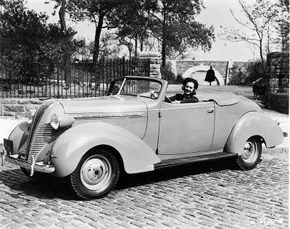
Roy D. Chapin had a winning formula on his hands. The Essex Terraplane was a runaway hit during the 1932 and 1933 model years, selling so well that Hudson’s president decided to kill the “Essex” prefix entirely. By 1934, the car was simply the Terraplane. This wasn’t just a rebranding exercise. It was a survival tactic. The separate-make Terraplane literally kept Hudson afloat when the Great Depression threatened to crush smaller automakers.
The engineering changes were significant. The old 193-cubic-inch six and 244-cid eight were retired. In their place came a new long-stroke six-cylinder engine. It displaced 212 cubic inches and started with an 80 to 85 horsepower output. By 1935 and 1936, that power was bumped up to 88 bhp. The 1937 model saw it climb further to 96 or 102 horsepower depending on the tune.
Pricing and Model Hierarchy
You couldn’t buy a new Essex Terraplane for less than $425. The 1934 successor cost more. Prices ranged from $565 to $880, targeting a slightly more upscale buyer. The lineup became more complex.
- Special and Challenger: These models sat on a 112-inch wheelbase. The Challenger was the midline option.
- Major: These used a longer 116-inch chassis.
The Major line was discontinued after 1934. In 1935, the Challenger was renamed the DeLuxe. The 1936 model year introduced a new 115-inch platform. This chassis carried the DeLuxe and the higher-trim Customs. For 1937, the platform was stretched by two inches to accommodate the new DeLuxe and Super models.
Body Styles and Design
Terraplane design followed the period trends but avoided the excesses seen in some luxury marques. The 1936 and 1937 grilles, often called the “fencer’s mask” due to their vertical slats, remain a point of contention among historians. But the body work was practical.
Roadsters and phaetons were never offered. Instead, buyers could choose from brougham and coach sedans in either regular or trunkback “touring” forms. Fixed-roof coupes and convertibles were standard fare. There was a quirky one-off: a smart victoria body style available only in 1934.
The 1936 DeLuxe offered a wood-bodied station wagon. It was exclusive to that year. By 1937, the brand dipped into commercial territory. A small number of Terraplane chassis were built for work use, expanding the brand’s utility beyond personal transport.
Performance and Driving Dynamics
These cars weren’t just cheap; they drove well. A British road test of a 1936 Terraplane sedan provides concrete data. The car weighed about 2,800 pounds. It hit 0 to 60 mph in 26.6 seconds. Top speed was a respectable 82 mph. For a mass-market car of that era, those numbers are highly creditable.
“The six-cylinder engine…has that suppleness and quietness in it’s running that are characteristic of American design…Even at 70 there is no special fuss…[The Terraplane] can thus be a decidedly swift car for journeying over long distances, and is an easy one to handle, too…[It] gives, and does, much for its price.”
The engine lacked the noise of lesser inline-sixes. It was smooth. It handled highway speeds without fuss. This made it an ideal touring car.
Sales Volume and Decline
Terraplane was the volume driver for Hudson. In each of its four years as a standalone brand, it accounted for the lion’s share of sales. Total sales reached nearly 280,000 units.
- 1934: ~51,000 units
- 1935: ~51,000 units
- 1936: ~87,000 units
- 1937: 90,253 units
The numbers peaked in 1937. But the strategy shifted. With the demise of other junior car lines, the 1938 Terraplane was reintegrated into the Hudson badge. The lineup expanded to include standard, DeLuxe, and Super models. Power increased by