The Trans Am didn’t just evolve. It mutated into something meaner.
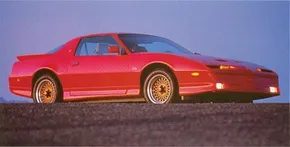
For 1987, Pontiac gave enthusiasts a version of the long-running Firebird that felt less like a cruiser and more like a threat. The GTA package wasn’t just about looks. Sure, it had the revised spoiler. The rocker skirts were sharper. But the real story was what lived under the massive hood.
Pontiac lifted the 5.7-liter (350-cid) small-block directly from the Corvette. It came with Tuned Port Injection (TPI). This wasn’t a carbureted relic. It was the biggest V-8 available in a Firebird in years. And it changed everything.
More Than Just Stickers
The old Trans Am relied on graphics. The 1987 version relied on physics.
The big hood decals? Gone. A real performance machine doesn’t need impertinent pictorials to prove its worth. The GTA stood on its own.
Priced at $2,700 as an option, this package delivered serious hardware. The engine produced 210 horsepower at 4,000 rpm. That number sounds modest by today’s standards. But the torque figure tells a different story.
315 pound-feet of torque hit the rear wheels.
To handle the strain, Pontiac added an oil cooler. The driver got a fully articulating seat. Long journeys stopped being painful. The car rolled on gold diamond-spoke wheels wrapped in P245/50VR16 tires. Four-wheel disc brakes were standard. The WS6 performance package tied it all together.
The Formula Revival
You could also get this engine in the base Formula package.
Pontiac revived the Formula option for 1987. It cost $1,070. Normally, it came with a carbureted V-8. You got the sport suspension. The rear spoiler. The same P245/50VR16 tires.
But if you wanted the Corvette-derived 5.7-liter, you paid extra.
Adding the big V-8 to a Formula or Trans Am cost $1,045. It mandated an automatic transmission. It mandated all-disc brakes. There was no manual option for the GTA. You were locked into the four-speed automatic.
Standard Trans Am Specs
The base Trans Am powertrain told a simpler story.
It used a 5.0-liter (305-cid) V-8. It made 165 horsepower. It came with a four-barrel carburetor. A five-speed manual was standard.
However, the TPI engine was available again. For the first time in recent memory, you could pair the 5.7-liter with a manual transmission. It was an option. Not a standard. But it was there.
The Death of the Four-Cylinder
Performance was taking a stronger foothold in Pontiac’s lineup.
The four-cylinder engines were gone. The S/E series was dead. Pontiac was narrowing its focus. They stopped offering compromises. They stopped offering “economy” variants of their sport cars.
The Firebird was becoming